1871 G25C BG-768 (Regular Strike)
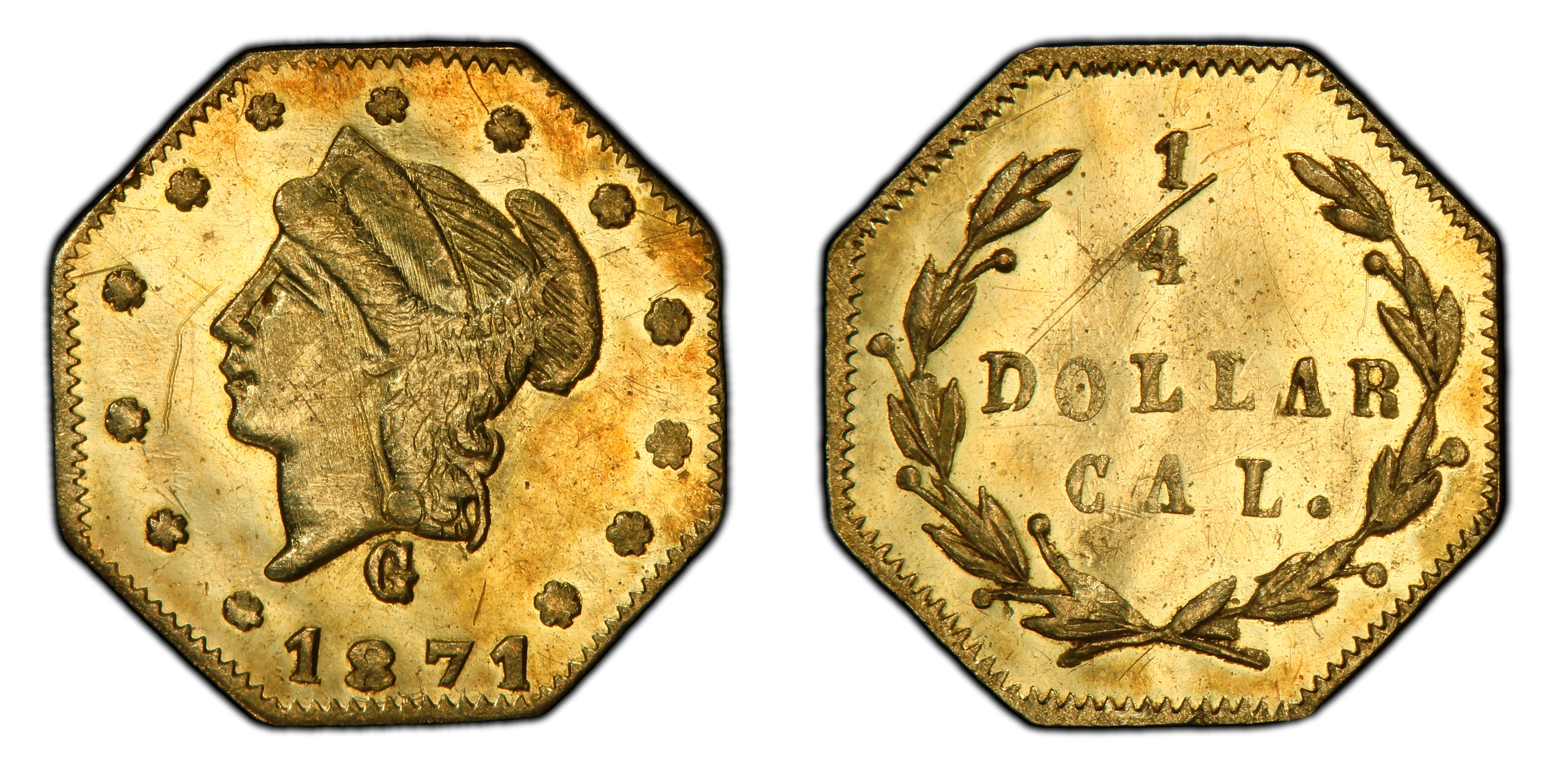
Obverse & Reverse
The 1871 G25C BG-768 emerges from the third and final period of California Fractional Gold production (1870-1882), a fascinating era that saw these miniature coins transition from instruments of necessity to cherished souvenirs. By the 1870s, the acute currency shortage that plagued California during the Gold Rush had largely subsided. The establishment of the San Francisco Mint in 1854 and an influx of federal coinage had stabilized the region's economy. However, the tradition of producing small-denomination gold coins persisted, driven by a new market: tourism and nostalgia. As travelers, businessmen, and settlers flocked to California, they sought keepsakes of the legendary Gold Rush. Private mints, many operated by jewelers and skilled metalworkers in San Francisco, met this demand by striking beautifully crafted gold quarters, half dollars, and dollars. These pieces, often called 'charms' or 'tokens,' were not intended for widespread circulation in the same way their 1850s predecessors were, but they were genuine products of the era, made of native California gold. The BG-768 variety, with its classic Liberty head and wreath design, is a quintessential example of this later period. It was likely sold in jewelry shops and souvenir stands, a tangible, glittering memento of California's golden identity. The craftsmanship was often excellent, though quality control could vary, leading to the many die states and minor varieties cataloged by Breen and Gillio. The passage of the Act of April 22, 1864, which prohibited private coinage, was largely unenforced against these small pieces until the Secret Service finally cracked down in the early 1880s, bringing the era of California Fractional Gold to a definitive close and cementing their numismatic legacy.
Associated EventPost-Gold Rush Economic Expansion and Tourism
Reason For MintingPrimarily created to be sold as souvenirs and keepsakes for tourists and locals, capitalizing on the romantic legacy of the California Gold Rush.
Minter HistoryThe specific minter of BG-768 is unknown, a common trait for many fractional gold issues of this period. Production was often anonymous to avoid potential legal issues and the high costs of advertising. However, numismatic scholarship often attributes many of these later-date designs to San Francisco jewelers and engravers such as Herman J. Brand or Robert B. Gray & Co., who possessed the necessary skills and equipment for such delicate work. These minters operated on a commercial basis, producing coins based on demand for the lucrative souvenir trade rather than for a circulating medium of exchange.
Historical SignificanceThe BG-768 represents the final evolution of private gold coinage in California, marking the shift from a functional medium of exchange born of necessity to a commercial product of nostalgia. It is a physical artifact of California's burgeoning tourism industry in the late 19th century and the enduring mystique of the Gold Rush. The eventual federal crackdown on these issues marks a final chapter in the story of private minting in the United States.
N/A
DenominationG25C (Gold 25 Cents)
Minting Period1871
Assayer/MinterUnknown private minter, possibly Herman J. Brand
Geographic OriginSan Francisco, California
Obverse DescriptionA classic depiction of the head of Liberty, facing left. Liberty wears a coronet inscribed with the word 'LIBERTY' (often weakly struck or incomplete). She is surrounded by thirteen stars, representing the original colonies.
Obverse InscriptionLIBERTY
Reverse DescriptionThe denomination '1/4' is at the center, surrounded by an ornamental wreath of leaves and berries tied with a bow at the bottom. The date '1871' is positioned above the wreath, and the inscription 'CALIFORNIA GOLD' is below the wreath. Some varieties may have a small 'G' below the wreath knot.
Reverse Inscription1871 1/4 CALIFORNIA GOLD
CompositionGold
Stated Fineness Actual FinenessVaries, but typically between .500 and .900 fine.
Weight0.25 grams
Diameter9.70 mm
EdgePlain
Unknown
Survival Estimate200-300
Rarity ScaleR-5
BG-768 is highly appealing to collectors due to its affordability relative to earlier date fractionals, its classic and attractive 'Liberty Head' design, and its status as a genuine artifact from the historic California Gold Rush era. It serves as an accessible entry point into the complex and fascinating world of California fractional gold.
Key VarietiesThe primary distinction for this issue is the 'Regular Strike.' The Breen-Gillio reference catalogs several die states and minor positional varieties for BG-768. There are no known original period Proofs or patterns. Collectors should be aware of a plethora of modern replicas and fantasy pieces that mimic this design; genuine period-one (1852-1882) examples are the only ones considered historically significant.
Authentication TipsAuthenticity is the paramount concern with California Fractional Gold. For BG-768, check for a sharp, well-defined strike, though some central weakness on Liberty's hair and the wreath is common. The lettering style should match known genuine examples; counterfeits often have incorrect fonts or spacing. The planchet should be thin, and the weight and diameter should be close to the specified 0.25g and 9.7mm. Many fakes are overweight or have a soapy, cast-like appearance. Professional third-party authentication and grading (by PCGS or NGC) is highly recommended for any purchase.
Shopping ConsiderationsA premium quality example of BG-768 will exhibit a bold strike with as much detail as possible on Liberty's coronet and the wreath's leaves. Look for smooth, lustrous surfaces with minimal distracting marks. Original, unconserved 'skin' with a slightly reddish-gold hue is highly desirable. Avoid examples that have been harshly cleaned, polished, or show signs of being mounted in jewelry (solder marks, rim damage). Pay close attention to the area around the date and inscriptions for evidence of tooling or repairs. A coin with superior eye appeal and a sharp strike will always command a significant premium over a lackluster or damaged specimen in the same numerical grade.
A coin's grade is its condition, rated on a 1-70 scale. For rare coins, this is the most critical factor in determining value, as a tiny difference in preservation can mean a huge difference in price.
Relevant Grade TypesOriginal issues of BG-768 were business strikes intended for commercial sale, not circulation in the traditional sense, though some saw limited use. They are found in Circulated grades (AU-50 to AU-58 are most common) and Mint State (MS, 60-70) grades. No Proofs (PR/PF) were struck during the original period of issue. Any coin described as a 'Proof' of this variety is either a modern creation or a misattribution of a high-quality business strike with prooflike surfaces.
Mint State CharacteristicsUncirculated examples of BG-768 typically exhibit a soft, satiny luster. The strike is often somewhat weak in the centers, particularly on the highest points of Liberty's hair curls and the details of the wreath. Planchets are small and thin, so they are susceptible to contact marks; even high-grade MS coins may show minor ticks or scuffs. A truly choice Mint State example will have minimal marks, strong luster, and better-than-average strike detail.
Circulated Wear PatternsWear first appears on the highest points of the design. On the obverse, friction will dull the luster and show first on Liberty's cheek, the hair above her eye, and the coronet. On the reverse, the highest points of the wreath leaves and the bow knot will show the first signs of abrasion. In lower grades (VF and below), the letters in 'LIBERTY' on the coronet will become indistinct, and the finer details of the wreath will merge.
Key Factors For ValueFor the 1871 G25C BG-768, value is driven by several key factors. First and foremost is certified authenticity and grade. Surface quality is paramount; an example with original, lustrous surfaces will be worth multiples of one that has been cleaned or polished. Strike sharpness is also critical, with a premium paid for well-defined details on the portrait and wreath. Finally, eye appeal—the overall visual impact of the coin, including any attractive toning—plays a significant role. A sticker from CAC (Certified Acceptance Corporation) indicating premium quality for the grade will add a substantial premium.
PCGS Price Guide
| Grade | Price | Population |
|---|---|---|
| 30 | $225.00 | 1 |
| 35 | $235.00 | N/A |
| 40 | $245.00 | N/A |
| 45 | $255.00 | 1 |
| 45+ | $265.00 | N/A |
| 50 | $275.00 | 2 |
| 50+ | $285.00 | N/A |
| 53 | $300.00 | 2 |
| 53+ | $310.00 | N/A |
| 55 | $325.00 | 8 |
| 55+ | $335.00 | N/A |
| 58 | $350.00 | 11 |
| 58+ | $360.00 | N/A |
| 60 | $375.00 | 6 |
| 61 | $400.00 | 13 |
| 62 | $425.00 | 24 |
| 62+ | $450.00 | N/A |
| 63 | $550.00 | 16 |
| 63+ | $650.00 | N/A |
| 64 | $950.00 | 2 |
| 66 | N/A | N/A |