1875 G25C BG-781 (Regular Strike)
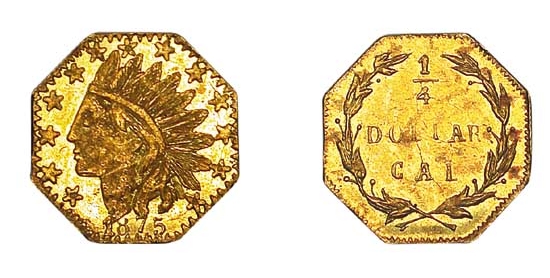
Obverse & Reverse
The 1875 25 Cents, cataloged as Breen-Gillio 781, is a quintessential example of 'Period Two' California Fractional Gold. By the mid-1870s, the acute coinage shortage that characterized the initial Gold Rush had largely subsided with the full-scale operation of the San Francisco Mint since 1854. The impetus for producing these miniature gold pieces had shifted from filling a desperate commercial need to serving a more nuanced economic and social function. These 'jeweler's issues,' as they are often called, were struck by anonymous artisans, likely French jewelers operating in San Francisco, who catered to a local population still very much accustomed to gold as a daily medium of exchange. These tiny, intricate pieces were lightweight for their stated value, making them a profitable venture for their makers and a form of de facto token coinage. They circulated alongside federal coinage for small transactions, were used as good-luck charms, and were popular as souvenirs for the burgeoning tourist trade and as gifts. The use of a generic Indian Head motif, rather than a Liberty Head emulating federal designs, was common in this period, perhaps as a stylistic choice or a subtle attempt to differentiate the pieces from official government coinage. The Coinage Act of 1864 had made private coinage illegal, but enforcement in the West was inconsistent, allowing this practice to continue until a Secret Service crackdown in the early 1880s finally brought the era of fractional gold to a close. The BG-781, therefore, is not a relic of the raw frontier chaos of 1849, but rather of a more mature, yet still uniquely Western, gold-based economy that persisted for decades.
Associated EventCalifornia Gold Rush Economic Aftermath
Reason For MintingTo provide a convenient small-denomination coin for commerce and serve the souvenir trade in post-Gold Rush California.
Minter HistoryThe minter of BG-781 is unknown, a common characteristic of Period Two and Three fractional gold. After the Coinage Act of 1864, private minters often left their products unmarked to avoid legal repercussions from the U.S. government. Research by scholars like Walter Breen and Ronald Gillio suggests that many of these pieces were the work of skilled French jewelers who had settled in San Francisco, but specific attribution for this die marriage has been lost to history.
Historical SignificanceThe BG-781 is significant as a tangible artifact of the second phase of private gold minting in California. It represents the transition of fractional gold from a necessary form of currency to a popular, locally accepted token and souvenir, reflecting the enduring 'gold culture' of the American West long after the initial rush had ended.
N/A
Denomination25 Cents (G25C)
Minting Period1875
Assayer/MinterAnonymous
Geographic OriginSan Francisco, California
Obverse DescriptionAn Indian Head facing left, adorned with a feathered headdress. The portrait is surrounded by thirteen stars, representing the original colonies. The date '1875' is positioned below the bust.
Obverse Inscription1875
Reverse DescriptionThe denomination '1/4' is enclosed within a wreath of leaves. The inscription 'CALIFORNIA GOLD' appears above the wreath, arching along the upper rim.
Reverse InscriptionCALIFORNIA GOLD 1/4
CompositionGold
Stated Fineness Actual FinenessVariable, typically between 14 and 22 karats. Period Two issues were made from native California gold, which naturally contained silver, and were often deliberately alloyed to reduce intrinsic value below face value.
Weight0.25 grams
Diameter9.80 mm
EdgePlain
Unknown
Survival Estimate75-125
Rarity ScaleR-5 (Very Scarce)
BG-781 appeals to collectors for its classic Indian Head design, octagonal shape, and its direct connection to the romanticized post-Gold Rush era of San Francisco. As a Period Two issue, it is more affordable than the earlier, circulating Period One coins, making it an accessible entry point into the fascinating and complex series of California Fractional Gold.
Key VarietiesNo major, widely recognized die varieties or restrikes are known for the BG-781 die marriage. The entire issue consists of regular business strikes. No proofs were produced during the original minting period, and no later collector restrikes are known to exist.
Authentication TipsGenuine pieces exhibit sharp, albeit sometimes unevenly impressed, details from a hand-operated press. The surfaces should have the texture of struck gold, not the porous or pitted appearance of a cast counterfeit. The lettering style and wreath details should be compared to known genuine examples. Modern replicas often have incorrect design details, a brassy color, or may feature a bear on the reverse, a design element never used on genuine 19th-century fractional gold. Authenticity is best confirmed by third-party grading services like PCGS or NGC, who attribute by BG number.
Shopping ConsiderationsA premium quality BG-781 will exhibit a sharp, well-centered strike. Look for full details on the headdress feathers and the individual leaves of the wreath. Original, lustrous surfaces are highly desirable and command significant premiums; many surviving examples have been cleaned or used as jewelry, impairing their surfaces and value. Eye appeal is paramount. Avoid examples with significant scratches, rim bumps, or evidence of tooling or repair. Weakness in the center of the strike is common, but a coin with bold central details is a superior specimen.
A coin's grade is its condition, rated on a 1-70 scale. For rare coins, this is the most critical factor in determining value, as a tiny difference in preservation can mean a huge difference in price.
Relevant Grade TypesOriginal issues of BG-781 were business strikes intended for limited circulation and trade, and are found in Circulated (1-58) and Mint State (MS, 60-70) grades. The majority of surviving examples are in uncirculated grades, as many were kept as souvenirs. No Proof (PR/PF) examples were struck during the original period of issue, nor are any later-date Proof restrikes known.
Mint State CharacteristicsAn uncirculated BG-781 is defined by its luster and lack of wear. Luster can range from satiny to semi-prooflike. The quality of the strike is a key determinant of grade; weakly struck examples with incomplete details are common and will be graded accordingly, even if uncirculated. High-grade Mint State examples (MS-64 and above) will have exceptional luster, a sharp strike, and minimal, scattered contact marks that are not distracting to the naked eye.
Circulated Wear PatternsWear first appears on the highest points of the design. On the obverse, check the cheek of the Indian Head and the feathers of the headdress. On the reverse, the high points of the wreath leaves and the fraction '1/4' will show the first signs of friction. On lower grade circulated examples, the stars and legends will begin to merge with the fields.
Key Factors For ValueThe primary drivers of value for an 1875 BG-781 are grade and surface quality. A sharply struck coin with vibrant, original luster will always command a premium. Eye appeal is critical; examples with pleasing, original reddish-gold toning are highly prized over harshly cleaned or polished specimens. A CAC sticker for this issue indicates premium quality for the grade and will typically result in a higher market value.
PCGS Price Guide
| Grade | Price | Population |
|---|---|---|
| 62 | $3,750.00 | 1 |
| 62+ | $4,250.00 | N/A |
| 63 | $5,000.00 | 2 |
| 63+ | $6,000.00 | N/A |
| 64 | $8,000.00 | 1 |