1853 G50C BG-428 (Regular Strike)
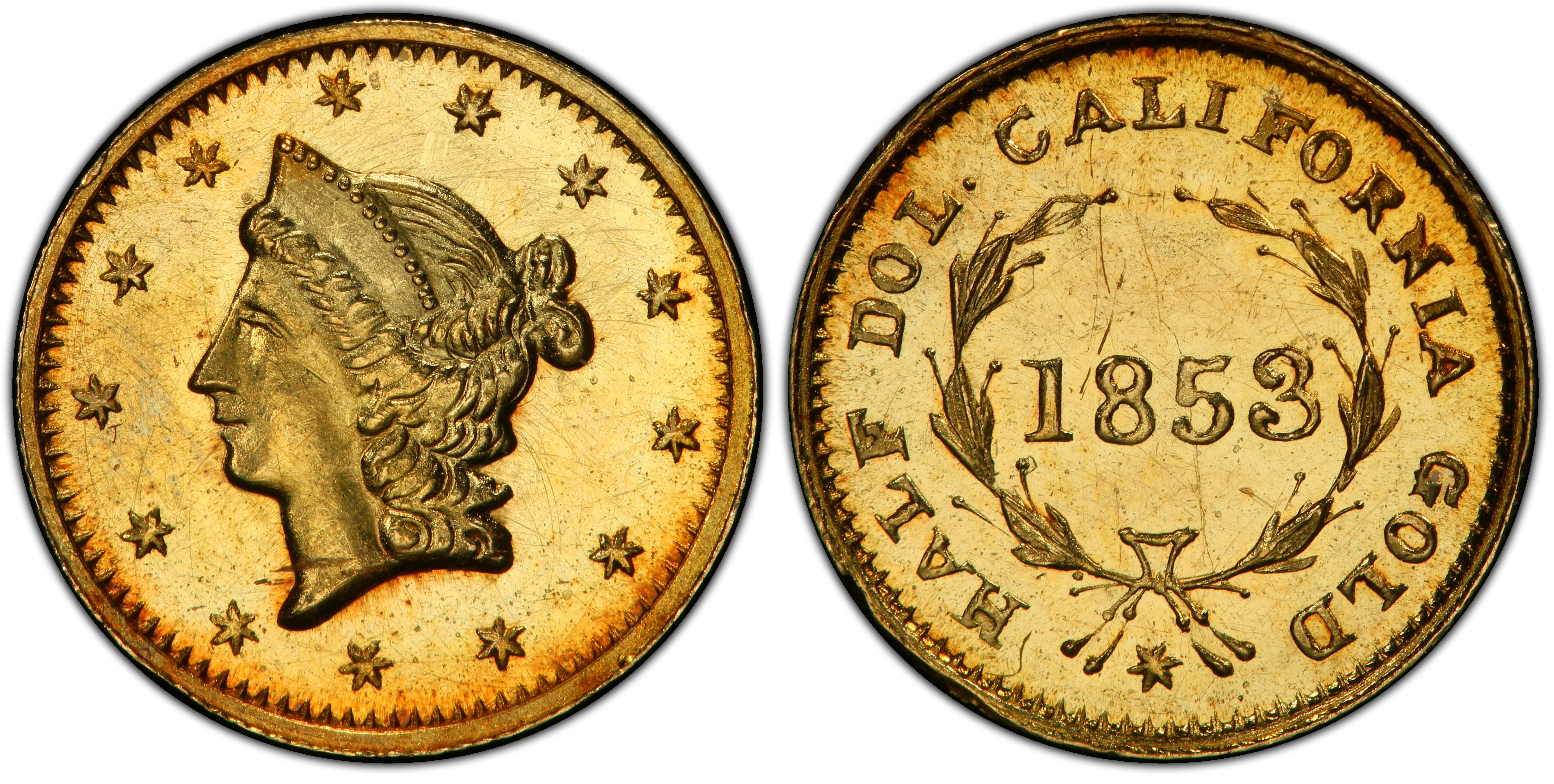
Obverse & Reverse
The 1853 Gold 50 Cents, cataloged as Breen-Gillio 428, is a quintessential artifact from the first period (1852-1857) of California's private gold coinage. Born from the chaotic crucible of the Gold Rush, these diminutive coins addressed a severe and crippling shortage of small-denomination currency. Following the discovery of gold at Sutter's Mill in 1848, hundreds of thousands of prospectors flooded California, creating a booming economy overnight. While vast quantities of raw gold dust and large-denomination private issue coins ($5 to $50) existed, conducting everyday transactions was nearly impossible. A pinch of gold dust for a drink or loaf of bread was an inaccurate and contentious system. The United States government was slow to respond; the San Francisco Mint would not open until 1854, and even then, its initial output of small coins was woefully inadequate. Into this monetary vacuum stepped enterprising local jewelers and metalsmiths, many of them French immigrants, who possessed the skills to create dies and strike coins. These artisans, whose identities are now largely lost to history, began producing fractional gold pieces—quarter dollars, half dollars, and dollars—to facilitate daily commerce. The BG-428 is a product of this environment, struck in 1853 when the need was at its peak. These coins were not government-sanctioned but were tolerated out of sheer necessity. They were typically crudely made via the 'hammer method,' where a planchet was placed on an anvil die and struck with a sledgehammer blow to a handheld upper die. This process resulted in inconsistent strike quality, with some pieces sharp and others weak or uneven. Although intended for circulation, their novelty and small size made them popular as souvenirs to be sent back East, a factor that contributed to the survival of many examples in high grades. By the late 1850s, an adequate supply of federal coinage from the San Francisco Mint rendered these private issues obsolete for commerce, cementing their transition from functional money to historical curiosities.
Associated EventCalifornia Gold Rush
Reason For MintingTo alleviate a severe shortage of small-denomination coinage for daily commercial transactions in Gold Rush-era California.
Minter HistoryThe specific minter of the BG-428 variety is unknown, a common trait for most Period One California fractional gold coins that do not bear initials. The pieces are attributed to the skilled but largely anonymous jewelers and artisans operating in San Francisco in the early 1850s. These individuals, many of whom were of French origin like Antoine Louis Nouizillet and M. Deriberpie, were primarily watchmakers, engravers, and jewelers who adapted their craft to meet the region's pressing monetary needs. They operated small, private workshops, using locally sourced gold of varying purity to produce the coins. Their operations ceased as the official San Francisco Mint came into full production, making their legacy the brief but vital series of fractional gold they created.
Historical SignificanceThe BG-428 and its contemporaries represent a fascinating chapter of American monetary history, demonstrating a private, localized solution to a government failure in providing adequate coinage. They are tangible relics of the Gold Rush economy, embodying the ingenuity and ad-hoc nature of frontier life. Numismatically, they are the first privately issued small-denomination gold coins in the United States, forming a highly collectible and complex series.
N/A
Denomination$0.50
Minting Period1853
Assayer/MinterAnonymous San Francisco Jeweler(s)
Geographic OriginSan Francisco, California
Obverse DescriptionA crudely rendered Liberty Head, facing left, with hair tied in a bun at the back. She wears a simple coronet. The portrait is flanked by four six-pointed stars, two on each side. The date 1853 is below the truncation of the neck.
Obverse Inscription1853
Reverse DescriptionThe denomination '1/2' is centered within a wreath composed of two branches tied with a bow at the bottom. The inscription CALIFORNIA GOLD is around the periphery, above the wreath.
Reverse InscriptionCALIFORNIA GOLD 1/2
CompositionGold
Stated Fineness Actual FinenessVariable, typical for Period One issues, often ranging from .800 to .900.
Diameter11.40 mm
EdgePlain
Unknown
Survival EstimateApproximately 400 in all grades
Rarity ScaleR-3 (Breen-Gillio Scale: 201-500 known)
The 1853 BG-428 is highly sought after as a representative of the earliest, most historically significant period of California fractional gold. Its crude charm, direct connection to the Gold Rush, and status as a non-initialed, anonymous issue make it a classic type coin for collectors of pioneer gold and Western Americana.
Key VarietiesThe primary variety of significance is the 'S.S. Central America' pedigree. A small number of BG-428 specimens were recovered from the 1857 shipwreck of the S.S. Central America. These coins are typically certified with a special designation and often exhibit unique seawater surface characteristics, commanding a premium due to their incredible backstory. No major die varieties from the original minting period are widely collected or recognized, though minor die states may exist.
Authentication TipsGenuine BG-428 pieces are very thin and often have a slightly uneven, wavy planchet due to the crude hammer-striking process. Look for a somewhat soft, mushy strike, particularly on the stars and wreath details; perfectly sharp, modern-looking strikes are suspect. The gold color should appear natural, often with a slightly lighter yellow hue due to the native California gold's silver content. Replicas are often thicker, have a brassy color, may feature incorrect design details (like bears), and often lack a specific denomination like '1/2'. Authentication by a reputable third-party grading service is strongly recommended.
Shopping ConsiderationsFor a premium quality example, seek a coin with a sharp, well-centered strike, especially on Liberty's portrait and the date. Original, uncleaned surfaces with some remaining mint luster are highly desirable. Many surviving pieces were used in jewelry and may show evidence of mounting, soldering, or harsh cleaning; these should be avoided or purchased at a significant discount. Pay close attention to planchet quality; while some crude features are expected, significant cracks, voids, or laminations can be distracting. A CAC sticker on a certified example indicates superior quality and eye appeal for the assigned grade and is highly valued for this series.
A coin's grade is its condition, rated on a 1-70 scale. For rare coins, this is the most critical factor in determining value, as a tiny difference in preservation can mean a huge difference in price.
Relevant Grade TypesOriginal 1853 BG-428 coins were business strikes intended for circulation and are found in Circulated (1-58) and Mint State (MS, 60-70) grades. No Proofs were struck during the original period. While many examples circulated, a significant number were saved as souvenirs, resulting in a relatively high survival rate in uncirculated grades. There are no known later-date Proof restrikes or special collector strikings for this specific variety.
Mint State CharacteristicsUncirculated examples of BG-428 often display a soft, satiny luster rather than a hard, frosty one. The strike is a key determinant of quality; many are weakly struck in the centers or peripheries. A well-struck piece will show clear details in Liberty's hair and the leaves of the wreath. Due to the primitive manufacturing process, even Mint State coins can have small planchet flaws, such as tiny depressions or striations. Some high-grade examples are described as 'prooflike,' with reflective fields, which is a desirable characteristic.
Circulated Wear PatternsWear first appears on the highest points of the design. On the obverse, this includes Liberty's cheek, the hair above her eye, and the coronet. On the reverse, the high points of the wreath's leaves and the bow will show initial friction and smoothing. In lower grades (VF and below), the stars will begin to merge with the fields and the finer details of the wreath will be lost.
Key Factors For ValueThe primary drivers of value for a BG-428 are grade and surface quality. An example with original, lustrous surfaces free of cleaning or tooling will command a substantial premium over a harshly cleaned coin of the same grade. Strike quality is also paramount; a sharply struck coin is always preferred to a weakly struck one. Eye appeal, including attractive original toning and a problem-free planchet, contributes significantly to value. Finally, a certified coin with a CAC sticker, or one with a prestigious pedigree like the S.S. Central America, will realize a significantly higher price.
PCGS Price Guide
| Grade | Price | Population |
|---|---|---|
| 40 | $165.00 | N/A |
| 45 | $175.00 | 2 |
| 45+ | $185.00 | N/A |
| 50 | $200.00 | 7 |
| 50+ | $215.00 | N/A |
| 53 | $235.00 | 4 |
| 53+ | $255.00 | N/A |
| 55 | $285.00 | 38 |
| 55+ | $325.00 | N/A |
| 58 | $375.00 | 82 |
| 58+ | $400.00 | N/A |
| 60 | $425.00 | 10 |
| 61 | $450.00 | 35 |
| 62 | $475.00 | 98 |
| 62+ | $500.00 | N/A |
| 63 | $525.00 | 31 |
| 63+ | $750.00 | N/A |
| 64 | $1,250.00 | 7 |
| 64+ | $2,250.00 | N/A |
| 65 | $5,250.00 | 1 |
| 65+ | $5,750.00 | N/A |
| 66 | $6,500.00 | N/A |