1853 G50C BG-415A (Regular Strike)
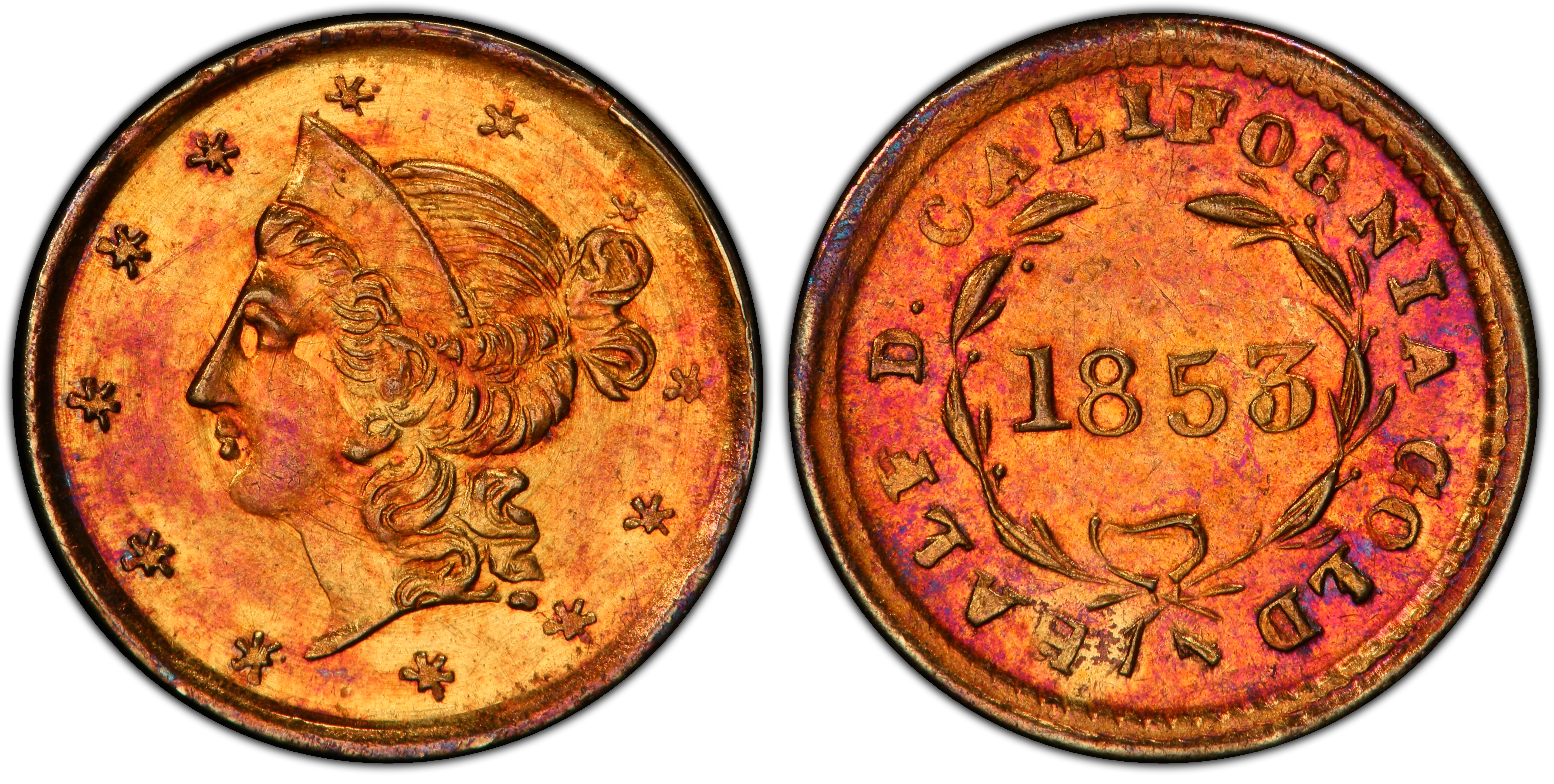
Obverse & Reverse
The 1853 BG-415A 50 Cents is an artifact born from the economic chaos and ingenuity of the California Gold Rush. Following the discovery of gold in 1848, a massive influx of prospectors and merchants flooded into California, creating a vibrant but chaotic economy. While large transactions were settled with raw gold dust or the hefty gold coins produced by private assayers, a severe shortage of small denomination coinage crippled daily commerce. A pinch of gold dust for a drink was an imprecise and often contentious method of payment. To fill this critical void, jewelers and metalsmiths in San Francisco began striking their own fractional gold coins in quarter, half, and dollar denominations starting in 1852. These 'Period One' issues, struck from 1852 to 1857, were intended for actual circulation and were generally made of native California gold, which often contained a significant amount of silver, giving them a lighter color. They were designed to mimic the appearance of federal gold coinage to inspire public trust. The BG-415A is a quintessential example of this phenomenon, yet it stands apart due to its extraordinary rarity. Unlike its more common counterparts, which circulated to varying degrees, the BG-415A is a ghost of the era. Cataloged by Walter Breen and Ronald J. Gillio in their authoritative work, its R-9 rarity rating suggests that perhaps only a single specimen is known to exist. Its existence was noted by its absence in the Jay Roe collection, the most complete assemblage of California Fractional Gold ever formed, which further cements its legendary status. Such a minuscule output suggests it may have been a trial piece or part of an extremely limited pilot run from a small, anonymous jeweler whose venture was either immediately halted or whose dies failed catastrophically after just a few strikes. The coin is not just a piece of currency, but a unique survivor of a fleeting moment of private enterprise, a testament to the desperate need for a functional medium of exchange on the American frontier.
Associated EventCalifornia Gold Rush
Reason For MintingTo alleviate a severe shortage of small-denomination coinage for everyday commercial transactions in Gold Rush-era California.
Minter HistoryThe minter of BG-415A is unknown. During 'Period One' (1852-1857), many fractional gold pieces were produced anonymously by various San Francisco jewelers and metalsmiths. The extreme rarity of this variety suggests it may have been the work of a very small or short-lived operation, and no identifying marks or records have ever allowed for a positive attribution.
Historical SignificanceAs a nearly unique 'Period One' issue, the BG-415A's significance lies in its extreme rarity and its representation of the private entrepreneurship that created circulating coinage out of necessity. It is a prime example of the localized solutions developed to solve economic problems on the isolated California frontier before the San Francisco Mint could produce sufficient federal coinage.
N/A
Denomination50 Cents
Minting Period1853
Assayer/MinterUnknown Private Minter
Geographic OriginSan Francisco, California
Obverse DescriptionFeatures a small Liberty Head, facing left, modeled after the design on contemporary federal gold dollars. The portrait is surrounded by thirteen six-pointed stars, representing the original colonies. The date '1853' is positioned below the bust.
Obverse Inscription1853
Reverse DescriptionA wreath of two olive branches, tied with a bow at the bottom, encircles the denomination. The denomination is expressed with '1/2' at the top, though some references describe it as 'HALF DOL.' within the wreath. At the top periphery, outside the wreath, are the words 'CALIFORNIA GOLD'.
Reverse InscriptionCALIFORNIA GOLD 1/2
CompositionGold
Stated Fineness Actual FinenessTypically .800 to .885 for Period One issues, often with a high silver content.
Weight0.86 grams
Diameter11.50 mm
EdgePlain
Extremely low, likely less than 5 pieces.
Survival Estimate1-2 known specimens.
Rarity ScaleR-9 (Unique or nearly unique)
The BG-415A is the ultimate prize for the advanced specialist in California Fractional Gold. Its appeal is based entirely on its status as one of the greatest rarities in the entire series. The fact that it was missing from the legendary Jay Roe collection elevates it to a near-mythical status.
Key VarietiesAs a unique or nearly unique die pairing, BG-415A is itself the key variety. There are no known major variations, restrikes, or patterns associated with this specific Breen-Gillio number. Any coin claiming to be BG-415A would be compared against the single known exemplar.
Authentication TipsAuthentication would require direct comparison with the certified, known specimen. General characteristics of authentic Period One fractionals include a slightly soft, crude strike from manual screw or hammer presses, and a composition of native gold with natural silver content. The die characteristics—placement of stars, date numerals, and letters—would be the primary diagnostic. Extreme caution is advised, as this is a target for sophisticated counterfeiters who might create fantasy pieces based on catalog descriptions.
Shopping ConsiderationsThe acquisition of this coin would be a private treaty transaction or a once-in-a-generation auction appearance. Any potential buyer must insist on impeccable provenance and certification from PCGS or NGC. For such a rarity, the concept of 'premium quality' is secondary to authenticity and existence. The focus would be on verifying the coin's pedigree and ensuring it is the single known specimen. Minor planchet flaws or a slightly uneven strike would be entirely acceptable and even expected for a piece of this nature. The primary concern is confirming it is the genuine, cataloged R-9 coin.
A coin's grade is its condition, rated on a 1-70 scale. For rare coins, this is the most critical factor in determining value, as a tiny difference in preservation can mean a huge difference in price.
Relevant Grade TypesOriginal 'Period One' issues like BG-415A were business strikes intended for circulation and are found in Circulated (1-58) and Mint State (MS, 60-70) grades. No proofs were struck during the original minting period. Given its potential status as a trial piece, it is likely the known specimen is in a high grade, either Mint State or About Uncirculated.
Mint State CharacteristicsA hypothetical Mint State BG-415A would likely exhibit a somewhat soft strike, characteristic of the crude minting technology used. Central details on Liberty's hair and the wreath's leaves might show weakness. Luster would be satiny rather than frosty. Small, inherent planchet flaws, fissures, or adjustment marks would not be unusual and are generally accepted by specialists in this series.
Circulated Wear PatternsFor a generic 1853 Liberty Head half dollar, wear first appears on the high points of Liberty's hair above the eye and on the cheek. On the reverse, the highest points of the wreath's leaves and the bow would show initial friction. As a likely unique coin that may never have circulated, defining specific wear patterns for BG-415A is purely theoretical.
Key Factors For ValueFor the BG-415A, value is almost entirely a function of its R-9 rarity. Authenticity and provenance are paramount. While the absolute grade is important, the coin's status as a unique or nearly unique item means it will command an extraordinary price regardless of whether it is AU-58 or MS-62. Any evidence of cleaning, tooling, or repairs would be severely detrimental, but less so than for a more common coin. The key factor is simply being the genuine article.
PCGS Price Guide
| Grade | Price | Population |
|---|---|---|
| 62 | $60,000.00 | 1 |