1855 G50C BG-432 (Regular Strike)
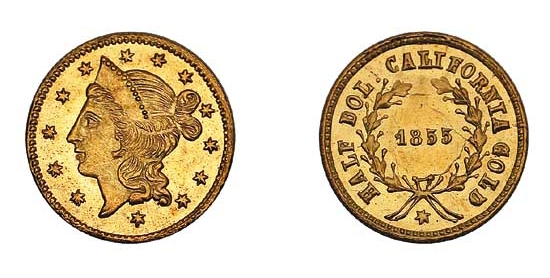
Obverse & Reverse
The 1855 BG-432 Half Dollar is a tangible relic from the 'Period One' (1852-1857) issuance of California Fractional Gold, a fascinating and complex series born of necessity. In the aftermath of the 1848 gold discovery, California's economy exploded, but it paradoxically suffered from a chronic shortage of small-denomination coinage. Gold dust and nuggets were plentiful, but impractical for minor daily transactions. Federal coinage was scarce on the West Coast, and the newly established San Francisco Mint initially focused on larger denominations, failing to meet the demand for pocket change. Into this void stepped local jewelers and metalsmiths who, leveraging their skills, began striking their own quarter, half, and one-dollar coins from native California gold. These 'Period One' issues were not souvenirs, but were intended to and did circulate as a vital medium of exchange to alleviate the severe coin shortage. Though often slightly underweight compared to their federal counterparts, they were generally accepted in commerce out of sheer necessity. The BG-432 is a product of this environment. Struck anonymously, as were most fractionals, it represents the decentralized, entrepreneurial response to a fundamental economic need in a frontier society. These tiny gold coins facilitated trade, allowing miners and merchants to conduct everyday business, from buying a meal to paying for supplies. By the late 1850s, the increased output of the San Francisco Mint rendered these private issues obsolete. Many were eventually melted, lost, or damaged, contributing to their modern-day scarcity. The BG-432 survives as a testament to the ingenuity and chaos of the Gold Rush, a period when private citizens took the coining of money into their own hands to keep the wheels of commerce turning.
Associated EventCalifornia Gold Rush
Reason For MintingTo alleviate a severe shortage of small-denomination circulating coinage for daily commerce in Gold Rush-era California.
Minter HistoryThe specific minter for the BG-432 variety, like many Period One California Fractional Gold issues, is unknown. Research by Walter Breen and Ronald J. Gillio attributed many pieces to specific jewelers like Antoine Louis Nouizillet or Deriberpe & Nouizillet, but a significant number of die varieties remain anonymous. These coins were produced by skilled artisans, likely San Francisco-based jewelers, who possessed the necessary equipment (dies, presses) and access to raw gold to meet the public's demand for small change. Their operations were small-scale and their identities were often not stamped on the coins themselves.
Historical SignificanceAs a 'Period One' issue, the BG-432 is significant for being a genuine circulating medium of exchange, not a souvenir. It represents the private sector's solution to a failure in the official monetary supply during a pivotal moment in American westward expansion. These coins are a direct link to the daily economic life of miners, merchants, and settlers during the California Gold Rush.
N/A
Denomination50 Cents
Minting Period1855
Assayer/MinterAnonymous
Geographic OriginSan Francisco, California
Obverse DescriptionA small Liberty Head facing left, similar in style to the contemporary federal gold dollars. The head is surrounded by thirteen stars, representing the original colonies.
Obverse Inscription1855
Reverse DescriptionA wreath composed of two branches tied with a bow at the bottom. Inside the wreath is the denomination '1/2'. The legend 'CALIFORNIA GOLD' is inscribed around the periphery, outside the wreath.
Reverse InscriptionCALIFORNIA GOLD 1/2
CompositionGold
Stated Fineness Actual FinenessTypically .800 to .880, reflecting the natural alloy of native California gold which contained significant amounts of silver.
Diameter10.00 mm
EdgePlain
Unknown
Survival Estimate31-75
Rarity ScaleR-5 [High R-5]
The BG-432 is sought after as a representative of the earliest, circulating California Fractional Gold. Its appeal lies in its direct connection to the Gold Rush economy, its affordability compared to larger pioneer gold, and the challenge of collecting the many die varieties. As an R-5 variety, it offers a pleasing level of scarcity without being prohibitively rare.
Key VarietiesThe BG-432 is itself a specific die marriage and is considered a 'regular strike' business issue from the original minting period. No major sub-varieties, patterns, or official restrikes are known or recorded for this specific die pair. The broader series includes many different die pairings (BG numbers), as well as octagonal versions and different designs from other minters.
Authentication TipsAuthentic Period One fractionals like BG-432 should exhibit a somewhat crude but sharp strike from hand-cut dies. Look for characteristic die markers, such as specific arrangements of the stars or letters. Counterfeits and modern replicas often have a soft, 'mushy' appearance, incorrect weight, or a soapy luster. The gold color should be consistent with the silver-rich alloy of native California gold, often a bit lighter yellow than federal issues. Any piece with a bear on it is a souvenir token, not an original fractional coin.
Shopping ConsiderationsA premium quality example of BG-432 will exhibit a bold strike, particularly on the highest points of Liberty's hair and the details of the wreath. Luster is key; look for original, frosty, or satiny mint luster rather than a dull or overly shiny cleaned surface. The planchets were often crudely made, so minor imperfections are common and acceptable, but avoid examples with significant scratches, rim bumps, or evidence of tooling or repair. Eye appeal is paramount; a well-centered strike on a clean planchet with attractive original color will always command a premium.
A coin's grade is its condition, rated on a 1-70 scale. For rare coins, this is the most critical factor in determining value, as a tiny difference in preservation can mean a huge difference in price.
Relevant Grade TypesAll original 1855 BG-432 coins are business strikes, created for circulation. They are found in Circulated grades (AG-3 to AU-58) and, more rarely, in Mint State (MS-60 to MS-70). No Proof (PR/PF) examples were struck during the original period of issue, as these were utilitarian coins, not collector pieces. Any coin described as a 'Proof' would be a much later replica or fantasy piece and not an authentic Period One fractional.
Mint State CharacteristicsAn uncirculated BG-432 is defined by the presence of original mint luster. This luster is typically soft and satiny. Strike quality varies; many were not struck with full force, so some weakness on the high points (central hair strands, leaf tips) can be expected even on a Mint State coin. Due to their small size and handling in bags, contact marks are common; a high-grade MS example will have minimal and well-hidden marks. The fields should be free of the hairlines that indicate cleaning.
Circulated Wear PatternsWear first appears on the highest points of the design. On the obverse, check for flatness on Liberty's hair above the eye and on the cheek. On the reverse, the leaves of the wreath and the bow's knot are the first elements to show wear. In lower grades (Fine and below), the stars will begin to merge with the field and the legend 'CALIFORNIA GOLD' will become weak.
Key Factors For ValueFor the BG-432, the primary value drivers are grade and surface quality. An example with sharp, original, frosty luster will be worth significantly more than a cleaned or polished coin of the same technical grade. The quality of the strike is critical; a well-struck piece with full details is highly desirable. Eye appeal, driven by attractive original coloration and a lack of distracting marks or planchet flaws, plays a major role. Finally, certification by a top-tier service (PCGS or NGC) is standard, and a CAC sticker indicating premium quality for the grade will add a substantial price premium.
PCGS Price Guide
| Grade | Price | Population |
|---|---|---|
| 50 | $260.00 | 1 |
| 50+ | $265.00 | N/A |
| 53 | $270.00 | N/A |
| 53+ | $275.00 | N/A |
| 55 | $285.00 | 2 |
| 55+ | $315.00 | N/A |
| 58 | $350.00 | 4 |
| 58+ | $375.00 | N/A |
| 60 | $400.00 | N/A |
| 61 | $450.00 | 6 |
| 62 | $500.00 | 10 |
| 62+ | $535.00 | N/A |
| 63 | $575.00 | 10 |
| 63+ | $750.00 | N/A |
| 64 | $1,450.00 | 7 |
| 64+ | $1,750.00 | N/A |
| 65 | $2,250.00 | 1 |