1871 25C BG-716 (Regular Strike)
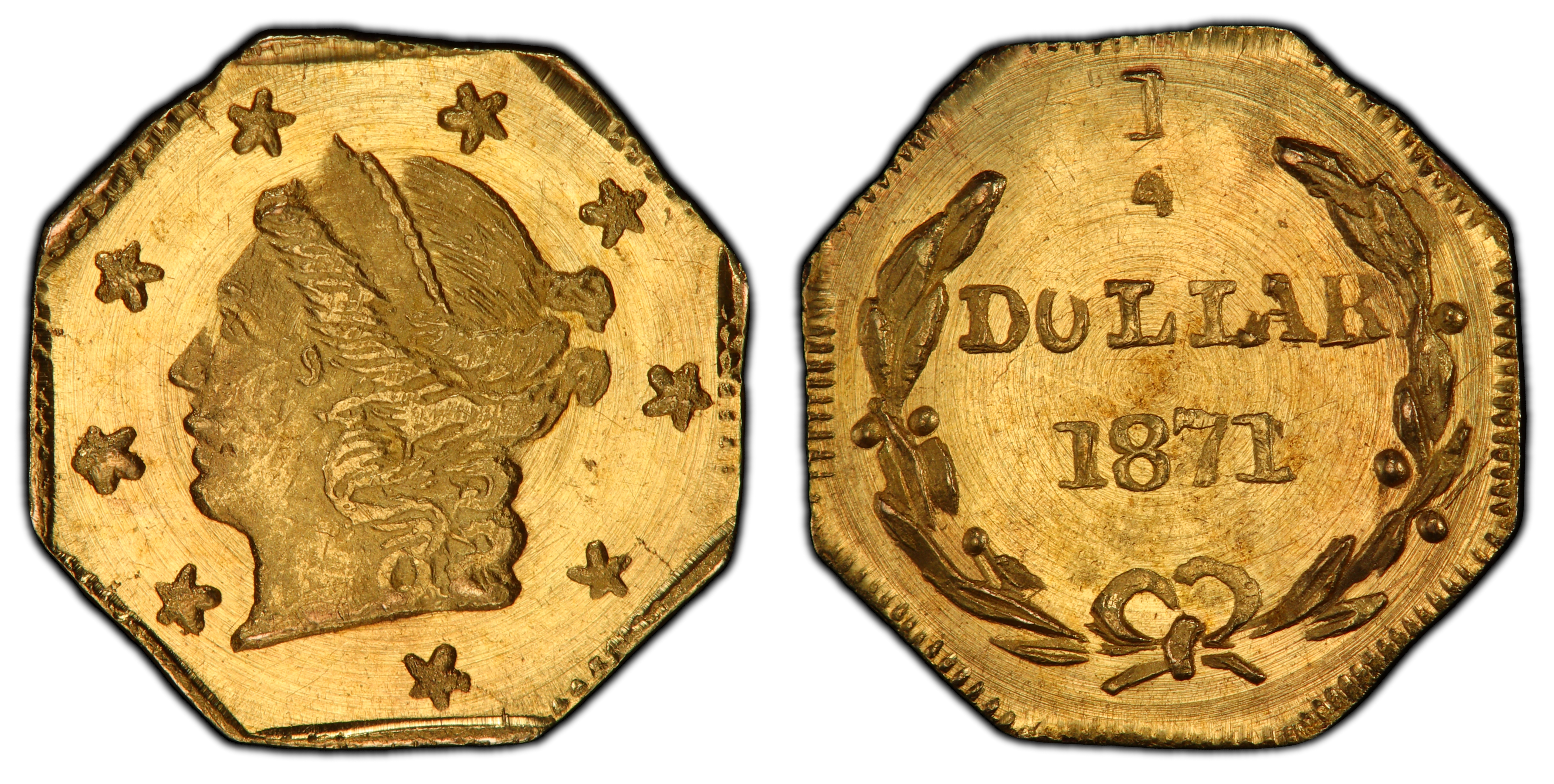
Obverse & Reverse
The 1871 BG-716 25 cent piece is a product of the fascinating and complex Period Two (1858-1882) of California Fractional Gold production. Following the initial Gold Rush, California's economy had matured, but a persistent shortage of small-denomination coinage continued to plague commerce. Federal coins under a dollar were scarce on the West Coast, and the smallest federally-issued gold coin was the dollar. This void created a market for privately manufactured, small-denomination gold tokens, colloquially known as 'charms' or 'souvenirs,' though they actively circulated as money, particularly in smaller transactions. By the 1870s, the production of these pieces was dominated by jewelers and specialized manufacturers in San Francisco, rather than the assayers of the Gold Rush era. These firms, such as the California Jewelry Company, mass-produced a wide variety of designs, often using advanced steam-powered coining presses, which resulted in higher quality strikes than their Period One predecessors. The designs frequently mimicked federal coinage, with the Indian Head motif being particularly popular, likely to enhance public acceptance. However, these pieces were almost universally underweight for their stated value, a fact that eventually drew the ire of the U.S. government. In 1876, the Treasury Department began actively investigating and prosecuting the makers of these tokens, viewing them as illegal private coinage that competed with official U.S. money. This federal crackdown, culminating in the Act of 1883 which explicitly outlawed them, brought the era of California Fractional Gold to a close. The BG-716, with its dated 1871, represents the peak of this final period of production before government suppression. Its survival today is a tangible link to a time when California's economy, still awash in gold but short on change, created its own unique numismatic solutions.
Associated EventPost-Gold Rush Economic Development in California
Reason For MintingTo alleviate a chronic shortage of small-denomination circulating coinage for daily commerce in California.
Minter HistoryThe specific minter is not definitively known, as jewelers often used generic dies. However, research by Breen and Gillio points towards the California Jewelry Co. of San Francisco as the likely manufacturer for many Period Two fractionals, including this type. These manufacturers were not assayers in the traditional sense but rather skilled jewelers and mechanics who saw a commercial opportunity in producing small gold tokens. They operated as private businesses, creating dies and striking pieces for various retailers who would then put them into circulation. Their operations ceased following increased federal scrutiny and legal action in the late 1870s and early 1880s.
Historical SignificanceThe BG-716 is representative of the final, most prolific phase of private currency in California. It illustrates the persistent need for small change on the West Coast and the ingenuity of private enterprise in meeting that need. Numismatically, it is a key component of the extensive and widely collected California Fractional Gold series, valued for its historical context and connection to the jeweler-minters of San Francisco.
N/A
Denomination25 Cents
Minting Period1871
Assayer/MinterCalifornia Jewelry Co. (Manufacturer), possibly retailed by Antoine Louis Nouizillet or other San Francisco jewelers.
Geographic OriginSan Francisco, California
Obverse DescriptionA stylized head of Liberty facing left, wearing a feathered headdress. The portrait is often referred to as an 'Indian Head'. Thirteen stars encircle the portrait along the rim.
Obverse Inscription(No text inscription)
Reverse DescriptionThe denomination '1/4' is surrounded by a wreath of leaves and berries, tied with a bow at the bottom. The word 'DOLLAR' and the date '1871' are located below the wreath. The design is open, with the wreath not fully joined at the top.
Reverse Inscription1/4 DOLLAR 1871
CompositionGold
Stated Fineness Actual FinenessVaries, typically between .500 and .600 fine (12-14 karat gold).
Weight0.25 grams
Diameter9.70 mm
EdgePlain
Unknown
Survival Estimate500-750
Rarity ScaleR-4
The BG-716 is popular among collectors due to its classic Indian Head design, affordability relative to rarer varieties, and its status as a representative example from the peak of Period Two production. It serves as an excellent entry point into the complex series of California Fractional Gold.
Key VarietiesThe primary issue is the business strike of 1871. There are no known major varieties from the original minting period for the BG-716 die marriage. Unlike some earlier territorial issues, Period Two fractionals like this one were not subject to later collector restrikes (e.g., Chapman restrikes). Collectors should be aware of contemporary counterfeits and modern replicas which are not numismatic items.
Authentication TipsGenuine BG-716 examples have a specific die state. Look for sharp, well-defined details in the wreath and lettering on the reverse, a characteristic of the California Jewelry Co.'s work. The stars on the obverse should be uniform. The planchet is typically thin. Counterfeits are common; they often have a soapy, cast-like appearance, incorrect weight, and mushy details, particularly in the fine lines of the hair and feathers. Authentication by a major grading service (PCGS or NGC) is highly recommended.
Shopping ConsiderationsA premium quality example for its grade will possess a sharp strike, especially on the high points of the Indian's cheek and the details of the wreath. Seek out pieces with smooth, lustrous surfaces and minimal distracting contact marks. Original, unconserved 'skin' is highly desirable and often manifests as a deep, reddish-gold or orange-peel texture. Avoid examples that have been harshly cleaned, which will appear unnaturally bright and show hairlines under magnification. Also be wary of pieces that have been used as jewelry, looking for evidence of removed solder or rim damage.
A coin's grade is its condition, rated on a 1-70 scale. For rare coins, this is the most critical factor in determining value, as a tiny difference in preservation can mean a huge difference in price.
Relevant Grade TypesOriginal period issues were business strikes intended for circulation and are found in Circulated (1-58) and Mint State (MS, 60-70) grades. True Proof (PR/PF) strikings of this variety from the original period of issue are not known to exist and were not a product of these private manufacturers. Any piece described as a 'Proof' is likely a modern copy or a misattributed high-grade business strike.
Mint State CharacteristicsAn uncirculated BG-716 will exhibit full, unbroken luster, which is typically frosty or satiny in appearance. The strike can be variable, but high-quality examples will show sharp details on the feathers of the headdress and the bow on the reverse wreath. Due to the small size and mass production techniques, even Mint State examples may show minor planchet flaws or a slightly uneven strike. Contact marks, while present, should be minimal and not located in focal areas like Liberty's face.
Circulated Wear PatternsWear first appears on the highest points of the design. On the obverse, this includes the cheek, the eyebrow, and the tips of the feathers. On the reverse, the high points of the wreath's leaves and the numerals '1/4' will show the first signs of friction. In lower grades (VG and below), the stars on the obverse may begin to merge with the field and the date on the reverse can become weak or illegible.
Key Factors For ValueThe primary driver of value is the certified grade. Beyond that, surface quality is paramount; an example with original, uncleaned surfaces and minimal marks will always command a premium over a cleaned or marked-up coin of the same grade. Strike sharpness is a key differentiator, with well-struck pieces showing full feather and wreath detail being highly sought after. Finally, eye appeal, which includes factors like the richness of the gold color and overall pleasing appearance, significantly influences market price. A CAC sticker for this issue indicates superior quality for the grade and will result in a substantial premium.
PCGS Price Guide
| Grade | Price | Population |
|---|---|---|
| 62 | N/A | N/A |
| 63 | $900.00 | 4 |
| 63+ | $920.00 | N/A |
| 64 | $1,000.00 | 2 |
| 64+ | $1,050.00 | N/A |
| 65 | $1,200.00 | 6 |
| 65+ | $1,350.00 | N/A |
| 66 | $2,000.00 | 5 |
| 66+ | $2,400.00 | N/A |
| 67 | $5,000.00 | 4 |