1854 G$1 BG-603 (Regular Strike)
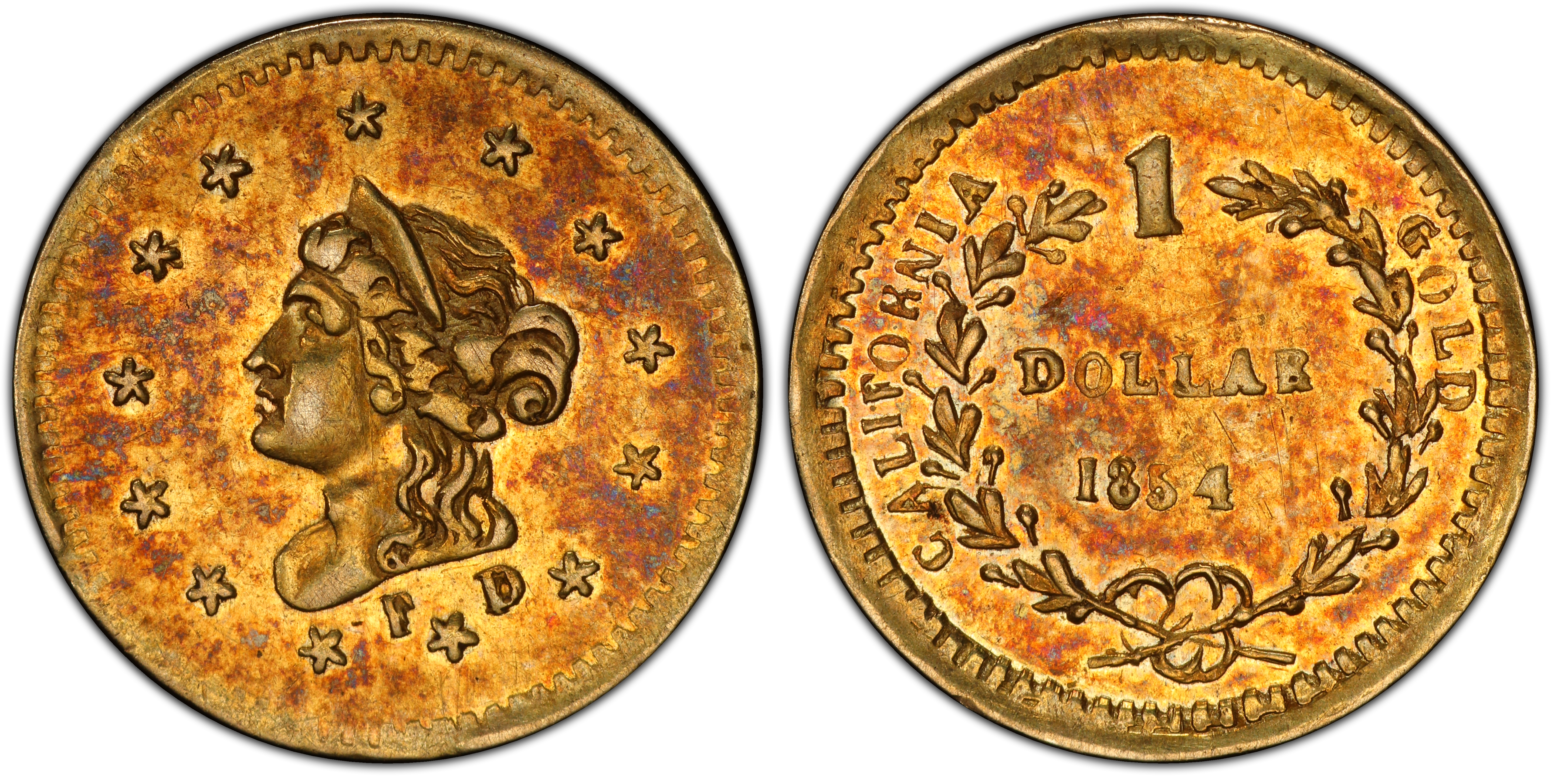
Obverse & Reverse
The 1854 One Dollar, cataloged as Breen-Gillio 603 (BG-603), is a quintessential artifact from the chaotic and economically vibrant era of the California Gold Rush. Following the discovery of gold at Sutter's Mill in 1848, a massive influx of prospectors and merchants flooded into California, creating a dynamic but unstable economy. A severe shortage of circulating small-denomination coinage plagued daily commerce. Federal gold coins were too large for minor transactions, and smaller silver coins were systematically hoarded or exported due to their higher intrinsic value relative to gold. Into this vacuum stepped private jewelers and metallurgists, who began striking their own small-denomination gold coins, now known as California Fractional Gold. These pieces, ranging from 25 cents to one dollar, were not government-sanctioned but were tolerated and widely accepted out of sheer necessity. The BG-603 is a product of this 'Period One' (1852-1856) of private coining, a time before state legislation in 1857 cracked down on the practice. It was likely manufactured by Antoine Louis Nouizillet, a French die-sinker, for the prominent San Francisco jewelry firm Gaime, Guillemot & Company. These coins were struck from locally sourced gold, but their weight and fineness were often inconsistent and slightly below their face value, a common and profitable practice for the private minters. Despite this, their utility in trade was undeniable, facilitating everything from buying a meal to paying for a shave. The BG-603, with its distinctive 'Large Head' Liberty design, circulated briefly but intensely before being supplanted by federal coinage and eventually melting pots. Its survival today provides a tangible link to the ingenuity and frontier capitalism that defined Gold Rush San Francisco.
Associated EventCalifornia Gold Rush
Reason For MintingTo alleviate a chronic shortage of small-denomination coinage for everyday commercial transactions in Gold Rush-era California.
Minter HistoryAntoine Louis Nouizillet was a French engraver and diesinker active in San Francisco during the 1850s. While he did not typically mark his work, numismatic scholarship, based on die characteristics and stylistic links, attributes many Period One California Fractional Gold pieces, including the BG-603, to his hand. He is believed to have produced dies and struck coins for several prominent jewelry firms, most notably Gaime, Guillemot & Co., located at 146 Montgomery Street. His work is characterized by a distinct style, often featuring a robust, somewhat crude rendering of Liberty, which was likely a pragmatic choice for rapid production rather than a lack of skill. Nouizillet's operations were representative of the many small-scale, private enterprises that filled the monetary void left by the federal government in the remote and booming economy of mid-19th century California.
Historical SignificanceThe BG-603 is historically significant as a direct monetary byproduct of the California Gold Rush, representing the private sector's response to a failure in official government services. It exemplifies the era's spirit of improvisation and entrepreneurship and serves as a key artifact of 'Period One' of the California Fractional Gold series, a period of unregulated and prolific private minting. As such, it is a crucial piece of evidence for understanding the day-to-day economic realities of one of the most formative periods in American history.
N/A
DenominationG$1
Minting Period1854
Assayer/MinterProbably Antoine Louis Nouizillet (for Gaime, Guillemot & Co.)
Geographic OriginSan Francisco, California
Obverse DescriptionA large, somewhat crudely rendered bust of Liberty facing left, with thirteen stars of varying quality encircling the portrait. Liberty's hair is tied in a bun, and she wears a coronet. The overall design is bold for the coin's small size.
Obverse Inscription(No lettering, only stars)
Reverse DescriptionThe denomination '1' and 'DOLLAR' are enclosed within a simple wreath of two olive branches tied with a bow at the bottom. The legend 'CALIFORNIA GOLD' is inscribed around the top periphery, above the wreath.
Reverse InscriptionCALIFORNIA GOLD / 1 / DOLLAR
CompositionGold
Stated FinenessNo fineness is stated on the coin.
Actual FinenessApproximately .800 to .850 fine, though it can vary.
Weight0.52 grams
Diameter11.50 mm
EdgePlain
Unknown
Survival Estimate50-75
Rarity ScaleR-6 (Very Rare)
The BG-603 is highly prized for its classic Gold Rush history, its status as a genuine circulating artifact of the era, and its distinctive 'Large Head' design. As a Period One dollar, it is one of the foundational issues of the popular California Fractional Gold series. Its high rarity (R-6) and connection to a known San Francisco jeweler add to its desirability among specialists.
Key VarietiesThe primary variety is the regular business strike. There are no known proof strikings, restrikes, or major die varieties from the original period of issue. However, collectors should be aware of numerous contemporary counterfeits made of brass, which often have mushy details and incorrect weight, as well as modern replicas. The key is to acquire a genuine piece struck in gold from Nouizillet's 1854 dies.
Authentication TipsAuthentic BG-603 examples have a characteristic fabric and strike. Look for sharp, albeit sometimes unevenly impressed, details on genuine specimens. The planchets are often slightly irregular and may show adjustment marks or minor planchet flaws common to these private issues. The style of the engraving, particularly the shape of Liberty's nose and the font used on the reverse, is a key diagnostic. Counterfeits are frequently brassy in color, underweight, and exhibit a soapy or cast-like texture. Comparison with high-resolution images of certified examples is essential.
Shopping ConsiderationsA premium quality BG-603 will exhibit a bold strike, especially on Liberty's portrait and the reverse denomination, which are often weak. Look for pleasing, original surfaces with some remnant luster; many surviving examples have been cleaned or used as jewelry, so originality commands a significant premium. The color should be a rich, buttery yellow-gold, sometimes with reddish toning. Avoid examples with significant rim bumps, scratches, or evidence of tooling or repair. Even on lower-grade circulated coins, clarity of the main design elements and legends is paramount. Given the high rarity, any example with good eye appeal and no major problems is a desirable acquisition.
A coin's grade is its condition, rated on a 1-70 scale. For rare coins, this is the most critical factor in determining value, as a tiny difference in preservation can mean a huge difference in price.
Relevant Grade TypesAll original 1854 BG-603 dollars were struck as business strikes intended for circulation and are found in Circulated (1-58) and Mint State (MS, 60-70) grades. Due to their heavy use in commerce, most known examples are circulated. Mint State specimens are exceedingly rare. No Proof (PR/PF) examples were struck during the original period of issue, and there are no known authorized later-date restrikes or special collector issues.
Mint State CharacteristicsAn uncirculated BG-603 will show uninterrupted, frosty to semi-prooflike luster across its surfaces. The strike is a critical factor; these were not always perfectly struck, but a premium MS example will have sharp details in Liberty's hair and the leaves of the wreath. Due to the rudimentary minting process and soft gold, even uncirculated pieces may exhibit minor planchet irregularities or small, scattered contact marks from being handled or stored in bulk with other coins. The overall eye appeal, combining luster, strike, and surface preservation, is key.
Circulated Wear PatternsWear first appears on the highest points of the design. On the obverse, this includes Liberty's cheek, the hair above her eye, and the coronet. On the reverse, the high points of the wreath's leaves and the numerical '1' will show the first signs of friction. In grades of VF and below, the smaller letters in 'CALIFORNIA GOLD' may begin to weaken, and the stars will lose their sharpness. On heavily worn examples, the entire design becomes soft, and the legends may become partially illegible.
Key Factors For ValueFor the BG-603, rarity is a given, so value is driven by condition and quality. A sharp, well-centered strike is the most important factor, as many are weakly struck. Secondly, original surfaces are paramount; an example with original 'skin' and luster, free from harsh cleaning, polishing, or scratches, will command a massive premium over a similarly graded but less attractive coin. Eye appeal, enhanced by attractive original toning, is a major value driver. Finally, certification by a top-tier grading service (PCGS or NGC) is standard for this series, and a CAC sticker signifying premium quality for the grade adds a further, significant premium.
PCGS Price Guide
| Grade | Price | Population |
|---|---|---|
| 25 | $7,000.00 | 1 |
| 30 | $7,500.00 | 1 |
| 35 | $8,000.00 | N/A |
| 40 | $8,500.00 | 2 |
| 45 | $9,000.00 | 1 |
| 45+ | $10,000.00 | N/A |
| 50 | $11,500.00 | 4 |
| 50+ | $12,500.00 | N/A |
| 53 | $16,500.00 | 3 |
| 53+ | $20,000.00 | N/A |
| 55 | $28,500.00 | 1 |
| 55+ | $31,500.00 | N/A |
| 58 | $37,500.00 | 1 |
| 63 | N/A | N/A |