1853 G$1 BG-517 (Regular Strike)
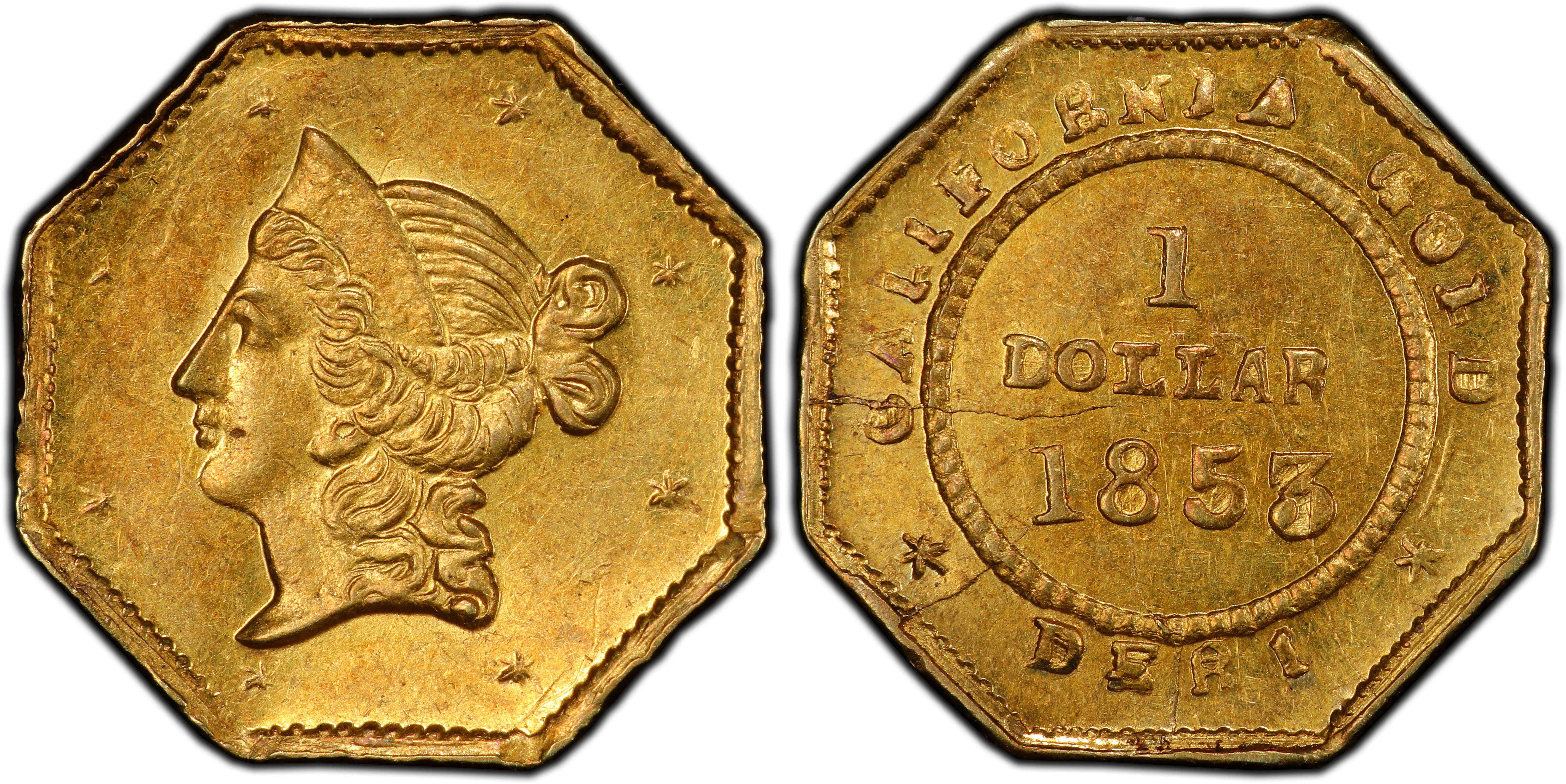
Obverse & Reverse
The 1853 'Defiant Eagle' Gold Dollar, cataloged as Breen-Gillio 517 (BG-517), stands as one of the most iconic and enigmatic issues within the broader series of California Fractional Gold. Struck amidst the chaotic and economically vibrant aftermath of the California Gold Rush, these small-denomination gold pieces fulfilled a critical need for circulating currency. In the early 1850s, the western United States was awash in gold dust but starved for official coinage. The smallest denomination struck by the U.S. Mint was the gold dollar, but these were often scarce in circulation on the West Coast. Private minters and jewelers stepped in to fill this void, producing a wide array of quarter-dollar, half-dollar, and dollar tokens from native California gold. These were not government-issued coins and their intrinsic value often varied, but their utility in daily commerce was undeniable. The BG-517 is a product of this environment, created to facilitate small transactions in an economy where a pinch of gold dust was a common, yet imprecise, medium of exchange. The specific maker of the BG-517 remains a subject of numismatic debate, though stylistic analysis and die characteristics strongly suggest the hand of Antoine Louis Nouizillet, a French-born die-cutter active in San Francisco. Nouizillet was a prolific producer of dies for various jewelers and private minters, and the distinct, somewhat crude but charmingly aggressive eagle on the reverse is considered a hallmark of his work. These coins circulated actively, though their unofficial status and the eventual establishment of the San Francisco Mint in 1854 led to their gradual disappearance from commerce. Public reception was likely mixed; while essential for trade, their variable weight and fineness compared to federal issues would have made some merchants wary. Today, the BG-517 is celebrated not just for its rarity but as a tangible link to the vibrant, unregulated economy of Gold Rush San Francisco, a time when private enterprise literally created its own money to keep the wheels of commerce turning.
Associated EventCalifornia Gold Rush
Reason For MintingTo provide a medium of exchange for small transactions due to a severe shortage of official U.S. small-denomination coinage in California.
Minter HistoryThe issuer of the BG-517 is not definitively known, as was common with many California Fractional Gold pieces. However, extensive numismatic research, particularly by specialists like Robert D. Leonard Jr., points strongly to Antoine Louis Nouizillet as the die engraver. Nouizillet was a key figure in San Francisco's private coining scene during the 1850s. A skilled craftsman, he produced dies for numerous jewelers and issuers, including some of the most famous California gold coiners. His work is often characterized by a distinctive, somewhat folk-art style, particularly in the rendering of eagles and portraits. Because he created dies for others rather than issuing coins under his own name, his direct history is pieced together through die-state analysis and stylistic comparisons across various known territorial issues.
Historical SignificanceThe BG-517 is historically significant as a prime example of privately issued coinage created to solve a currency crisis on the American frontier. It represents the ingenuity and unregulated nature of the Gold Rush economy before the establishment of federal minting operations in the West. Its existence highlights the lag between economic booms and the governmental response, and it remains a key artifact of the monetary system that underpinned one of the most transformative periods in American history. As one of the earliest and most distinctive Period One (1852-1857) dollar issues, it is a cornerstone piece for specialists in the field.
N/A
DenominationG$1
Minting Period1853
Assayer/MinterUnknown, possibly Antoine Louis Nouizillet
Geographic OriginSan Francisco, California
Obverse DescriptionA Liberty head facing left, with a diadem or coronet inscribed with 'LIBERTY'. The head is surrounded by thirteen stars, representing the original colonies. The date '1853' is positioned below the bust.
Obverse InscriptionLIBERTY / 1853
Reverse DescriptionA stylized, defiant-looking eagle with outstretched wings, head turned to its right. It clutches arrows and an olive branch in its talons. The inscription 'CALIFORNIA GOLD' appears above the eagle.
Reverse InscriptionCALIFORNIA GOLD
CompositionGold
Stated Fineness Actual FinenessTypically ranges from .800 to .880, below the U.S. Mint standard of .900 fine.
Weight1.70 grams
Diameter14.50 mm
EdgePlain
Unknown
Survival Estimate50-75
Rarity ScaleR-6
The BG-517 is highly sought after for its large size (for a fractional dollar), its iconic and boldly styled 'Defiant Eagle' design, and its status as a genuine, circulating artifact from the peak of the Gold Rush. Its high rarity and connection to the romantic history of early California make it a trophy piece for advanced collectors of territorial gold.
Key VarietiesThe primary issue is the regular business strike. There are no known major varieties from the original minting period. No patterns, trial pieces, or official later-date restrikes are known to exist for the BG-517. The primary variations seen by collectors are minor die states, reflecting the wear and tear on the dies during their short production life.
Authentication TipsGenuine examples have a specific 'look' to the gold, often with a slightly brassy or reddish hue from the alloy. The strike is characteristically weak in areas, particularly on the highest points of Liberty's hair and the eagle's breast feathers. The lettering style is distinctive to the Nouizillet school, with slightly crude but consistent punches. Counterfeits often have incorrect weight, a soapy or cast-like surface texture, or incorrect luster. They may also exhibit tooling marks or have details that are too sharp and uniform compared to genuine, weakly struck specimens. Verification by a specialist or a major grading service is essential.
Shopping ConsiderationsA premium quality example for its grade will exhibit minimal distracting marks and retain some of its original, soft satiny luster. Look for a strong strike on the date and legends, as these areas are often weak. The eagle's head and the stars on the obverse are also key focal points. Many surviving examples have been cleaned, so specimens with original 'skin' and attractive, honest wear command significant premiums. Avoid coins with obvious rim damage, scratches, or evidence of having been used in jewelry, as this was a common fate for these small gold pieces. An example with sharp details for the grade, pleasing color, and problem-free surfaces is the ideal purchase.
A coin's grade is its condition, rated on a 1-70 scale. For rare coins, this is the most critical factor in determining value, as a tiny difference in preservation can mean a huge difference in price.
Relevant Grade TypesOriginal period issues of BG-517 were business strikes intended for circulation. Therefore, they are found in Circulated grades (AG-3 to AU-58) and, very rarely, in Mint State (MS, 60-70). The vast majority of known examples are circulated. No Proof (PR/PF) examples were struck during the original period of issue, and no later-date Proof restrikes are known to exist. Any coin described as a 'Proof' would be highly suspect.
Mint State CharacteristicsAn uncirculated BG-517 is exceptionally rare. Such a piece would exhibit full, frosty, or satiny mint luster. However, due to the primitive coining techniques, even a Mint State example is expected to have a relatively weak strike, particularly on the central high points like Liberty's cheek and the eagle's breast. Contact marks are common due to the softness of the high-karat gold and the practice of shipping coins in bags. A truly choice MS example would combine strong luster with minimal marks and a better-than-average strike.
Circulated Wear PatternsWear first appears on the highest points of the design. On the obverse, this includes Liberty's cheek, the hair above the ear, and the coronet. On the reverse, the eagle's head, the top of the wings, and the breast feathers will show the first signs of friction. In lower grades (VG and below), the date and the word 'LIBERTY' on the coronet will become faint and eventually merge with the fields.
Key Factors For ValueFor the BG-517, the primary value drivers are grade and surface quality. An example with original, uncleaned surfaces commands a massive premium over a harshly cleaned or polished coin of the same technical grade. Sharpness of strike is also critical; a coin with a bold date and clear details on the eagle will be more desirable than a mushy, weakly struck example. Eye appeal, which includes attractive toning and problem-free surfaces, is paramount. Finally, certification by a top-tier grading service (PCGS or NGC), especially with a CAC sticker indicating premium quality for the grade, provides crucial buyer confidence and adds a significant premium to the coin's value.
PCGS Price Guide
| Grade | Price | Population |
|---|---|---|
| 45 | N/A | N/A |
| 55 | $3,500.00 | 2 |
| 55+ | $3,750.00 | N/A |
| 58 | $4,000.00 | 4 |
| 58+ | $4,500.00 | N/A |
| 60 | $5,250.00 | 2 |
| 61 | $6,000.00 | 2 |
| 62 | $7,500.00 | 1 |