No Date G25C BG-203 (Regular Strike)
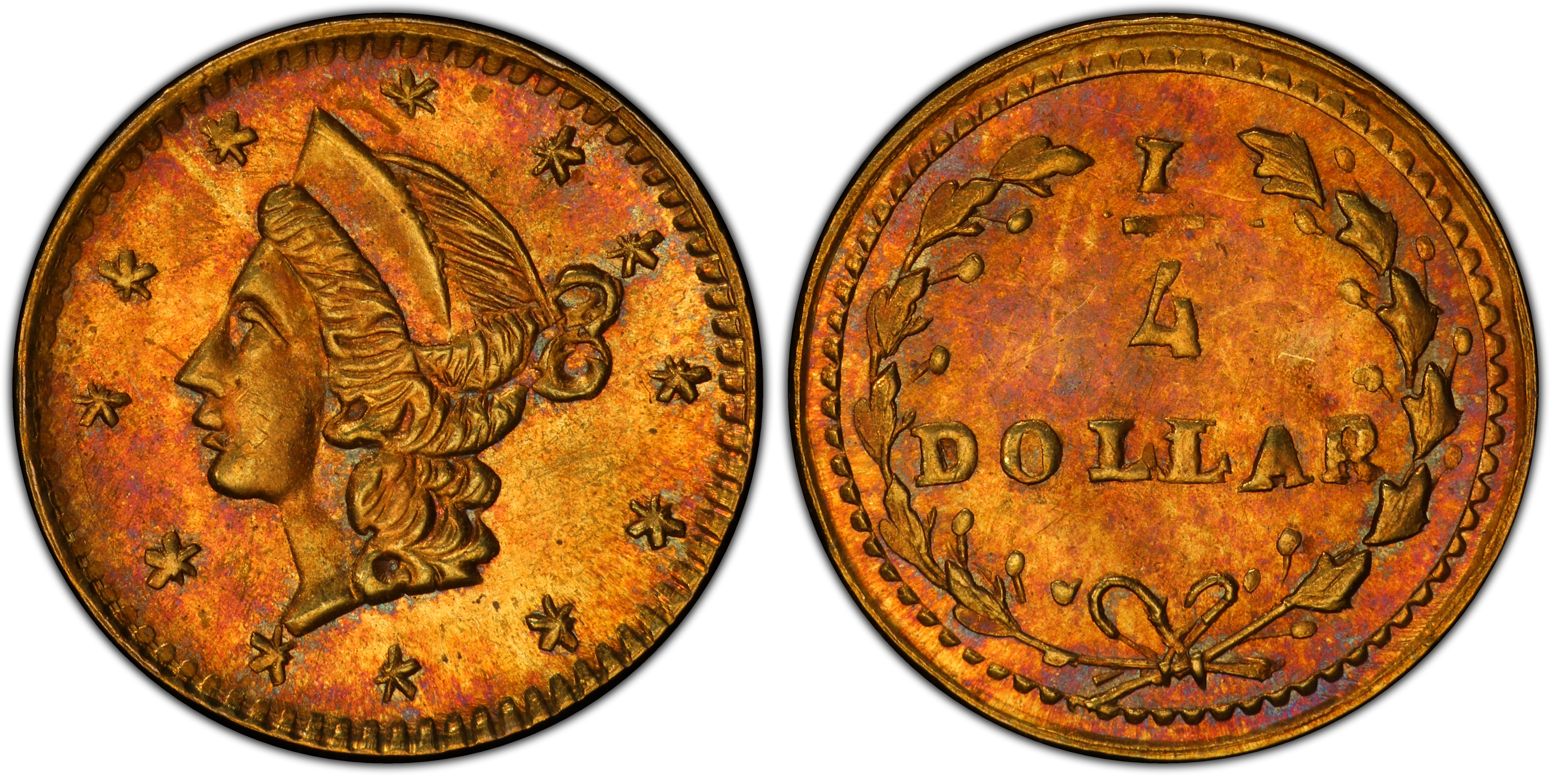
Obverse & Reverse
The 'No Date' Indian Head 25 Cents, cataloged as Breen-Gillio 203 (BG-203), represents the final chapter in the fascinating story of California Fractional Gold. These small-denomination gold pieces arose from a critical need for circulating coinage in the chaotic, gold-rich economy of post-Gold Rush California. Federal coinage was scarce on the West Coast, and the daily flood of gold dust was impractical for small transactions. Jewelers and metalworkers began striking their own quarter dollar, half dollar, and dollar coins in the early 1850s to facilitate commerce. This initial 'Period One' (1852-1857) saw the creation of genuine, circulating currency. However, the U.S. Mint's establishment in San Francisco in 1854 and subsequent federal laws in 1864 banning private coinage dramatically altered the landscape. From the mid-1860s onward, the production of 'California Gold' shifted from a utilitarian to a souvenir-driven purpose. The BG-203 is a classic example of these 'Period Two' issues, struck from the early 1870s until 1882. They were no longer intended to satisfy a monetary need but were marketed as keepsakes, charms, and mementos of the Golden State for tourists and locals alike. These later pieces were often mass-produced with less concern for intrinsic value and more for novelty. The 'No Date' feature itself is characteristic of this period, a deliberate omission to avoid any conflict with federal laws regarding the dating of private issues and perhaps to give the pieces a timeless, generic 'Gold Rush' feel. The dies for BG-203 are believed to have been engraved by the celebrated George Ferdinand Albrecht, a prominent San Francisco die-sinker, and struck by firms like Robert B. Gray & Co., prolific manufacturers of such souvenir gold pieces. Their existence speaks to a nostalgic commercialization of the Gold Rush era, transforming a practical monetary solution into a collectible artifact long after the initial need had vanished.
Associated EventPost-Gold Rush California Commerce and Tourism
Reason For MintingPrimarily created as souvenirs and keepsakes for the tourist trade, capitalizing on the nostalgia of the California Gold Rush.
Minter HistoryWhile the specific minter is unconfirmed, evidence strongly points to jewelers and manufacturers in San Francisco who specialized in souvenir items. Robert B. Gray & Co. is a leading candidate, having been a major producer of small gold tokens and charms during this period. These 'minters' were not assayers in the traditional sense like their Period One predecessors but were businesses capitalizing on a market for gold novelties. They operated in a legal gray area, carefully designing the pieces to be perceived as tokens or charms rather than illegal private currency.
Historical SignificanceThe BG-203 is significant not as a circulating coin but as a tangible artifact of how the California Gold Rush was memorialized and commercialized. It represents the transition of California Fractional Gold from essential currency to a nostalgic souvenir, marking the end of a unique chapter in American numismatic history. Its widespread availability and common use in jewelry demonstrate the popular romanticism of the Gold Rush era in the late 19th century.
N/A
Denomination25 Cents
Minting Period1872-1882
Assayer/MinterUnknown San Francisco Jeweler (Possibly Robert B. Gray & Co.)
Geographic OriginSan Francisco, California
Obverse DescriptionA stylized head of a Native American (Indian Head) facing left. The portrait is somewhat crude, with thirteen stars surrounding the periphery. There is no date on this variety.
Obverse Inscription[No Inscription]
Reverse DescriptionThe denomination '1/4' is enclosed within a simple wreath composed of two branches tied with a bow at the bottom. The legend 'CALIFORNIA GOLD' is inscribed above the wreath, arching along the upper rim. On some examples, a small 'G' (for the engraver, Albrecht) can be seen below the bow, though it is often weak or absent.
Reverse InscriptionCALIFORNIA GOLD 1/4
CompositionGold
Stated Fineness Actual FinenessVaries, often between .500 and .750 (12k to 18k gold), significantly lower than federal coinage.
Weight0.09 grams
Diameter8.70 mm
EdgePlain
Several thousand; considered very common for the series.
Survival Estimate1,500 - 2,500
Rarity ScaleR-2
The BG-203 is a very popular entry point into the complex series of California Fractional Gold. Its affordability, classic 'Indian Head' design, and status as a genuine 19th-century gold piece make it highly appealing to new collectors and those on a budget. It serves as a perfect representative of the souvenir or 'Period Two' issues.
Key VarietiesThe primary issue is the regular business strike. There are no known major die varieties from the original minting period, nor are there any special collector restrikes or patterns associated with BG-203. However, minor die states and variations in strike quality are common. Collectors should be aware that many examples were mounted as jewelry, and evidence of this (solder, rim damage) constitutes a distinct category of damaged but historically interesting pieces.
Authentication TipsAuthentic BG-203 coins often exhibit a slightly soft or 'mushy' strike, particularly on the stars and the details of the wreath. The lettering can be crude. Look for known die markers, such as specific positions of letters relative to the wreath. Counterfeits are common but often get the style wrong; they may be too sharply detailed, have incorrect lettering fonts, or be made of gold-plated base metal (check weight and specific gravity carefully). The fabric of the planchet should appear consistent with 19th-century production, not modern and sterile.
Shopping ConsiderationsA premium quality example for its grade will show a relatively sharp strike for the issue, especially on the central Indian portrait and the '1/4' on the reverse. Seek out pieces with smooth, lustrous surfaces that are free of the distracting marks, scratches, and rim bumps that are common on these soft gold coins. Many surviving examples have been cleaned or polished; a coin with original 'skin' and a gentle, mellowed gold color is far more desirable and commands a significant premium. Carefully check the rims and edges under magnification for any evidence of removal from jewelry, which is the most common and value-impairing problem for this type.
A coin's grade is its condition, rated on a 1-70 scale. For rare coins, this is the most critical factor in determining value, as a tiny difference in preservation can mean a huge difference in price.
Relevant Grade TypesOriginal period issues of BG-203 were business strikes. While not intended for long-term circulation in the traditional sense, they were sold and handled, so they are found in both Circulated (1-58) and Mint State (MS, 60-70) grades. No true Proof (PR/PF) examples were struck during the original period of issue, and no later-date Proof restrikes are known to exist for this specific variety. Any piece described as a 'Proof' is likely a high-quality, proof-like Mint State specimen or is misattributed.
Mint State CharacteristicsAn uncirculated BG-203 typically exhibits a soft, satiny luster rather than a deeply proof-like or frosty one. The strike is almost always somewhat weak in the peripheral areas, such as the tips of the stars and the ends of the wreath leaves. Planchet quality can be mediocre, with minor striations or adjustment marks sometimes visible. Bag marks are common due to the softness of the low-karat gold. A truly choice MS example is one that combines a better-than-average strike with clean surfaces and pleasing luster.
Circulated Wear PatternsWear first appears on the high points of the design: the cheek and feathers of the Indian Head on the obverse, and the numerals '1/4' and the bow of the wreath on the reverse. On moderately circulated examples (VF-XF), the finer details of the hair and feathers will merge. In lower grades (F and below), the stars will become faint and the wreath will appear flat, with the legends remaining legible until the lowest grades.
Key Factors For ValueThe primary drivers of value for a BG-203 are grade and surface preservation. An example with minimal marks, original luster, and no evidence of having been cleaned or used in jewelry will command a strong premium. Strike sharpness is a key differentiator; a well-struck piece with full central details is highly desirable. Eye appeal is crucial; coins with a pleasant, original reddish-gold or yellow-gold hue are preferred over those that are harshly cleaned, spotted, or discolored. Third-party certification by PCGS or NGC is standard for this series, and a sticker from CAC (Certified Acceptance Corporation) indicates premium quality for the grade and adds significant value.
PCGS Price Guide
| Grade | Price | Population |
|---|---|---|
| 53 | N/A | 1 |
| 55 | $700.00 | 2 |
| 55+ | $725.00 | N/A |
| 58 | $800.00 | 2 |
| 58+ | $850.00 | N/A |
| 60 | $900.00 | N/A |
| 61 | $1,050.00 | 4 |
| 62 | $1,750.00 | 9 |
| 62+ | $2,100.00 | N/A |
| 63 | $2,750.00 | 8 |
| 63+ | $3,250.00 | N/A |
| 64 | $4,500.00 | 2 |
| 64+ | $5,000.00 | N/A |
| 65 | $6,500.00 | 1 |