1880 25C BG-799W, PL (Regular Strike)
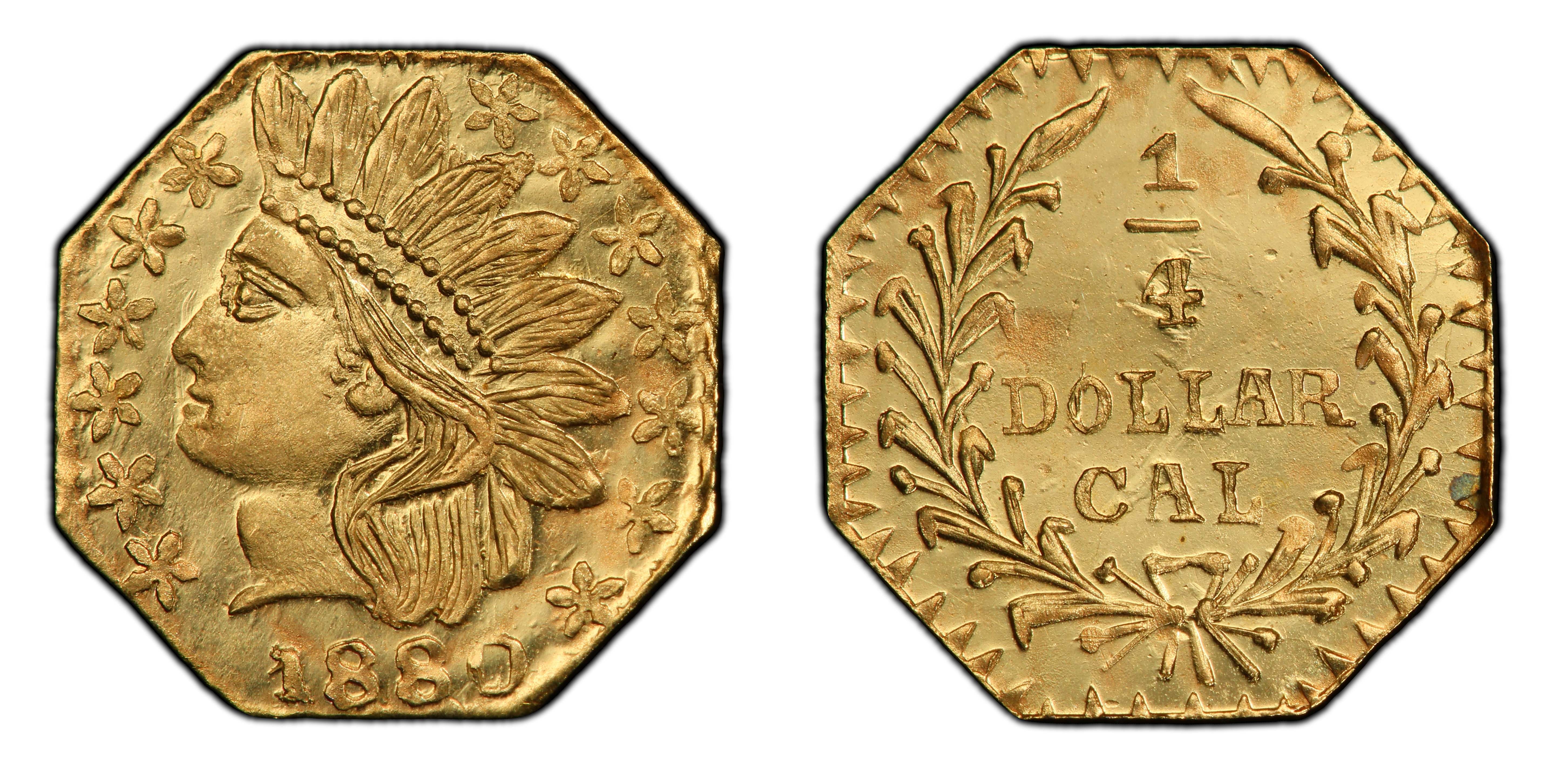
Obverse & Reverse
The 1880 BG-799W 25 Cents is a quintessential example of a 'Period Two' California Fractional Gold piece. By 1880, the chaotic, desperate need for small denomination coinage that defined the 1850s Gold Rush had long subsided. The San Francisco Mint, operating since 1854, was in full production, supplying the West Coast with ample federal silver and gold coins for commerce. The continued production of these minuscule gold pieces had thus shifted from a commercial necessity to a cottage industry catering to a different market: tourists, merchants, and collectors. These later issues, often termed 'jeweler's pieces,' were manufactured by various San Francisco jewelers and artisans who recognized the romantic appeal of Gold Rush history. They were sold as souvenirs, keepsakes, and novelty items, tangible mementos of the region's famous mineral wealth. Unlike their 'Period One' predecessors, which were struck with the serious intent of filling a void in circulation and often contained gold value close to their denomination, Period Two pieces were typically underweight and struck with a more commercial, less utilitarian, eye. The U.S. Secret Service viewed these later private issues with suspicion, seeing them as potential violations of federal anti-counterfeiting laws and the government's sole prerogative to coin money. An investigation led by Chief James J. Brooks in the early 1880s resulted in a crackdown, with agents seizing pieces from jewelers who sold them as money. This federal pressure effectively ended the era of denominated fractional gold production by 1883, forcing subsequent makers to issue their souvenirs as un-denominated 'tokens' or 'charms'. The BG-799W, therefore, represents one of the final expressions of this unique numismatic tradition, produced just before federal enforcement closed the chapter on privately issued, denominated gold coinage in California.
Associated EventPost-Gold Rush California Tourism & Commerce
Reason For MintingPrimarily struck as souvenirs and jewelry items for the tourist trade, capitalizing on the romanticism of the California Gold Rush.
Minter HistoryThe specific minter for the BG-799W variety is not definitively known, which is common for many 'Period Two' issues. Production was often carried out by various jewelers in San Francisco who used shared or similar design punches. Firms known to be active during this period include Robert B. Gray & Co. and the California Jewelry Co. (Levison Brothers), among others. These artisans were skilled metalworkers who also produced jewelry and watches, and the striking of these small gold pieces was a natural extension of their business, meeting a steady demand for gold novelties.
Historical SignificanceThe BG-799W is historically significant as it represents the twilight of denominated private coinage in the United States. It is a product of an era transitioning from frontier necessity to commercial nostalgia, embodying the enduring legacy of the Gold Rush in California's identity and its appeal to the broader American public. Its high rarity today underscores the limited, localized production and the effects of the eventual Secret Service crackdown on these 'jeweler's issues'.
N/A
Denomination25 Cents
Minting Period1880
Assayer/MinterUnknown San Francisco Jeweler
Geographic OriginSan Francisco, California
Obverse DescriptionThe obverse features a stylized head of an American Indian facing left, wearing a feathered headdress. The portrait is somewhat crude, typical of the jeweler's issues of the period. Thirteen stars encircle the portrait along the octagonal border.
Obverse Inscription[None]
Reverse DescriptionThe reverse design is dominated by a wreath composed of two branches tied together at the bottom with a bow. Within the wreath, the denomination is expressed on two lines, with the fraction '1/4' above the word 'DOL.' The date, 1880, is positioned below the bow at the bottom of the coin.
Reverse Inscription1/4 DOL. 1880
CompositionGold
Stated Fineness Actual FinenessVariable, but often in the range of 14 to 22 karats for Period Two issues.
EdgePlain
Unknown, but extremely small.
Survival Estimate13-30 coins known.
Rarity ScaleHigh R-6
This coin is highly sought after due to its extreme rarity (High R-6), attractive octagonal Indian Head design, and its status as a late-date 'Period Two' issue. The availability of Prooflike (PL) examples with mirrored surfaces adds significant appeal for collectors who prize superb eye appeal.
Key VarietiesThe primary variety is the regular business strike. A significant and highly desirable subset of the surviving population consists of Prooflike (PL) specimens, which were struck from highly polished dies. These are not true Proofs but are business strikes with special surface characteristics. No later-date restrikes or patterns are known for this specific BG variety.
Authentication TipsGenuine examples of BG-799W will be extremely thin and lightweight. Replicas are often thicker, heavier, and have a soapy or cast-like appearance. The strike on genuine pieces can be uneven, but the details should be relatively sharp, not mushy. Crucially, authentic pieces must carry a denomination ('1/4 DOL.'); souvenir tokens that feature a bear or lack a denomination are not genuine period coinage. All known genuine examples have a plain edge. Any piece exhibiting a reeded edge is a fantasy item or replica.
Shopping ConsiderationsFor a potential buyer, a premium quality example is defined by several factors beyond the numerical grade. For a Prooflike (PL) designated coin, look for deep, uninterrupted flash and reflectivity in the fields. A 'premium quality' PL coin will exhibit a strong cameo contrast between the mirrored fields and any frosted devices. The strike is critical; many fractionals are weakly struck, so examples with sharp details on the high points of the Indian's headdress and the lettering are desirable. Surface preservation is paramount: due to the soft nature of gold, these tiny coins are susceptible to hairlines and contact marks, which will be very apparent on a mirrored surface. Seek out examples with clean, flashy surfaces and original, attractive orange-gold toning. Avoid pieces that have been cleaned, as this will destroy the delicate original surfaces and significantly impair value.
A coin's grade is its condition, rated on a 1-70 scale. For rare coins, this is the most critical factor in determining value, as a tiny difference in preservation can mean a huge difference in price.
Relevant Grade TypesOriginal period issues were business strikes intended for sale as souvenirs, not circulation, and are thus typically found in Mint State (MS, 60-70) grades. Circulated examples (1-58) are rare, as these were not generally used in daily commerce. No true Proof (PR/PF) examples were struck during the original period of issue. However, a portion of the mintage was struck using highly polished dies, resulting in Prooflike (PL) business strikes, which are a distinct and highly prized category for collectors. These are not a different type of coin, but rather business strikes with special surface qualities.
Mint State CharacteristicsUncirculated examples of BG-799W are characterized by their strike and surface quality. The strike is often uneven, with some softness on the stars or parts of the wreath being common. High-grade specimens, especially those designated Prooflike (PL), exhibit 'super flashy mirrored surfaces that are coated with orange-gold luster.' Luster on non-PL coins is typically satiny. Due to their small size and handling as novelties, even high-grade uncirculated coins can show minor die polish lines or tiny planchet flaws, which are characteristic of the crude manufacturing process.
Circulated Wear PatternsAlthough most examples are uncirculated, any wear would first appear on the highest points of the design. On the obverse, this would be the cheek of the Indian and the feathers of the headdress. On the reverse, the high points of the wreath's leaves and the numerical fraction '1/4' would show the first signs of friction. In lower grades, the stars and legends would begin to lose their sharpness.
Key Factors For ValueFor the BG-799W, value is driven primarily by three factors: rarity, grade, and surface quality. Being a High R-6 variety, any example is valuable. The numerical grade is the next critical component, with each point increase in the Mint State range bringing a substantial price jump. The most significant value multiplier is the Prooflike (PL) designation; a PL example will command a massive premium over a standard MS coin of the same grade. Eye appeal is paramount; coins with deep, clean mirrors and attractive original toning are prized. A CAC sticker on a certified example provides further validation of quality for the grade and will add another significant premium.
PCGS Price Guide
| Grade | Price | Population |
|---|---|---|
| 64 | $1,250.00 | N/A |
| 64+ | $1,650.00 | N/A |
| 65 | $2,500.00 | 1 |
| 66 | N/A | N/A |