1875 G25C BG-783 (Regular Strike)
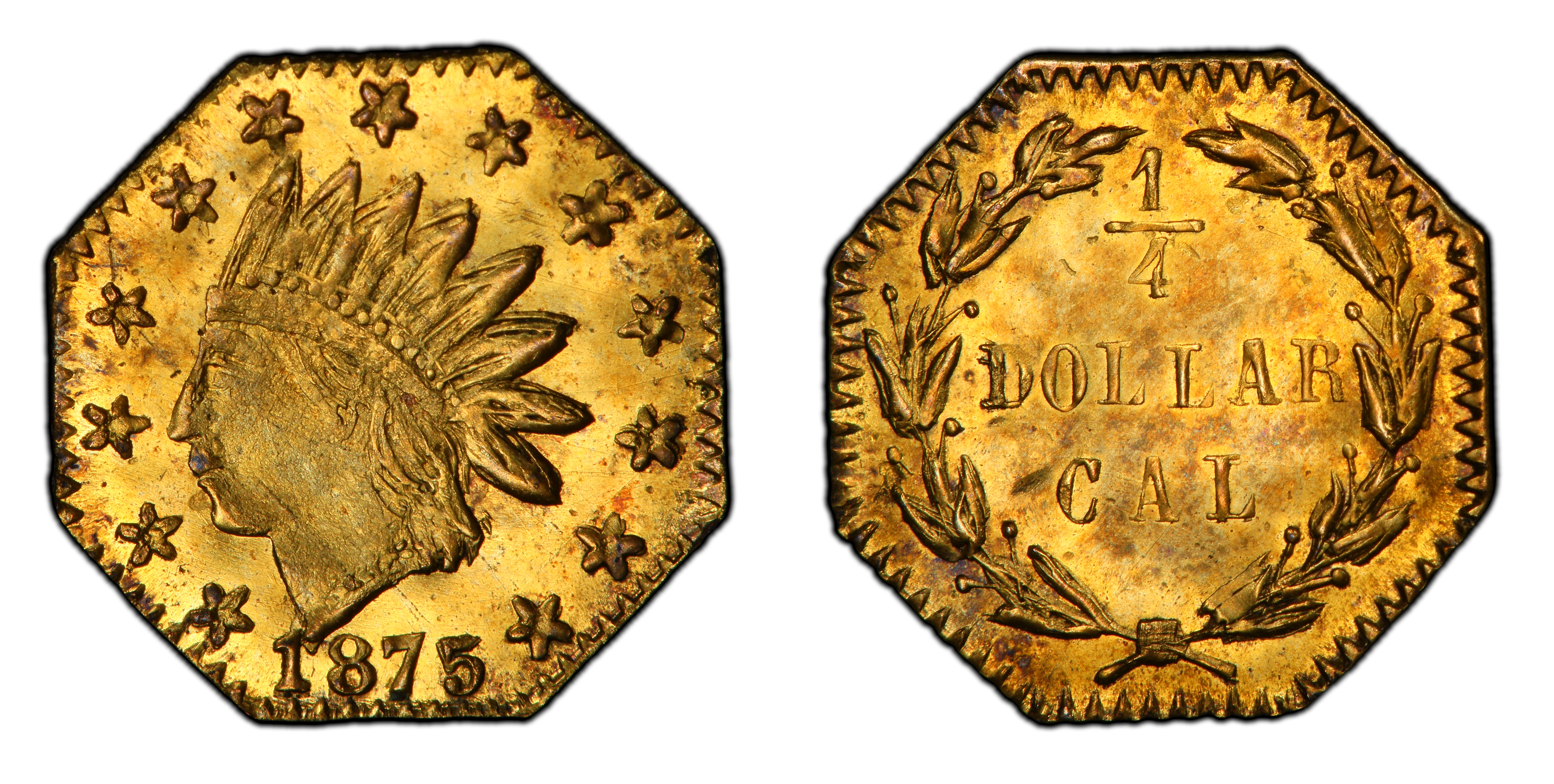
Obverse & Reverse
The 1875 G25C BG-783 is a product of the second period (1859-1882) of California Fractional Gold production, a fascinating chapter in American numismatics. Unlike the earlier 'Period One' pieces (1852-1856), which were struck to alleviate a severe shortage of small change during the initial chaos of the Gold Rush, the Period Two issues were created in a different economic climate. By the 1870s, the San Francisco Mint was in full operation, and the acute need for private coinage had subsided. Instead, these minuscule gold pieces were manufactured by jewelers primarily as souvenirs, keepsakes, and novelty items for tourists and locals nostalgic for the Gold Rush era. This variety was struck by Christopher Ferdinand Mohrig, a prominent San Francisco jeweler who was a prolific producer of these tokens. His work is characterized by a distinctive 'Large Indian Head' motif, which he used on several dies between 1872 and his arrest in 1876. The socio-economic context of the 1870s in San Francisco was one of maturation and growing pains; the city was a bustling metropolis, but the fever of the initial gold strikes had passed. The continued production of fractional gold was a testament to the enduring romance of the Gold Rush and the entrepreneurial spirit of jewelers like Mohrig who catered to this market. However, their activities operated in a legal gray area. The Coinage Act of 1864 had made private coinage illegal, but the law was not strictly enforced against these small, low-value pieces until the mid-1870s. In August 1876, Secret Service agents, concerned about potential for fraud, arrested Mohrig, confiscating and destroying his dies and inventory. This event abruptly ended his production and is a primary reason for the scarcity of his later-dated issues. The BG-783, dated just a year before this crackdown, is a tangible artifact from the final years of this uniquely Californian industry, representing the transition of fractional gold from a circulating necessity to a nostalgic commodity on the edge of legality.
Associated EventPost-Gold Rush California Commerce
Reason For MintingPrimarily created as a souvenir and novelty item for the tourist trade, not for general circulation.
Minter HistoryChristopher Ferdinand Mohrig was a German-born jeweler and engraver who operated a shop in San Francisco. He became one of the most significant and artistic producers of 'Period Two' California Fractional Gold. His pieces are noted for their consistent style, particularly the 'Large Indian Head' design used on varieties from 1872 to 1876, including the BG-783. Mohrig's career as a private minter was cut short on August 10, 1876, when he was arrested for violating the Private Coinage Act of 1864. His equipment and remaining coins were seized by the Secret Service, contributing to the rarity of many of his issues.
Historical SignificanceThe coin is significant as a representative of the 'souvenir' phase of fractional gold production, made when these pieces were no longer a commercial necessity. Its issuance by Ferdinand Mohrig and its date just prior to his arrest place it at the very end of this numismatic era, making it a historical bookend to the private minting period in California.
N/A
Denomination25 Cents
Minting Period1875
Assayer/MinterChristopher Ferdinand Mohrig
Geographic OriginSan Francisco, California
Obverse DescriptionAn octagonal planchet featuring a large, stylized head of a Native American facing left. The portrait wears a feathered headdress, and the 13 stars of the Union encircle the bust along the angled periphery. The date '1875' is positioned below the bust.
Obverse Inscription1875
Reverse DescriptionThe denomination '1/4 DOLLAR' is inscribed within a wreath composed of two branches tied together at the bottom with a bow. The wreath is open at the top.
Reverse Inscription1/4 DOLLAR
CompositionGold
Stated Fineness Actual FinenessTypically varied from 14 to 22 karats for jeweler's issues of this period.
Weight0.25 grams
Diameter9.80 mm
EdgePlain
Unknown; very small
Survival EstimateFewer than 20 known
Rarity ScaleR-6 (Very Rare)
The BG-783 is highly sought after due to its connection to a known and artistic minter (Mohrig), its status as a late-date issue just before the government crackdown, and its overall scarcity. The octagonal shape and classic Indian Head design add to its collector appeal.
Key VarietiesThe primary variety is the Regular Strike business issue. No proof strikings or major die varieties from the period of issue are known or cataloged for BG-783 specifically. As a 'Period Two' issue, it is itself considered a special collector's piece and should not be confused with earlier circulating 'Period One' coinage or modern replicas.
Authentication TipsAuthentic examples have a characteristic strike that is often uneven, with some softness in the high points of the hair, yet sharp details on the stars and date. The surfaces should exhibit a soft, satiny luster, sometimes with prooflike fields. Be wary of pieces with a modern, brilliant finish, incorrect weight, or a 'soapy' appearance often seen on casts. A key diagnostic is the precise positioning and font of the date and reverse lettering, which should be compared against known genuine examples. Modern replicas are common and often made of brass or low-karat gold-plate; genuine pieces will have the density and color of solid gold.
Shopping ConsiderationsA premium quality example for its grade will display a relatively sharp strike for the issue, with strong details on the headdress feathers and reverse wreath. Original, undisturbed surfaces are paramount; many of these tiny coins have been cleaned, polished, or used in jewelry. Look for examples with attractive, reddish-gold or deep yellow-gold toning. Avoid pieces with scratches, rim bumps, or signs of tooling in the fields. Given the typically uneven strikes, a coin that is well-centered and fully struck on both the date and denomination commands a significant premium.
A coin's grade is its condition, rated on a 1-70 scale. For rare coins, this is the most critical factor in determining value, as a tiny difference in preservation can mean a huge difference in price.
Relevant Grade TypesOriginal period issues were business strikes intended for sale as souvenirs, not circulation. They are found in both Circulated (AU-58 and below, from handling) and Mint State (MS, 60-70) grades. No true Proofs were struck in 1875. The term 'Prooflike' (PL) is often used to describe examples with mirror-like fields, which resulted from polished dies, but these are still considered business strikes.
Mint State CharacteristicsUncirculated examples of BG-783 typically feature a soft, satiny luster, though some possess reflective, prooflike fields. The strike is often somewhat weak on the high points of the Indian's hair and cheek. Conversely, the stars and date are usually sharp. Small, inherent planchet flaws or adjustment marks are not uncommon and should be distinguished from post-striking damage. Contact marks, even small ones, can be distracting on such a tiny coin and will significantly impact the grade.
Circulated Wear PatternsWear first appears on the highest points of the design: the cheek and the feathers in the headdress on the obverse. On the reverse, the leaves and the bow of the wreath will show the first signs of friction. In lower grades (VF and below), the date and stars will begin to lose their sharpness, and the fine details within the wreath will merge.
Key Factors For ValueFor the BG-783, the most important value factors are surface preservation and strike quality. An example with original, uncleaned surfaces and minimal marks will always be prized. A sharp, well-centered strike that brings up the details of the Indian's hair and the reverse wreath is highly desirable and commands a substantial premium. Eye appeal, driven by attractive original color and lustrous surfaces, is critical. A CAC sticker for this issue confirms premium quality for the grade and often results in a higher market value.
PCGS Price Guide
| Grade | Price | Population |
|---|---|---|
| 53 | $300.00 | 1 |
| 53+ | $315.00 | N/A |
| 55 | $340.00 | 2 |
| 55+ | $360.00 | N/A |
| 58 | $385.00 | N/A |
| 58+ | $415.00 | N/A |
| 60 | $450.00 | N/A |
| 61 | $475.00 | 3 |
| 62 | $500.00 | 11 |
| 62+ | $525.00 | N/A |
| 63 | $575.00 | 10 |
| 63+ | $650.00 | N/A |
| 64 | $775.00 | 8 |
| 64+ | $1,325.00 | N/A |
| 65 | $3,500.00 | 3 |