1868 G25C BG-744 (Regular Strike)
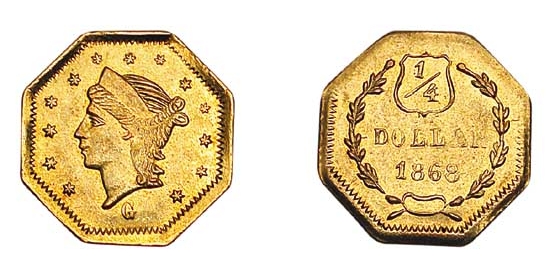
Obverse & Reverse
The 1868 BG-744 25 Cents is a quintessential example of a 'Period Two' California Fractional Gold piece. The series itself was born from the chaotic, commerce-starved environment of the California Gold Rush. Following the discovery of gold in 1848, a massive influx of population created an acute shortage of small denomination coinage for daily transactions. Initially, gold dust, pinches of gold, and foreign coins served as makeshift currency, but this proved impractical and unreliable. To fill this void, private minters, primarily jewelers in San Francisco with the requisite skills in working with precious metals, began striking their own small-denomination gold coins in 1852. These 'Period One' (1852-1857) issues were generally of good weight and intended to circulate to alleviate the coin shortage. However, by the time the 1868 BG-744 was produced, the context had shifted significantly. The San Francisco Mint, opened in 1854, was producing ample federal coinage, effectively ending the necessity for private fractional gold to circulate as money. Consequently, 'Period Two' pieces (1859-1882) were largely created to serve the burgeoning souvenir and tourist trade. Jewelers recognized a market in selling these charming, miniature gold coins as mementos of the Gold Rush. These pieces were often intentionally underweight and not expected to pass as legal tender, functioning more as tokens or keepsakes. The Coinage Act of 1864 made private coinage illegal, but it was not strictly enforced against these small souvenir pieces until 1883, allowing their production to flourish through the 1860s and 1870s. The BG-744, with its classic Liberty Head design reminiscent of federal coinage but octagonal shape, perfectly fits this historical niche—a tangible link to the romanticism of the Gold Rush, produced for a public eager to own a piece of that legacy.
Associated EventCalifornia Gold Rush Aftermath
Reason For MintingPrimarily struck to be sold as souvenirs and keepsakes to tourists and collectors, rather than to alleviate a coinage shortage.
Minter HistoryThe specific minter for BG-744 is unknown, which is typical for most Period Two California Fractional Gold. The pieces from this era were largely produced by a competitive community of San Francisco jewelers. Many were of French origin, leading to the collective term 'jeweler's issues.' They operated without identifying mint marks, likely to maintain a level of anonymity and avoid potential scrutiny from federal authorities. Their business was in crafting attractive, gold-based novelties for a public fascinated with the Gold Rush, not in establishing a reputation as assayers or official minters.
Historical SignificanceThe BG-744 and its Period Two counterparts represent the commercial evolution of the Gold Rush legacy. While not coins of necessity like their Period One predecessors, they are important numismatic artifacts that demonstrate how the romance of the Gold Rush was packaged and sold. They are a direct product of San Francisco's developing economy, where tourism and novelty goods became a significant industry. The vast number of varieties from this period speaks to a competitive market and a high public demand for these miniature gold souvenirs.
BG-744
Denomination25 Cents
Minting Period1868
Assayer/MinterUnknown, likely various San Francisco jewelers
Geographic OriginSan Francisco, California
Obverse DescriptionA head of Liberty facing left, with 'LIBERTY' inscribed on her coronet. She is surrounded by thirteen stars, representing the original colonies. The design is a miniature homage to the contemporary federal gold coinage designed by Christian Gobrecht.
Obverse InscriptionLIBERTY
Reverse DescriptionThe denomination '25 CENTS' and date '1868' are contained within a beaded circle, which is itself enclosed by a simple wreath. The composition of the wreath can be a key diagnostic for specific BG varieties.
Reverse Inscription25 CENTS 1868
CompositionGold
Stated Fineness Actual FinenessVaries, but generally lower than the .900 standard of federal coinage.
Diameter10.00 mm
EdgePlain
Unknown
Survival EstimateFewer than 30
Rarity ScaleR-8
The BG-744 is highly sought after due to its extreme rarity (R-8). As a Period Two issue, it is part of the extensive and popular California Fractional Gold series. Its octagonal shape and classic Liberty Head design make it a visually appealing representative of the 'jeweler's issue' souvenir coinage that defined the era.
Key VarietiesThe primary catalog for this series is 'California Pioneer Fractional Gold' by Walter Breen and Ronald J. Gillio, hence the 'BG' designation. For BG-744, there are no major varieties from the original minting period, as it is itself a specific die marriage. The broader series of California Fractional Gold contains over 500 distinct BG varieties, creating a vast field for specialists. There are no known official restrikes or patterns associated with BG-744. Collectors must be wary of a plethora of modern replicas and fantasy pieces, often unmarked or with designs not found in the BG catalog, that are passed off as originals.
Authentication TipsAuthentic Period Two pieces are denominated (e.g., '25 CENTS' or '1/4 DOLLAR'). Replicas often lack a denomination or use phrases like 'CAL GOLD CHARM'. The strike on genuine pieces can be crude and uneven, a result of being made with hand-operated screw presses or even by hammer. Look for known die markers and compare against high-resolution images of certified examples. Counterfeits may appear too perfect or have a soapy, cast-like appearance. The specific arrangement and style of the letters and numbers are critical for authenticating the BG-744 die pairing.
Shopping ConsiderationsFor a high-rarity piece like BG-744, any example is a significant find. A 'premium quality' specimen would exhibit a sharp strike, particularly on Liberty's coronet and the digits of the date. Look for original, undisturbed surfaces with some remaining mint luster; these pieces are often found with prooflike or semi-prooflike fields. Many surviving examples have been cleaned, so one with original 'skin' commands a substantial premium. Avoid examples with significant rim bumps, scratches, or evidence of having been mounted in jewelry, a common fate for these souvenir coins. Third-party certification by PCGS or NGC is highly recommended for authentication and liquidity.
A coin's grade is its condition, rated on a 1-70 scale. For rare coins, this is the most critical factor in determining value, as a tiny difference in preservation can mean a huge difference in price.
Relevant Grade TypesOriginal issues of BG-744 were business strikes, although not intended for long-term circulation, and are found in both Circulated (1-58) and Mint State (MS, 60-70) grades. Due to their status as souvenirs, a higher proportion survive in uncirculated condition compared to Period One issues. No true Proofs were struck during the original period of issue. Later-date restrikes or fantasy pieces are not considered part of the original series and are valued differently.
Mint State CharacteristicsUncirculated examples of BG-744 often display reflective, prooflike surfaces from polished dies. The strike can be inconsistent; weakness is common on the stars or the details of the wreath. Luster is typically bright and flashy. Due to the softness of the gold and small size, even high-grade uncirculated examples may show minor ticks and contact marks from handling over the years. The overall eye appeal, combining luster, strike, and surface preservation, is paramount.
Circulated Wear PatternsWear first appears on the highest points of the design. On the obverse, this includes Liberty's cheek, the hair above the eye, and the inscription on the coronet. On the reverse, the highest points of the wreath and the digits of the date will show the first signs of friction. On lower-grade examples, the stars and lettering will begin to merge with the fields.
Key Factors For ValueRarity is the primary driver of value for BG-744. Given its R-8 rating, any certified example is valuable. After that, grade and surface quality are key. An example with sharp details and original, lustrous surfaces will command a significantly higher price than a cleaned or circulated specimen. Coins with attractive prooflike surfaces are particularly prized. Given the prevalence of counterfeits, authentication and grading by a top-tier service like PCGS or NGC is essential for realizing the coin's full market value.
PCGS Price Guide
| Grade | Price | Population |
|---|---|---|
| 60 | $2,000.00 | 2 |
| 61 | $2,350.00 | N/A |
| 62 | $2,750.00 | 1 |
| 64 | N/A | 1 |
| 65 | N/A | N/A |
| 66 | N/A | N/A |