1880 25C BG-799L (Regular Strike)
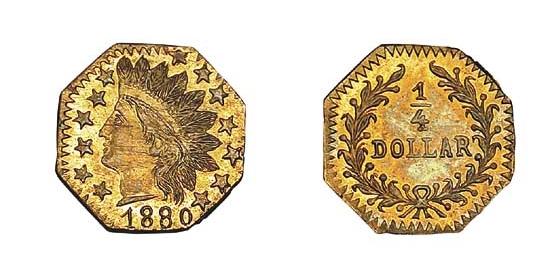
Obverse & Reverse
The 1880 25C BG-799L is a product of the second period of California Fractional Gold production (1859-1882), an era distinct from the initial coinage rush. By 1880, the acute shortage of small denomination currency that plagued California in the early 1850s had largely subsided due to the robust output of the U.S. Mint in San Francisco. The impetus for creating fractional gold thus shifted. No longer essential tools of commerce, these tiny gold pieces evolved into charming souvenirs and jewelry items. San Francisco was transforming from a chaotic boomtown into a major American city and a tourist destination. Jewelers and private minters astutely capitalized on the romanticism of the Gold Rush, producing a wide variety of attractive, and often underweight, gold tokens for sale to visitors and locals as keepsakes. The BG-799L, with its popular Indian Head motif, was a perfect example of this commercial pivot. Unlike the earlier Period One issues that saw heavy circulation, many Period Two pieces like this one were preserved in higher grades, having been purchased as mementos rather than spent. This period also operated in a gray legal area. The Coinage Act of 1864 had prohibited private coinage, but enforcement was lax, especially in the West. This allowed for the continued production of denominated tokens until a federal crackdown in the early 1880s finally halted the practice, forcing the few subsequent makers to backdate their issues (creating the 'Period Three' category). The 1880-dated pieces therefore represent the final, legal sunset years of this uniquely American numismatic chapter.
Associated EventCalifornia Gold Rush Aftermath & Tourism Boom
Reason For MintingPrimarily produced as a commercial souvenir and jewelry item for a growing tourist trade, not to alleviate a widespread coinage shortage.
Minter HistoryThe specific minter of BG-799L is not definitively known, a common trait for 'Period Two' issues. Production was not centralized but rather undertaken by various San Francisco jewelers and artisans. These makers, sometimes identified only by an initial (like the 'L' on some 1871 issues for Levison Brothers) or not at all, would create their own dies and strike small quantities of various designs to sell in their shops. They were entrepreneurs responding to a market demand for affordable gold souvenirs, operating small-scale minting operations within their jewelry businesses.
Historical SignificanceThis coin is significant as a tangible artifact of California's economic transition from a frontier society dependent on private money to a developed state with a tourism-driven economy. It represents the final phase of legal private fractional gold production before federal legislation was more strictly enforced, effectively ending a 30-year tradition of private minting that began in the chaos of the Gold Rush.
N/A
Denomination$0.25 (25 Cents)
Minting Period1880
Assayer/MinterUnknown San Francisco Jeweler
Geographic OriginSan Francisco, California
Obverse DescriptionA portrait of a Native American figure (Indian Head) facing left, wearing a feathered headdress. The portrait is encircled by thirteen six-pointed stars.
Obverse Inscription Reverse DescriptionThe denomination '25 CENTS' is displayed prominently within a decorative wreath of leaves, tied with a bow at the bottom. The date '1880' is positioned below the wreath.
Reverse Inscription25 CENTS 1880
CompositionGold
Stated Fineness Actual Fineness EdgePlain
Unknown
Survival Estimate76-200
Rarity ScaleHigh R-5
The BG-799L is popular with collectors due to its classic Indian Head design, octagonal shape, and its status as a relatively accessible entry point into the fascinating world of California Fractional Gold. It is an essential piece for those assembling type sets or Breen-Gillio variety sets.
Key VarietiesThe primary issue is the business strike. Grading services also recognize special surface characteristics, creating distinct collector categories: 'Prooflike' (PL) and 'Deep Mirror Prooflike' (DMPL). These are not separate strikes but are from early, highly polished die states and carry significant premiums. There are no known major die varieties for the BG-799L designation itself, though the broader series of 1880-dated quarter dollars has numerous distinct BG numbers corresponding to different dies.
Authentication TipsAuthenticity is a major concern. Genuine examples are typically very thin, comparable to a heavy business card. Fakes and modern replicas are often thicker, with a soapy or cast-like texture and may lack the denomination entirely. Look for crisp die work, even if the strike is weak in areas. A weak strike can actually be a sign of authenticity, as many modern fakes are unnaturally sharp and uniform. Professional certification by PCGS or NGC is strongly advised for any potential purchase.
Shopping ConsiderationsA premium quality example will exhibit a bold strike, particularly on the details of the headdress feathers and the wreath leaves. Seek out pieces with bright, original mint luster and minimal distracting contact marks. Because these were often sold as souvenirs, evidence of jewelry mounting (solder, rim damage, holes) is common and should be avoided. The pinnacle of quality for this issue are coins designated PL or DMPL by grading services, which exhibit highly reflective, mirror-like fields and are prized by advanced collectors.
A coin's grade is its condition, rated on a 1-70 scale. For rare coins, this is the most critical factor in determining value, as a tiny difference in preservation can mean a huge difference in price.
Relevant Grade TypesOriginal period issues were business strikes intended for commercial sale as souvenirs, and are found in both Circulated (1-58) and, more commonly, Mint State (MS, 60-70) grades. No true Proof (PR/PF) examples were struck in 1880. However, some business strikes were produced using highly polished dies, creating coins with mirrored surfaces. When these characteristics are pronounced, third-party grading services will add the designation 'Prooflike' (PL) or 'Deep Mirror Prooflike' (DMPL). These are not a different striking method but are highly desirable surface characteristics within the business strike category.
Mint State CharacteristicsIn Mint State, the BG-799L typically displays a soft, satiny luster, though semi-prooflike and prooflike examples are frequently encountered. The strike is a key differentiator; many are softly struck in the centers, so a coin with sharp detail on the Indian's face and the wreath commands a premium. Small, scattered contact marks are common from handling and storage, but a top-tier example will be clean and free of significant abrasions.
Circulated Wear PatternsWear first appears on the highest points of the design: the Indian's cheekbone and the feathers of the headdress on the obverse. On the reverse, the bow and the upper leaves of the wreath will show the first signs of friction. On lower-grade circulated examples, the stars and legends will begin to weaken and merge with the fields.
Key Factors For ValueValue is determined foremost by grade and surface preservation. An uncirculated coin with brilliant, original luster will always be worth more than a circulated or cleaned example. The strike quality is paramount; a sharply struck coin is worth significantly more than a weakly struck one of the same grade. The presence of a PL or DMPL designation from PCGS or NGC can multiply the coin's value. Finally, superior eye appeal—a pleasing, cohesive look without distracting spots or marks—is a critical factor for discerning collectors.
PCGS Price Guide
| Grade | Price | Population |
|---|---|---|
| 63 | $425.00 | 4 |
| 63+ | $500.00 | N/A |
| 64 | $600.00 | 12 |
| 64+ | $725.00 | N/A |
| 65 | $850.00 | 6 |
| 65+ | $1,150.00 | N/A |
| 66 | $3,250.00 | 2 |