1852 25C BG-799U (Regular Strike)
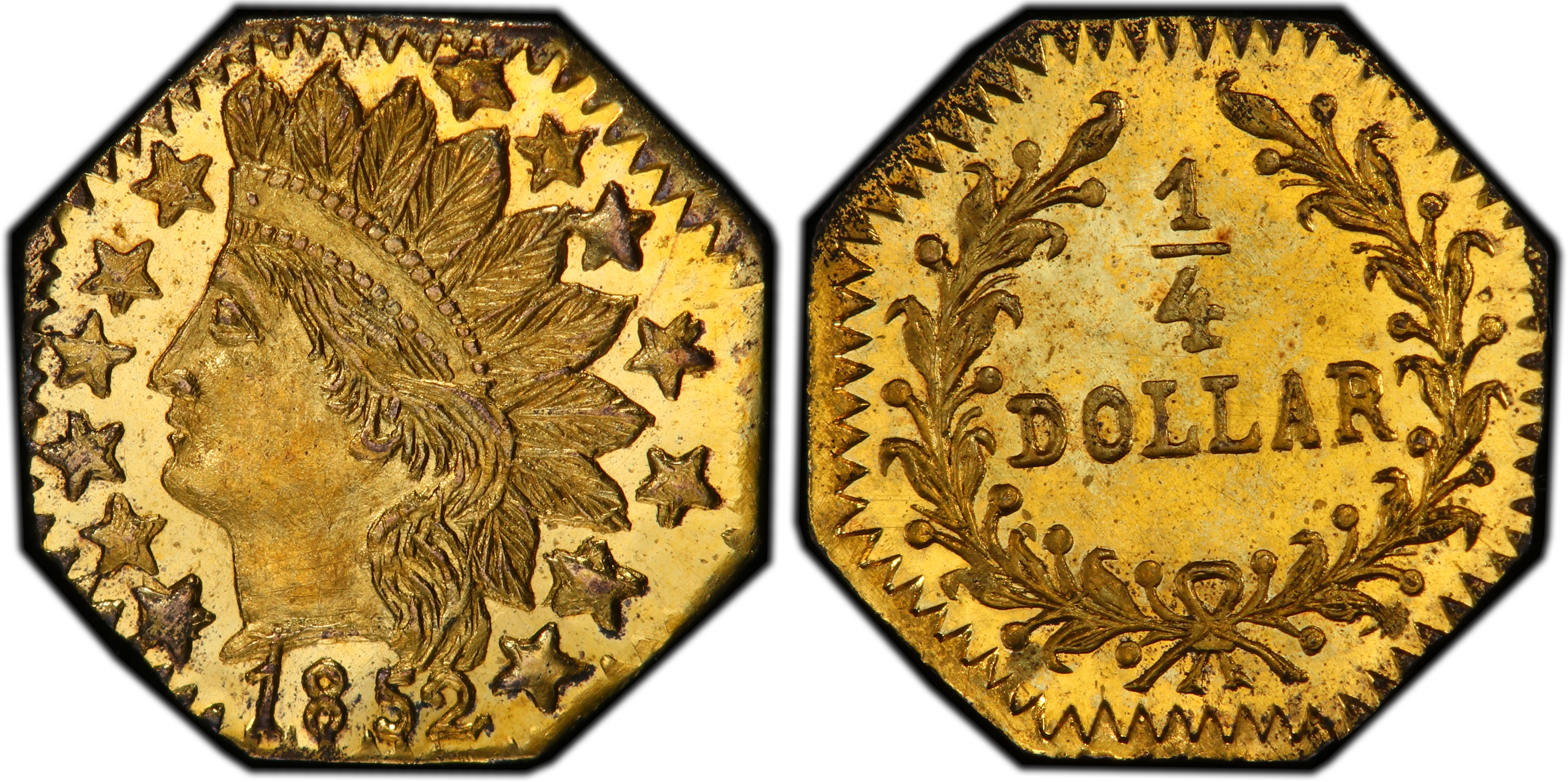
Obverse & Reverse
The 1852 BG-799U octagonal 25-cent piece is a tangible artifact from the chaotic, formative years of the California Gold Rush. Following the discovery of gold at Sutter's Mill in 1848, a massive influx of prospectors and merchants descended upon California, creating a vibrant but haphazard economy. While vast quantities of gold dust and large denomination ingots circulated, the region suffered from a severe, chronic shortage of small denomination coinage for everyday transactions. A pinch of gold dust for a drink or a small purchase was an imprecise and often contentious method of payment. Federal coinage was scarce on the West Coast, and the establishment of the San Francisco Mint was still years away. Into this monetary vacuum stepped numerous private jewelers and metallurgists who began striking their own small-denomination gold coins in 1852. These pieces, today known as California Fractional Gold, were born of pure necessity to facilitate local commerce. The BG-799U belongs to what numismatists classify as 'Period One' (1852-1857), the era when these tiny gold pieces were genuinely intended to and did circulate as currency. Unlike the later 'Period Two' issues, which were often underweight and made primarily as souvenirs, Period One coins had a more legitimate, if unofficial, role in the economy. They were, however, almost immediately controversial; their intrinsic gold value was often less than their face value, and their minuscule size made them easy to lose. Public acceptance was mixed, and banks generally refused them. Despite this, they filled a crucial need for small change. The BG-799U, with its Indian Head motif—a design choice likely meant to evoke a sense of American frontier identity—was produced using hand-cut dies and rudimentary screw or hammer presses, resulting in significant variation in strike quality. The production of these coins was a legally gray area, and most minters remained anonymous to avoid potential prosecution under federal laws that reserved the right of coinage to the U.S. government. The eventual arrival of federal coinage from the new San Francisco Mint in 1854 began the decline of these fractional pieces as circulating money, though they quickly found a new market as popular keepsakes and mementos of the Gold Rush.
Associated EventCalifornia Gold Rush
Reason For MintingTo alleviate a severe shortage of small-denomination circulating coinage for daily commerce in Gold Rush-era California.
Minter HistoryThe minter of BG-799U is unknown, as is typical for most Period One California Fractional Gold issuers. Production was dominated by a community of San Francisco jewelers and metallurgists, many of French or German origin, who had the skills and equipment to create dies and strike coins. They operated small, private workshops and generally avoided placing identifiable marks on their products to circumvent laws against private coinage. These artisans were entrepreneurs filling a critical market niche, creating the tools of commerce that the federal government had not yet provided to the rapidly growing territory.
Historical SignificanceThe BG-799U is a prime example of a necessary, privately-issued currency that sustained a frontier economy in the absence of federal coinage. It represents the ingenuity and ad-hoc capitalism of the Gold Rush and is one of the earliest attempts to solve the region's chronic lack of small change. As a Period One issue, it holds greater historical weight than later souvenir pieces, representing a genuine, albeit unofficial, circulating coin from one of the most dynamic periods in American history.
BG-799U
Denomination25 Cents
Minting Period1852
Assayer/MinterUnknown private minter
Geographic OriginSan Francisco, California
Obverse DescriptionAn Indian Head, facing left, wearing a feathered headdress. The portrait is typically rendered in a somewhat crude but distinct style, surrounded by thirteen stars of varying quality along the octagonal border. The date '1852' is below the bust.
Obverse Inscription1852
Reverse DescriptionA simple wreath composed of two branches tied with a bow at the bottom. Inside the wreath is the denomination '1/4'.
Reverse Inscription1/4
CompositionGold
Stated Fineness Actual FinenessVariable, typically struck from native California gold which contained natural silver alloys, resulting in fineness between .800 and .900.
Weight0.25 grams
Diameter9.50 mm
EdgePlain
Unknown
Survival Estimate31-75 coins known
Rarity ScaleHigh R-5
This coin is highly sought after as a representative of the earliest, functional period of California Fractional Gold. Its octagonal shape, 1852 date (the first year of issue for fractionals), and classic Indian Head design make it a quintessential Gold Rush artifact. Its 'High R-5' rarity ensures it is a significant challenge for specialists to acquire, particularly in high grade.
Key VarietiesThe primary variations for BG-799U are in die state and strike quality due to the primitive manufacturing process. Some specimens may show die cracks, rotated dies, or evidence of die erosion. No formal restrikes or special collector issues are known for this specific die marriage. Collectors should be aware of the broader BG-799 die family, which includes many different varieties with various dates and characteristics made over several decades, but BG-799U is specific to the 1852 date.
Authentication TipsGenuine Period One pieces like BG-799U often exhibit a slightly soft, somewhat crude strike. The surfaces should show the characteristic luster of real gold, often with a slightly greenish or reddish hue from the natural silver and copper alloys. Lettering and stars may be imperfectly formed. Many modern replicas are sharply struck, have a brassy color, and often feature a bear on the reverse, a design never used on genuine 19th-century issues. Authentic pieces will have a denomination (e.g., '1/4'), whereas many fakes and tokens will say 'CALIFORNIA GOLD' or 'CHARM' instead. Due to the high number of counterfeits in this series, third-party authentication by PCGS or NGC is highly recommended.
Shopping ConsiderationsA premium quality example for this issue is defined by a sharp strike, especially on the high points of the Indian's headdress and the details of the wreath. Luster is paramount; many examples are found with prooflike surfaces, which command a premium, but a coin with original, frosty mint luster is also highly desirable. Look for examples free of planchet problems, such as laminations or unstruck areas, which are common. Bending, cleaning, and previous mounting for jewelry are common impairments that drastically reduce value. A superior specimen will have a pleasing, original 'old gold' color and exceptional eye appeal for the assigned grade. Given the tiny size, even minor marks can be distracting, so 'clean' surfaces are a huge plus.
A coin's grade is its condition, rated on a 1-70 scale. For rare coins, this is the most critical factor in determining value, as a tiny difference in preservation can mean a huge difference in price.
Relevant Grade TypesOriginal BG-799U coins were business strikes intended for circulation and are found in Circulated (1-58) and Mint State (MS, 60-70) grades. No proofs were struck during the original minting period. While some specimens exhibit prooflike (PL) or deep mirror prooflike (DMPL) surfaces due to freshly polished dies, these are considered business strikes with special surface characteristics, not true Proof issues. There are no known later-date Proof restrikes associated with the original BG-799U dies.
Mint State CharacteristicsIn Mint State, BG-799U is characterized by its luster, which can range from satiny to deeply prooflike. Strike quality varies significantly; many uncirculated examples are weakly struck in the centers, particularly on the Indian's cheek and the wreath's bow. A well-struck example with full details is rare and desirable. Due to the softness of the gold and rudimentary handling, even high-grade specimens often show small, scattered contact marks or planchet flaws. The color of the native gold can also vary, with some pieces showing a desirable greenish-gold tint.
Circulated Wear PatternsWear first appears on the highest points of the design. On the obverse, this includes the feathers of the headdress, the cheek, and the eyebrow. On the reverse, the high points of the wreath's leaves and the tie of the bow will show the first signs of friction. In lower grades (VF and below), the stars will begin to merge with the border and the date will become weak.
Key Factors For ValueFor the BG-799U, value is driven by a combination of grade and eye appeal. A sharp, well-centered strike is a primary determinant of value, as many are softly struck. Surface quality is critical; an example with minimal contact marks and original, undisturbed luster will command a significant premium over a cleaned or abraded coin of the same grade. Specimens designated as PL or DMPL are highly prized. Finally, a CAC sticker, indicating premium quality for the grade, adds a substantial premium for this and other scarce California Fractional Gold issues.
PCGS Price Guide
| Grade | Price | Population |
|---|---|---|
| 58 | $300.00 | 1 |
| 58+ | $320.00 | N/A |
| 60 | $350.00 | N/A |
| 61 | $375.00 | N/A |
| 62 | $400.00 | 1 |
| 62+ | $500.00 | N/A |
| 63 | $675.00 | 5 |
| 63+ | $750.00 | N/A |
| 64 | $1,175.00 | 12 |
| 64+ | $1,300.00 | N/A |
| 65 | $1,600.00 | 8 |
| 65+ | $2,000.00 | N/A |
| 66 | $2,250.00 | 2 |
| 66+ | $2,500.00 | N/A |
| 67 | $3,000.00 | N/A |