1870 G25C BG-758 (Regular Strike)
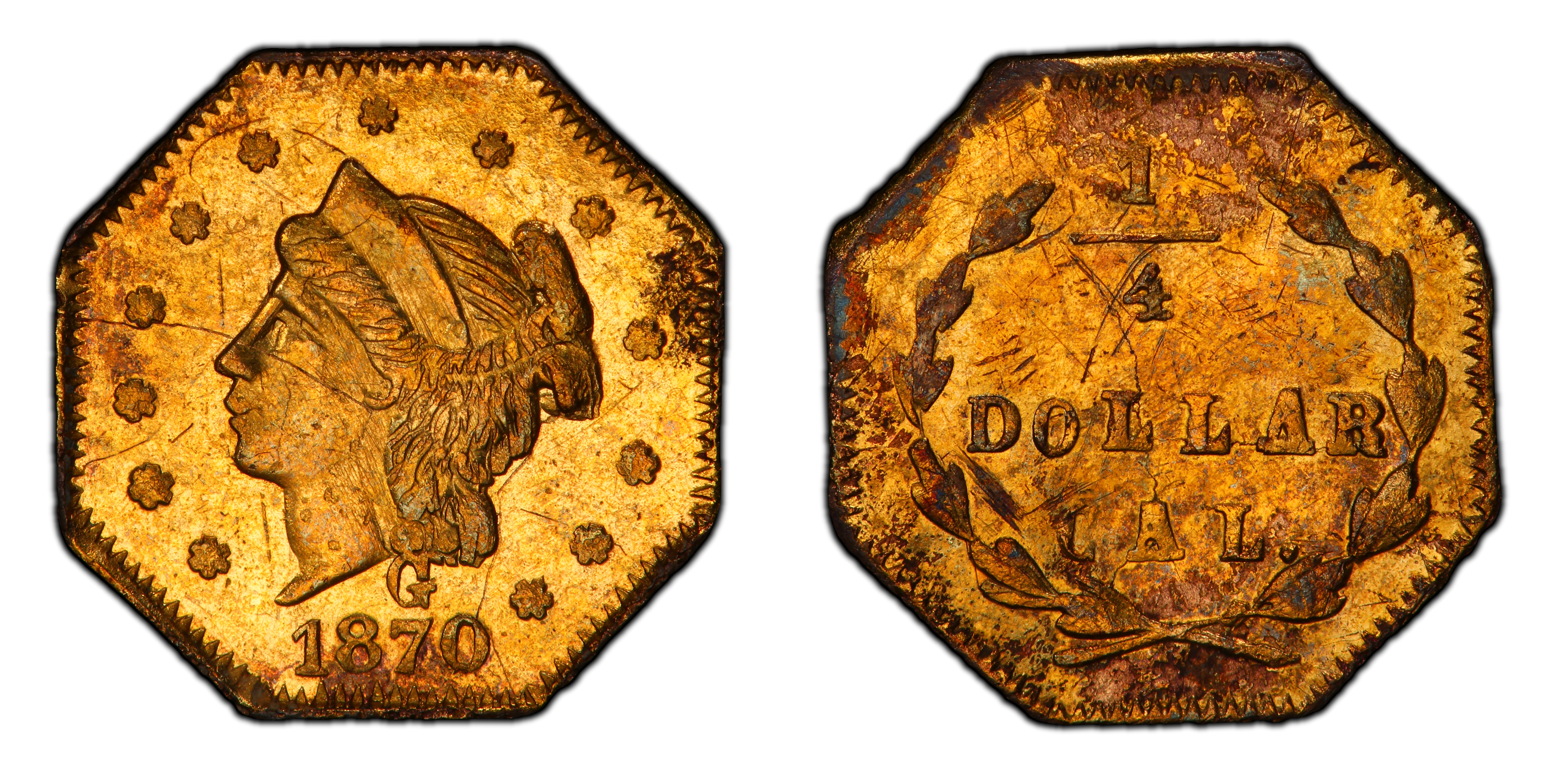
Obverse & Reverse
The 1870 Octagonal Liberty Head 25 Cents, cataloged as Breen-Gillio 758, is a product of the second period (1859-1882) of California Fractional Gold production. Unlike the earlier 'Period One' issues struck out of commercial necessity during the height of the Gold Rush, these later pieces, often termed 'Jeweler's Issues,' catered to a burgeoning market for souvenirs and keepsakes. By 1870, the acute shortage of small denomination coinage in California had been largely resolved by the output of the San Francisco Mint. However, the romance of the Gold Rush and the novelty of privately-minted gold coins sustained a strong demand, particularly from tourists and collectors back East. These tiny, intricate pieces were manufactured by various jewelers and artisans in San Francisco, who often operated in a legal gray area. The Private Coinage Act of 1864 had made such minting illegal, but federal enforcement was lax on the West Coast until the Secret Service finally cracked down in 1883. To circumvent the law, minters of this era often backdated their coins to pre-1864 dates, although this BG-758 variety bears the contemporary 1870 date. The production method was typically crude, using a hammer to strike a planchet between two hand-cut dies, leading to significant variation in strike quality. The gold content of these Period Two issues was intentionally made lower than their face value, ensuring profitability for the minter. The BG-758 is an artifact of this fascinating cottage industry, representing a transition from functional currency to a numismatic collectible, embodying the enduring legacy of the California Gold Rush in American culture.
Associated EventCalifornia Gold Rush Aftermath
Reason For MintingPrimarily created as popular souvenirs and collector pieces during an era of weak enforcement of private coinage laws.
Minter HistoryThe specific minter for the BG-758 die marriage is unrecorded, a common trait for many 'Jeweler's Issues' of California Fractional Gold. Production was decentralized among various San Francisco-based jewelers and artisans who rarely, if ever, applied identifiable mintmarks. These craftsmen were skilled metalworkers who capitalized on the public's fascination with gold and the mystique of the West, creating hundreds of distinct varieties of these miniature gold coins.
Historical SignificanceThe BG-758 is significant as an example of a 'Period Two' California Fractional Gold piece, illustrating the evolution of private coinage from a necessity of commerce to a souvenir and collectible. It represents a chapter of numismatic history where private enterprise continued to produce quasi-monetary items long after the initial frontier conditions had passed, navigating a complex legal landscape. Its extreme rarity underscores the ephemeral nature of many of these private minting operations.
N/A
Denomination25 Cents
Minting Period1870
Assayer/MinterUnknown Private Minter
Geographic OriginSan Francisco, California
Obverse DescriptionAn octagonal planchet featuring a left-facing Liberty Head. The portrait is adorned with a diadem and surrounded by thirteen stars, representing the original colonies.
Obverse InscriptionNo textual inscription; features a Liberty Head portrait and 13 stars.
Reverse DescriptionThe central inscription '1/4 DOLLAR' is enclosed within a wreath of leaves and berries. The date '1870' is positioned below the wreath, and the abbreviation 'CAL.' appears above it.
Reverse Inscription1/4 DOLLAR 1870 CAL.
CompositionGold
Stated Fineness Actual FinenessVariable, but generally between 14 and 22 karats for Period Two issues.
EdgePlain
Extremely low; likely less than a few dozen originally struck.
Survival Estimate2-3 known specimens.
Rarity ScaleR-8
The BG-758 is a classic rarity within the popular California Fractional Gold series. Its appeal is driven by its extreme scarcity (R-8), the distinctive octagonal shape, and the historical allure of the Gold Rush era. As a significant die marriage, it is a target for advanced specialists attempting to complete a comprehensive collection of Breen-Gillio varieties.
Key VarietiesBG-758 is itself a unique and extremely rare die marriage. The obverse die was also used to strike the very scarce BG-757 and the common BG-759, but the reverse die is unique to the BG-758 marriage. No proof restrikes or patterns are known to exist for this specific variety.
Authentication TipsAuthenticity is paramount. Genuine examples exhibit sharp, albeit sometimes uneven, details from a hand-hammered strike. The surfaces may show die polishing lines and a characteristic luster. Counterfeits are rampant in this series and are often cast, showing a soft, porous appearance, incorrect weight, or soapy details. Compare the piece to high-resolution images of certified examples. A key diagnostic for at least one known high-grade specimen is a distinctive striking imperfection in the form of an arc on the reverse. All suspected examples should be authenticated by a top-tier third-party grading service.
Shopping ConsiderationsFor a specimen of this rarity, any opportunity to acquire one is significant. A 'premium quality' example would be one that is well-centered and sharply struck, particularly on the Liberty Head's curls and the numerals of the date. Many Cal Gold pieces are found with prooflike surfaces; auction records note that high-grade examples of BG-758 are deeply prooflike with frosted devices, creating a strong cameo contrast. Given the handmade nature of these coins, minor planchet flaws or strike weaknesses may be inherent and should be evaluated in context. Avoid examples that have been harshly cleaned, exhibit rim damage, or show evidence of being mounted in jewelry, as these issues drastically reduce value and appeal.
A coin's grade is its condition, rated on a 1-70 scale. For rare coins, this is the most critical factor in determining value, as a tiny difference in preservation can mean a huge difference in price.
Relevant Grade TypesOriginal period issues were business strikes intended for souvenir sales and limited circulation, and are found in Circulated (1-58) and Mint State (MS, 60-70) grades. Due to their collectible nature from the outset, a higher proportion survive in uncirculated condition than earlier, more utilitarian issues. There were no Proofs struck during the original minting period, and no later-date Proof restrikes are known for this variety.
Mint State CharacteristicsAn uncirculated BG-758 is defined by its luster. High-grade examples are known to be deeply prooflike or DMPL, with mirror-like fields. Strike quality is a key variable; a sharp strike on the high points of Liberty's hair and the details of the wreath is highly desirable but not always present. The devices may exhibit a frosted texture, creating a cameo effect. Because the gold is soft, even Mint State examples may show minuscule handling marks, but these should be minimal and not detract from the overall eye appeal.
Circulated Wear PatternsWear first appears on the highest points of the design: the hair above Liberty's eye and ear, her cheek, and the high points of the wreath leaves on the reverse. On lower-grade circulated examples, the stars on the obverse will begin to merge with the fields, and the date and 'CAL.' on the reverse will show significant flattening.
Key Factors For ValueFor the BG-758, the primary value driver is its extreme rarity. Beyond that, the grade and surface quality are paramount. A certified Mint State example will command a massive premium over a circulated one. Deeply prooflike surfaces with strong cameo contrast add significant eye appeal and value. Original, uncleaned surfaces with attractive reddish-gold toning are highly prized. Given the stakes, certification by PCGS or NGC is essential, and a CAC sticker would provide further confirmation of premium quality for the assigned grade.
PCGS Price Guide
| Grade | Price | Population |
|---|---|---|
| 45 | $1,850.00 | 1 |
| 45+ | $1,900.00 | N/A |
| 50 | $2,000.00 | 1 |
| 50+ | $2,100.00 | N/A |
| 53 | $2,300.00 | N/A |
| 53+ | $2,350.00 | N/A |
| 55 | $2,500.00 | 1 |
| 55+ | $3,000.00 | N/A |
| 58 | $4,000.00 | N/A |
| 58+ | $4,500.00 | N/A |
| 60 | $5,000.00 | N/A |
| 61 | $5,750.00 | 1 |
| 62 | $6,250.00 | N/A |
| 62+ | $6,750.00 | N/A |
| 63 | $8,500.00 | 1 |
| 63+ | $11,500.00 | N/A |
| 64 | $17,500.00 | 1 |