1874 25C BG-799Q, PL (Regular Strike)
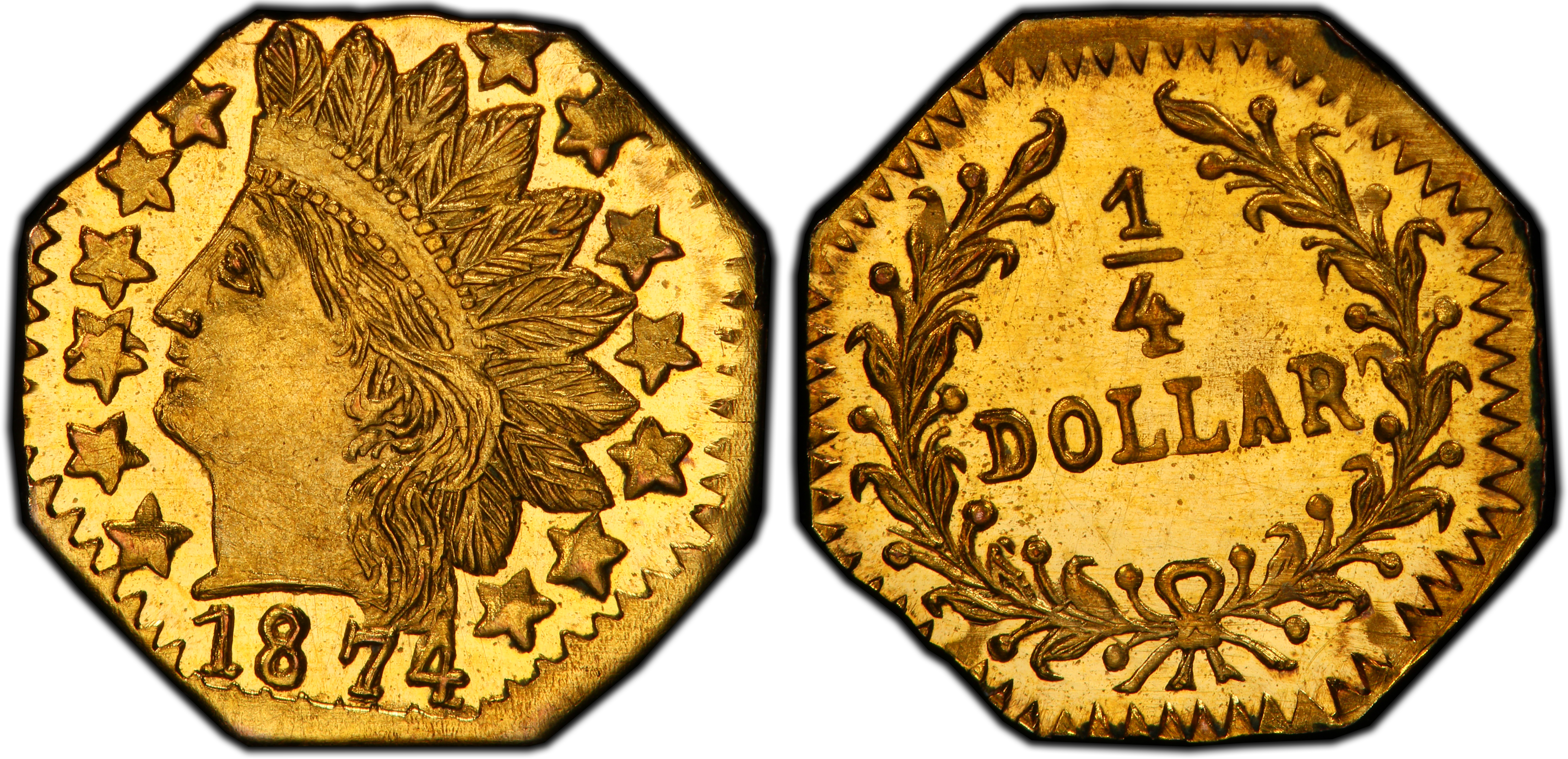
Obverse & Reverse
The 1874 Octagonal 25 Cent piece, cataloged as Breen-Gillio 799Q, belongs to the second great era of California Fractional Gold production, often termed 'Period Two' (1859-1882). Unlike their 'Period One' predecessors which arose from a genuine necessity for small-denomination circulating coinage during the initial chaos of the Gold Rush, these later issues were primarily created to satisfy a burgeoning market for souvenirs and keepsakes. By the 1870s, the United States Mint in San Francisco was in full operation, adequately supplying the region with official federal coinage and obviating the need for private issues in commerce. However, the romance of the Gold Rush had captured the nation's imagination. Tourists, businessmen, and settlers journeying to California sought tangible mementos of their experience. Astute local jewelers, many of whom had been involved in the earlier period of minting, recognized this demand and began producing a wide variety of attractive, miniature gold coins. These pieces were intentionally underweight, containing significantly less gold than their face value, effectively making them profitable tokens rather than true currency. The BG-799Q, with its popular Indian Head motif—a design choice mirroring contemporary federal coinage to lend an air of legitimacy and appeal—was a product of this commercial environment. It was likely struck using the 'hammer method,' where dies were struck by hand, leading to frequent variations in strike quality. The passage of the Coinage Act of 1864 had made all private coinage illegal, but the law was not strictly enforced against these small souvenir pieces until the Secret Service, under Chief James J. Brooks, began a crackdown in 1883, bringing the era of California Fractional Gold to a definitive close. These tiny gold pieces, therefore, represent the sunset of a uniquely American phenomenon, transitioning from a practical monetary solution to a nostalgic commodity.
Associated EventPost-Gold Rush California Tourism
Reason For MintingTo serve as a popular and profitable souvenir of the California Gold Rush for tourists and visitors.
Minter HistoryThe specific minter for BG-799Q is not definitively known, a common trait for many 'Period Two' issues. However, the style and period of manufacture are consistent with the work of San Francisco jewelers who specialized in these items. Prominent among them was Robert B. Gray & Co., who had purchased the business of another fractional gold pioneer, Antoine Louis Nouizillet, around 1859. Gray and his successors were prolific producers of these souvenir coins into the 1870s. It is highly probable that this piece originated from one of these established jewelry firms that possessed the diesinking and minting capabilities.
Historical SignificanceThe BG-799Q is a tangible artifact of the commercialization of the Gold Rush legend. It marks the shift in the purpose of private gold coinage from a necessary medium of exchange to a souvenir commodity, reflecting California's evolving economy and its burgeoning identity as a tourist destination. Numismatically, it is a key representative of the diverse and artistically interesting 'Period Two' issues.
Not Applicable
Denomination25 Cents
Minting Period1874
Assayer/MinterUnknown San Francisco Jeweler (Possibly Robert B. Gray & Co. or successor)
Geographic OriginSan Francisco, California
Obverse DescriptionAn Indian Head portrait facing left, reminiscent of the design on contemporary federal coinage. The head is adorned with a feathered headdress. Thirteen stars encircle the portrait.
Obverse Inscription[None, date on reverse]
Reverse DescriptionThe denomination '1/4 DOLLAR' and the date '1874' are enclosed within a wreath. The wreath is composed of two branches tied with a bow at the bottom.
Reverse Inscription1/4 DOLLAR 1874
CompositionGold
Stated Fineness Actual FinenessVariable, typically 14-22 karats. Deliberately underweight as a souvenir token.
Weight0.24 grams
Diameter9.60 mm
EdgePlain
Unknown
Survival Estimate31-75
Rarity ScaleR-5+
This variety appeals to collectors due to its high rarity (R-5+), attractive Indian Head design, octagonal shape, and its historical context as a 'Period Two' souvenir issue. Examples with prooflike surfaces are particularly prized.
Key VarietiesThe primary issue is the business strike of BG-799Q. No known patterns, trial pieces, or official restrikes exist from the period. Modern replicas are common but are not considered numismatic items. Collectors should focus on attributing specific die states and identifying pieces with exceptional strike and surface characteristics.
Authentication TipsKey diagnostics for genuine BG-799Q examples include a widely repunched third star on the obverse. On the reverse, the right leg of the 'R' in DOLLAR points directly to a berry in the wreath. A pair of distinctive, thick parallel die lines can often be seen on the Indian's neck. Genuine pieces may show weakness in the strike due to being hand-hammered, whereas modern replicas are often sharply and uniformly struck. All authentic 'Period Two' pieces should be denominated; tokens without a denomination are typically later charms.
Shopping ConsiderationsFor a premium quality example, seek out a coin with a sharp strike on the Indian's headdress and the date. Surface quality is paramount; look for original, lustrous fields free of distracting marks, cleaning, or evidence of having been mounted in jewelry (a common fate for these pieces). Coins designated as 'Prooflike' (PL) or 'Deep Mirror Prooflike' (DMPL) command significant premiums as they showcase the dies in their best state. Given the tiny size, third-party certification by PCGS or NGC is highly recommended not only for authentication and grading but also for secure handling and preservation.
A coin's grade is its condition, rated on a 1-70 scale. For rare coins, this is the most critical factor in determining value, as a tiny difference in preservation can mean a huge difference in price.
Relevant Grade TypesOriginal issues were business strikes produced for sale as souvenirs, not for circulation. As such, they are typically found in Mint State (MS, 60-70) grades, though some may have entered circulation and exist in Circulated grades (1-58). No true Proofs were struck during the original period of issue. The 'PL' (Prooflike) or 'DMPL' (Deep Mirror Prooflike) designations refer to business strikes made with highly polished dies and are highly sought after.
Mint State CharacteristicsIn uncirculated grades, the BG-799Q is often found with surprisingly good luster, frequently with prooflike or deep mirror prooflike fields. The strike can be inconsistent due to the hammer-striking process; weakness may be apparent on the high points of the feathers or the wreath. Small planchet flaws or die polishing lines are common and not always considered detrimental. The finest known examples are sharply struck with dazzling, reflective surfaces.
Circulated Wear PatternsAlthough most examples are uncirculated, any wear would first appear on the high points of the design. On the obverse, look for flattening on the Indian's cheek, the feathers of the headdress, and the tips of the stars. On the reverse, the highest points of the bow and the leaves in the wreath would show initial friction and loss of detail.
Key Factors For ValueThe primary value driver for BG-799Q is its grade and surface quality. A high-grade Mint State coin (MS-64 or better) is worth substantially more than a lower-grade one. The presence of a Prooflike (PL) or Deep Mirror Prooflike (DMPL) designation dramatically increases value. Eye appeal is critical; coins with clean, reflective surfaces and a sharp strike are highly prized. A CAC sticker, indicating premium quality for the grade, adds a significant premium for this and other California Fractional Gold issues.
PCGS Price Guide
| Grade | Price | Population |
|---|---|---|
| 66 | $2,650.00 | 1 |
| 66+ | $2,850.00 | N/A |
| 67 | $3,250.00 | N/A |