1869 G25C BG-750 (Regular Strike)
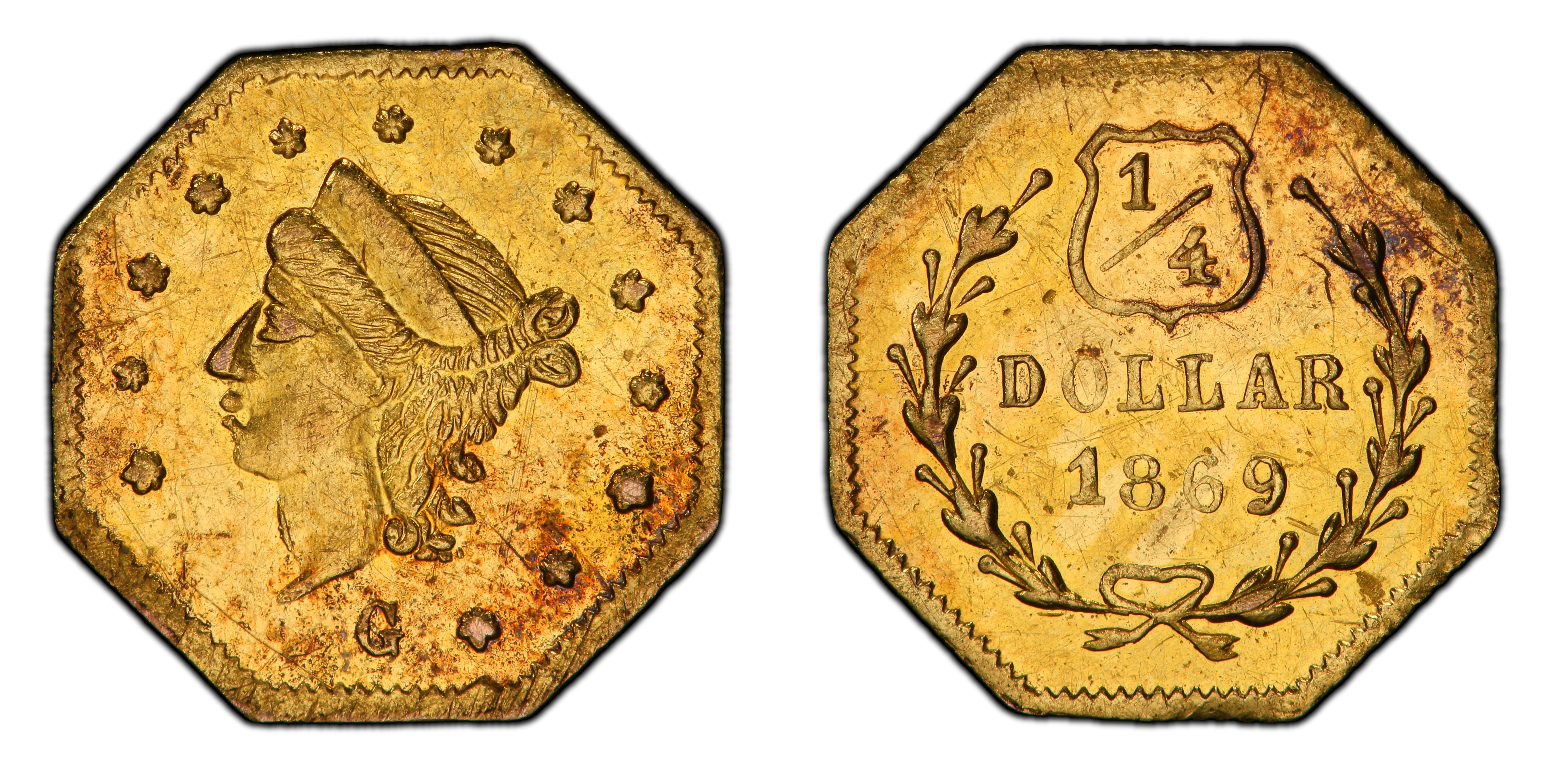
Obverse & Reverse
The 1869 25 Cents, cataloged as Breen-Gillio 750 (BG-750), is a quintessential example of a 'Period Two' California Fractional Gold piece. By the late 1860s, the initial, urgent need for small-denomination coinage that characterized the California Gold Rush had largely subsided. The establishment and full-scale operation of the San Francisco Mint by 1856 had introduced a sufficient supply of federal silver coinage, rendering the privately-issued 'Period One' (1852-1856) fractionals obsolete for circulatory purposes. However, a new market emerged, driven by tourism, nostalgia, and the Victorian penchant for curios and keepsakes. Jewelers and private minters in San Francisco continued to produce these miniature gold pieces, not as a monetary necessity, but as popular souvenirs that could be easily mailed back East or worn as jewelry. The Coinage Act of April 22, 1864, had explicitly outlawed private coinage, pushing these manufacturers into a legally grey area. To circumvent prosecution, many of these 'Period Two' issues, like the BG-750, were intentionally struck underweight and with fineness levels below their face value, reinforcing their status as tokens rather than legitimate currency. They were sold for a small premium over their minimal gold content. These pieces were not intended to circulate in commerce and rarely did; instead, they satisfied a public fascination with the romanticism of the Gold Rush. The anonymous nature of the BG-750's minter is typical of this era, as producers sought to avoid the scrutiny of the U.S. Secret Service, which had begun to crack down on such operations. Today, the BG-750 is appreciated not as a coin born of necessity, but as a fascinating artifact of California's post-Gold Rush cultural and economic landscape, representing a transition from utilitarian private money to commercial collectible tokens.
Associated EventPost-Gold Rush California Souvenir Trade
Reason For MintingProduced primarily as a souvenir or keepsake for the tourist and jewelry trade rather than for monetary circulation.
Minter HistoryThe specific minter for BG-750 is unknown, a common characteristic for many 'Period Two' California Fractional Gold pieces. Following the Coinage Act of 1864, which prohibited private coinage, many jewelers and minters in San Francisco began producing these pieces anonymously to avoid legal trouble. Prominent firms like Robert B. Gray & Co. and the Levison Brothers were known to produce fractional gold during this period, but direct attribution for most varieties, including BG-750, has not been established.
Historical SignificanceThis coin is significant as it represents the second phase of California Fractional Gold, where the purpose shifted from filling a commercial need for small change to serving a burgeoning souvenir and novelty market. Its creation in the face of prohibitive federal laws also highlights the persistent entrepreneurial spirit of the West and the enduring allure of gold.
N/A
Denomination25 Cents
Minting Period1869
Assayer/MinterUnknown Private Minter
Geographic OriginSan Francisco, California
Obverse DescriptionA Liberty Head facing left, similar in style to contemporary federal gold coinage but often rendered more crudely. Her hair is tied in a bun at the back. She is surrounded by thirteen six-pointed stars arranged in a circle near the octagonal border.
Obverse Inscription Reverse DescriptionThe denomination '1/4' is at the center, surrounded by a laurel wreath. Below the fraction and wreath is the date, '1869'. The inscription 'CALIFORNIA GOLD' appears along the upper periphery, following the octagonal edge.
Reverse Inscription1/4 CALIFORNIA GOLD 1869
CompositionGold
Stated Fineness Actual FinenessVariable, but typically lower than federal coinage of the era, often ranging from .500 to .800 fine.
Weight0.25 grams
Diameter9.50 mm
EdgePlain
Unknown
Survival Estimate4-12
Rarity ScaleR-7
The BG-750 appeals to collectors due to its extreme rarity (R-7), classic octagonal Liberty Head design, and its status as a 'Period Two' issue, which tells a different story than the earlier circulating fractionals. Its diminutive size and historical context as a Gold Rush-era souvenir make it a captivating piece of Americana.
Key VarietiesThe primary variety is the Regular Strike, as listed in the Breen-Gillio reference. No major die varieties from the period of issue are widely recognized for BG-750. Being a 'Period Two' issue, it was produced for collectors and jewelers from the start, so no separate 'Proof' or pattern issues are known. Collectors should be aware that many replica and fantasy pieces with similar designs exist, often made in the 20th century.
Authentication TipsAuthentic BG-750 examples often exhibit a weak or uneven strike due to the crude 'hammer method' of minting. The surfaces may be proof-like or semi-proof-like, a common characteristic for souvenir issues. Look for die markers specific to the variety by comparing to high-resolution images of certified examples. Counterfeits are rampant in this series; many fakes are brassy in color, have mushy details, incorrect weights, or feature a bear on the reverse (no genuine pre-1900 fractionals have a bear). Professional authentication is strongly recommended for any raw example.
Shopping ConsiderationsA premium quality example for its grade will possess sharp details, particularly on Liberty's hair and the leaves of the wreath. Many genuine pieces were mounted as jewelry, so look carefully for evidence of soldering, tooling, or repaired holes, which drastically reduce value. Original, lustrous surfaces are highly prized; avoid examples that have been harshly cleaned or polished. Given their souvenir nature, many high-grade examples exist, but they are often found with minor distracting marks. A specimen with smooth, pleasing surfaces and strong eye appeal will command a significant premium. The R-7 rarity means few will ever come to market, making any appearance a significant event.
A coin's grade is its condition, rated on a 1-70 scale. For rare coins, this is the most critical factor in determining value, as a tiny difference in preservation can mean a huge difference in price.
Relevant Grade TypesOriginal period issues were business strikes, although not intended for circulation. They are found in both Circulated (1-58) and Mint State (MS, 60-70) grades. Due to their status as souvenirs, a higher proportion of uncirculated examples survived compared to 'Period One' issues. No true Proofs were struck during the original minting period, though many specimens exhibit proof-like (PL) or deep mirror proof-like (DMPL) surfaces from being struck with polished dies.
Mint State CharacteristicsUncirculated examples of BG-750 are defined by their luster, which can range from satiny to deeply proof-like. The strike is a key factor; many are weakly struck in the centers, with mushiness on Liberty's highest points or the wreath. A well-struck MS example is a condition rarity. As these pieces were handled as curios, small, light contact marks ('chatter') are common even on high-grade specimens. The gold is soft, making pristine surfaces exceptionally rare.
Circulated Wear PatternsFor the few examples that may have seen light handling, wear first appears on the high points of Liberty's hair, cheek, and the upper leaves of the wreath. As wear progresses, the stars on the obverse and the lettering on the reverse will begin to lose their sharpness and merge with the fields. In lower grades, the date and denomination become difficult to read.
Key Factors For ValueThe primary value driver for BG-750 is its extreme rarity (R-7). Beyond that, grade is paramount. A Mint State example will be worth many multiples of a circulated one. Surface quality is critical: a coin with original, undisturbed proof-like or lustrous fields commands a substantial premium over one that has been cleaned or has numerous distracting marks. Strike quality is also a key differentiator, with sharply struck specimens being highly sought after. Finally, certification by a top-tier grading service (PCGS or NGC) is essential for market acceptance and value realization. A CAC sticker would add a further premium, confirming quality within the assigned grade.
PCGS Price Guide
| Grade | Price | Population |
|---|---|---|
| 55 | $260.00 | 2 |
| 55+ | $270.00 | N/A |
| 58 | $300.00 | 5 |
| 58+ | $325.00 | N/A |
| 60 | $375.00 | 2 |
| 61 | $600.00 | 6 |
| 62 | $950.00 | 13 |
| 62+ | $1,025.00 | N/A |
| 63 | $1,200.00 | 6 |
| 63+ | $1,575.00 | N/A |
| 64 | $2,750.00 | 1 |