1867 G25C BG-743 (Regular Strike)
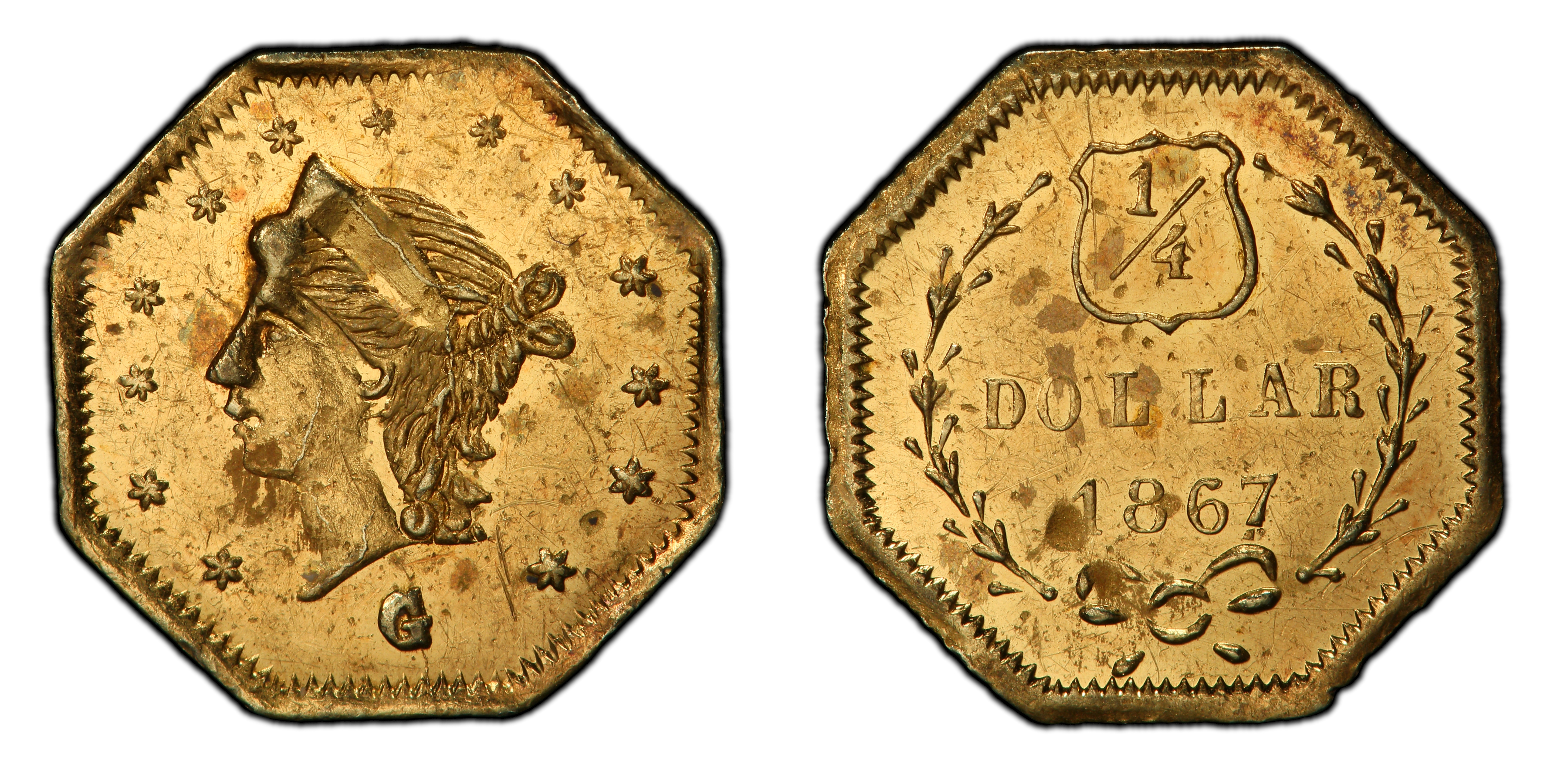
Obverse & Reverse
The 1867 G25C BG-743 is a product of the second great wave of private gold coining in California, a period numismatists classify as 'Period Two' (1859-1882). Unlike the earlier 'Period One' issues (1852-1857), which were struck out of genuine commercial necessity to alleviate a shortage of small change, the Period Two pieces emerged in a different economic landscape. By the late 1860s, the San Francisco Mint was in full operation, and federal coinage was more readily available. The impetus for striking these tiny gold pieces had shifted from necessity to novelty and commerce of a different sort. San Francisco was becoming a major tourist destination, and local jewelers and artisans capitalized on this by creating miniature gold 'coins' as souvenirs and keepsakes. These pieces, often backdated to the Gold Rush heyday, captured the romanticism of the era for visitors. The Coinage Act of April 22, 1864, had officially made private coinage illegal, but enforcement in the West was lax until the early 1880s. This legal gray area allowed dozens of anonymous makers, likely jewelers like Robert B. Gray & Co., to produce a vast array of designs. The BG-743, an octagonal 25-cent piece, fits perfectly within this context. Its production was not intended to satisfy a need for circulating currency but to be sold as a popular memento of a visit to the 'Golden State.' The quality and gold content of these Period Two pieces varied wildly; many were intentionally debased or even just gold-plated silver, making them more akin to tokens than true coins. Their crude engraving and manufacture, compared to federal issues, added to their charm. Many were mounted into jewelry, which explains why problem-free, high-grade survivors are so scarce today. The journey of the BG-743 from a tourist's pocket to a modern numismatic cabinet encapsulates the transition of California from a raw frontier to a symbol of American adventure and prosperity.
Associated EventPost-Gold Rush Economic Expansion and Tourism
Reason For MintingPrimarily produced for sale as souvenirs and jewelry charms for the growing tourist trade in San Francisco.
Minter HistoryThe specific minter for BG-743 is unknown, which is typical for Period Two issues. Dozens of jewelers and private minters operated in San Francisco during this time, creating these pieces without identifying marks. Prominent figures from this era who could have been involved in such production include Robert B. Gray, the Joseph Brothers (Lionel and Josephus), and Herman J. Brand, all of whom were known to strike fractional gold pieces for commercial sale rather than circulation.
Historical SignificanceThe BG-743 is historically significant not as a coin for circulation, but as a cultural artifact representing the commercialization of the Gold Rush mythos. It marks a shift from utilitarian private coinage to souvenir tokens, reflecting California's changing economy and its emerging identity as a tourist destination. These pieces are tangible links to the post-Civil War era in San Francisco and the enduring public fascination with gold.
BG-743
Denomination25 Cents
Minting Period1867
Assayer/MinterUnknown Private Minter
Geographic OriginSan Francisco, California
Obverse DescriptionFeatures a Liberty Head motif, typical for the series. The portrait style on Period Two issues is often cruder and more stylized than on federal coinage. The head is surrounded by a number of stars (typically 13) representing the original colonies.
Obverse Inscription1867
Reverse DescriptionA wreath of leaves and berries, open at the top, encircles the denomination. Within the wreath, the fraction '1/4' is typically displayed, with the word 'DOL.' or 'DOLLAR' below it.
Reverse Inscription1/4 DOLLAR CAL.
CompositionGold
Stated Fineness Actual FinenessVariable, often below the .900 standard of federal coinage, sometimes as low as 14 karats. Some Period Two pieces were merely gold-plated.
EdgePlain
Unknown
Survival EstimateExtremely low; likely fewer than 20-30 pieces known.
Rarity ScaleR-6 (13-30 known)
The BG-743 is sought after for its high rarity and its octagonal shape, which is emblematic of the pioneer gold series. As a Period Two issue, it is part of the vast and challenging California Fractional Gold set, appealing to specialists who appreciate the diversity and history of these privately struck pieces.
Key VarietiesNo major varieties of the BG-743 marriage are widely recognized. However, the entire California Fractional Gold series is composed of hundreds of die varieties (BG numbers), making each a 'variety' in itself. No special collector issues like proofs or restrikes from the original minting period are known for these private issues. Later 20th-century copies and replicas are common and should not be confused with original pieces.
Authentication TipsAuthentic Period Two pieces often have a slightly crude, handmade look. Check for sharp, even reeding on the edge; originals have plain edges. The luster on genuine examples is often soft and satiny, unlike the hard, flashy luster of modern replicas. The word 'DOLLAR' or an abbreviation (DOL., D.) must be present for it to be a Breen-Gillio recognized coin, rather than a token. Many counterfeits exist, so authentication by a major grading service (PCGS or NGC) is highly recommended. Pay close attention to the style of the Liberty head and the reverse wreath, comparing them to known genuine examples in auction archives.
Shopping ConsiderationsFor a premium quality BG-743, look for a sharp strike, especially on the stars, date, and the details of the wreath. Many were weakly struck due to the hammer-striking process. Original, undisturbed surfaces are paramount; avoid examples that have been cleaned, polished, or show evidence of being removed from jewelry (solder marks, rim damage). Eye appeal is critical; a pleasing, original reddish-gold or yellow-gold patina is highly desirable. Given the coin's rarity, any example without significant impairments is considered a major prize, but problem-free, high-grade specimens command significant premiums.
A coin's grade is its condition, rated on a 1-70 scale. For rare coins, this is the most critical factor in determining value, as a tiny difference in preservation can mean a huge difference in price.
Relevant Grade TypesOriginal 1867 issues were business strikes, technically intended for commerce but mostly sold as souvenirs. They are found in Circulated (1-58) and Mint State (MS, 60-70) grades. Due to their intended purpose as keepsakes, uncirculated examples are more common than for Period One issues, though often impaired. No original Proofs (PR/PF) were struck by these private minters, and no official later-date Proof restrikes are known to exist.
Mint State CharacteristicsAn uncirculated BG-743 would be judged on the quality of its strike and luster. These were often made with less care than federal coins, so a full strike is rare; weakness on the high points of Liberty's hair and the leaves of the wreath is common. Luster is typically soft and satiny, not deeply prooflike. Due to the softness of the gold and minimal handling, even Mint State examples may show small planchet flaws or contact marks from storage with other pieces. A truly 'gem' example would combine a strong strike, clean surfaces, and attractive original luster.
Circulated Wear PatternsWear first appears on the highest points of the design: Liberty's hair above the eye and ear, and the cheekbone. On the reverse, the high points of the wreath's leaves and the bow will show initial friction and flattening. In lower grades (VF and below), the stars on the obverse will begin to merge with the fields, and the finer details of the wreath will be lost.
Key Factors For ValueRarity is the primary driver of value for BG-743. Beyond that, surface preservation is key. An example with original, uncleaned surfaces will always be worth significantly more than a cleaned or damaged coin of the same grade. Strike quality is the next factor; a sharply struck piece with full details is a major condition rarity. Eye appeal, encompassing attractive toning and a lack of distracting marks, also plays a significant role. Certification by PCGS or NGC is virtually required for market acceptance, and a CAC sticker on a high-grade example would denote premium quality and add a substantial price premium.
PCGS Price Guide
| Grade | Price | Population |
|---|---|---|
| 58 | $3,500.00 | 1 |
| 58+ | $3,750.00 | N/A |
| 60 | $4,000.00 | N/A |
| 61 | $4,250.00 | 1 |
| 62 | $4,750.00 | 1 |
| 62+ | $5,000.00 | N/A |
| 63 | $5,750.00 | N/A |
| 63+ | $6,250.00 | N/A |
| 64 | $7,500.00 | 1 |