1874 G25C BG-795 (Regular Strike)
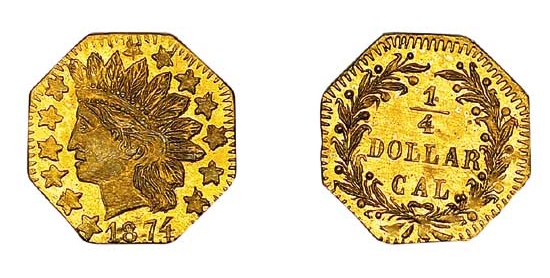
Obverse & Reverse
The 1874 BG-795 25 Cent piece belongs to the 'Period Two' (1859-1882) of California Fractional Gold production, a fascinating and complex chapter in American numismatics. Unlike the earlier 'Period One' (1852-1856) issues, which were struck out of genuine commercial necessity to alleviate a shortage of small change during the initial frenzy of the Gold Rush, Period Two pieces were created under vastly different circumstances. By the 1870s, the San Francisco Mint was in full operation, supplying ample quantities of official U.S. silver and minor coinage, effectively ending the need for private fractional gold to facilitate daily transactions. Instead, the production of these miniature gold coins shifted to serve a burgeoning tourist and souvenir market. San Francisco had transformed from a chaotic boomtown into a major American city and a destination for travelers. Jewelers and private minters, whose names are now mostly lost to history, capitalized on the romantic allure of the Gold Rush by manufacturing these attractive, gold-based keepsakes. These pieces were not intended to circulate as money, but rather to be sold as charms, keepsakes, and mementos of a visit to the 'Golden State.' The Coinage Act of 1864 had explicitly prohibited private coinage, but the law was not aggressively enforced against these small, denominational tokens until the Secret Service finally cracked down in 1883, bringing the era of California Fractional Gold to a definitive end. The BG-795, with its popular Indian Head motif and octagonal shape, was a quintessential example of this souvenir-driven production. Its existence speaks to a California that was no longer a raw frontier, but one that was beginning to mythologize and commercialize its own recent past.
Associated EventPost-Gold Rush California Tourism
Reason For MintingPrimarily struck for sale as a souvenir or charm to tourists and locals, capitalizing on the romanticism of the earlier Gold Rush era.
Minter HistoryThe specific minter for the BG-795 variety is unknown, which is common for Period Two issues. Production was handled by various San Francisco jewelers, such as Robert B. Gray & Co., California Jewelry Co. (Levison Bros.), and others who created a wide array of types and varieties. These minters operated in a legally grey area, producing denominated tokens that mimicked coinage but were understood to be novelties.
Historical SignificanceThe BG-795 is significant not as a circulating coin, but as a tangible artifact of California's economic and cultural transition in the decades after the Gold Rush. It represents the shift from coinage of necessity to coinage of nostalgia, marking the period when the Gold Rush became a celebrated, marketable part of California's identity.
N/A
Denomination25 Cents
Minting Period1874
Assayer/MinterUnknown Private Minter/Jeweler
Geographic OriginSan Francisco, California
Obverse DescriptionA stylized head of Liberty facing left, wearing a Native American feathered headdress. The portrait is surrounded by 13 five-pointed stars along the octagonal border. The date, 1874, is positioned below the bust.
Obverse Inscription1874
Reverse DescriptionThe denomination '1/4' is centered within a decorative wreath of leaves and berries. The text 'CALIFORNIA GOLD' encircles the wreath along the upper octagonal border.
Reverse InscriptionCALIFORNIA GOLD 1/4
CompositionGold
Stated Fineness Actual FinenessVariable and typically debased. Period Two issues are known to be underweight and of lower purity than their face value would imply, consistent with their production as low-cost souvenirs rather than circulating currency.
EdgePlain
Unknown
Survival EstimateModerately available, with NGC and PCGS population reports showing over 100 graded examples, suggesting a surviving population of several hundred coins.
Rarity ScaleR-5 (Heritage Auctions); some sources cite R-3. Generally considered scarce but obtainable.
This coin is highly popular due to its classic Indian Head design, octagonal shape, and direct connection to the romantic era of post-Gold Rush California. It offers a relatively accessible entry point into the complex and historic field of California Fractional Gold.
Key VarietiesThe most significant known variety involves die rotation. A notable BG-795 variety exists with the reverse die rotated 90 degrees from the obverse. Diagnostics for this specific BG number also include the date sloping sharply down until the numeral 4 nearly touches the rim.
Authentication TipsGenuine Period Two pieces like the BG-795 must be denominated (e.g., '1/4', 'CENTS', or 'DOLLAR'). Be wary of pieces that say 'CAL GOLD' without a denomination, or which feature a bear on the reverse, as these are typically later, non-monetary tokens or brass counterfeits. The strike on genuine pieces can be sharp but is often slightly crude, with minor planchet imperfections. Modern fakes may appear too perfect or have a soapy, indistinct look. The Breen-Gillio reference is the definitive guide for die characteristics.
Shopping ConsiderationsA premium quality BG-795 will exhibit a sharp, well-defined strike on the Indian's headdress and the details of the wreath. Many examples were struck on polished planchets, and those with deep, proof-like (PL) or mirror-like surfaces command a significant premium. Look for original, uncleaned surfaces with attractive luster. Avoid examples that are holed or show evidence of being mounted in jewelry, as was common. Minor planchet or striking flaws are typical for the issue and generally accepted by specialists, but distracting marks or scratches will limit the value.
A coin's grade is its condition, rated on a 1-70 scale. For rare coins, this is the most critical factor in determining value, as a tiny difference in preservation can mean a huge difference in price.
Relevant Grade TypesAll original 1874 BG-795 pieces were business strikes, although many were struck on polished planchets to enhance their appeal as souvenirs, resulting in proof-like (PL) surfaces. They are found in both Circulated (1-58) and, more commonly, Mint State (MS, 60-70) grades due to their limited use. No true Proof (PR/PF) examples were struck during the original period of issue.
Mint State CharacteristicsAn uncirculated BG-795 is characterized by flashy, often reflective fields. The strike can vary, but high-end examples will show sharp details in the feathers and the wreath. Luster is typically bright and satiny or deeply proof-like. As these were made by jewelers and not a formal mint, minor planchet flaws or die polishing lines can be present even on high-grade specimens and are considered part of the coin's character.
Circulated Wear PatternsFor circulated examples, wear first appears on the highest points of the design. On the obverse, this includes the cheek, the eyebrow, and the feathers of the headdress. On the reverse, the highest points of the wreath's leaves and bow will show the first signs of friction and flattening. In lower grades, the stars and legends will begin to weaken.
Key Factors For ValueThe primary driver of value is grade, with a steep premium for Gem (MS-65 and above) examples. Surface quality is critical; coins with clean, original, proof-like surfaces are most desirable. A sharp, well-centered strike adds significant value. Eye appeal, including attractive original gold toning, is also a key factor. Coins certified by top-tier services like PCGS and NGC, especially those with a CAC sticker, are highly sought after and command the strongest prices in the market.
PCGS Price Guide
| Grade | Price | Population |
|---|---|---|
| 55 | $265.00 | 1 |
| 55+ | $270.00 | N/A |
| 58 | $280.00 | 3 |
| 58+ | $290.00 | N/A |
| 60 | $300.00 | 1 |
| 61 | $315.00 | 5 |
| 62 | $325.00 | 29 |
| 62+ | $350.00 | N/A |
| 63 | $375.00 | 54 |
| 63+ | $450.00 | N/A |
| 64 | $575.00 | 74 |
| 64+ | $650.00 | N/A |
| 65 | $800.00 | 24 |
| 65+ | $1,075.00 | N/A |
| 66 | $2,000.00 | 3 |
| 67 | N/A | N/A |