1868 25C BG-799R (Regular Strike)
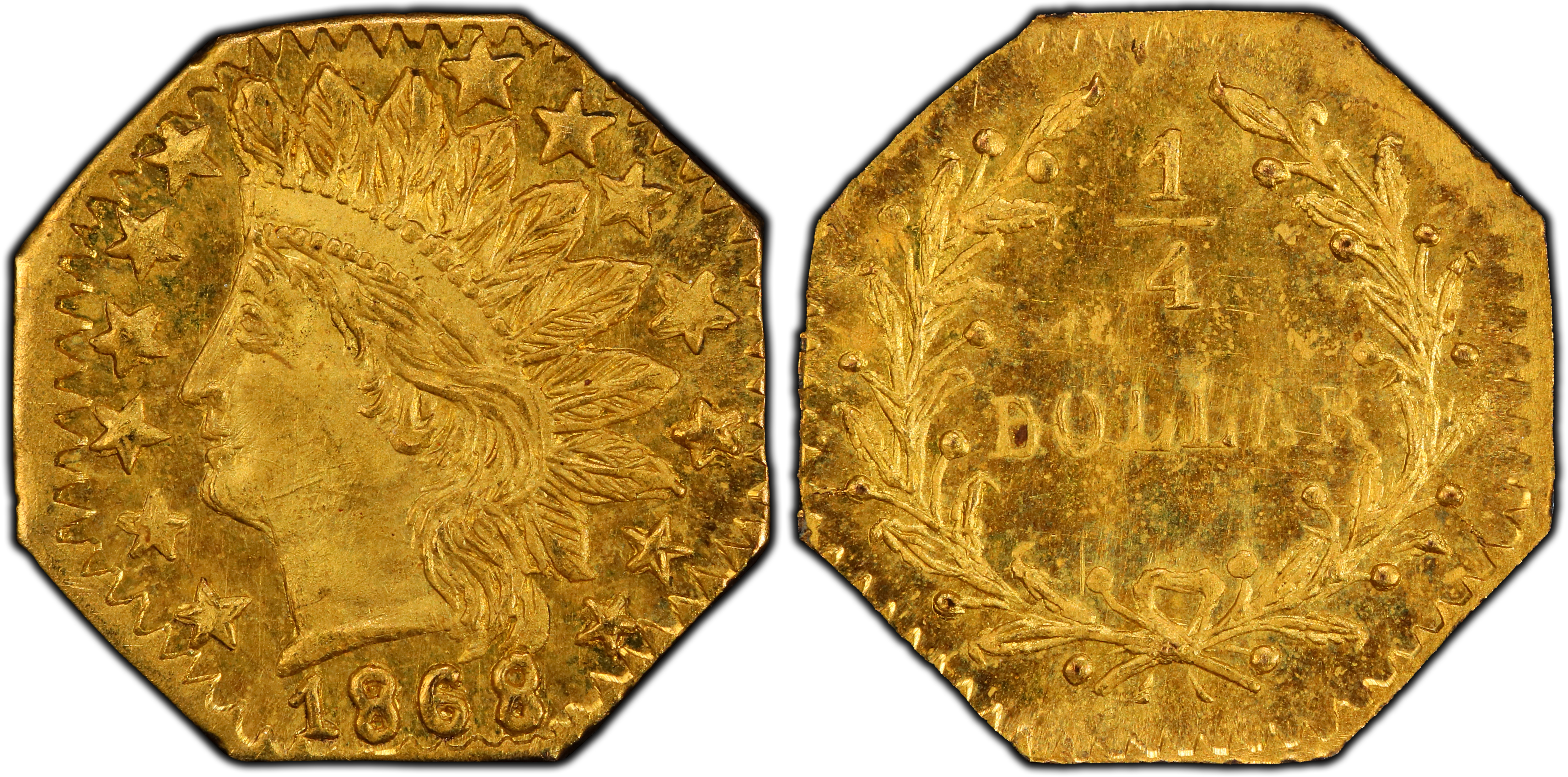
Obverse & Reverse
The 1868 25C BG-799R is a quintessential example of a 'Period Two' California Fractional Gold piece, a fascinating and complex series born from the California Gold Rush but evolving into a unique numismatic collectible. The initial period of fractional gold (1852-1857) was a direct response to a severe shortage of small change in the booming, gold-fueled economy of the West. These early issues were generally of good weight and fineness and served a genuine commercial need. However, by the late 1850s, the San Francisco Mint was in full operation, alleviating the coin shortage. This marked the beginning of Period Two (1858-1882), during which the purpose of fractional gold shifted dramatically. The Coinage Act of April 22, 1864, officially outlawed all private coinage, rendering further production illegal. Despite this, enforcement was inconsistent, and a small group of San Francisco jewelers, including prominent figures like Robert B. Gray & Co., continued to strike these miniature gold pieces. The motivation was no longer commerce but commerce of a different sort: the burgeoning tourist and souvenir trade. These later issues, including the BG-799R, were not intended to circulate as money. Instead, they were sold as mementos of the Gold Rush, jewelry charms, and curiosities for collectors back East and in Europe. Consequently, many Period Two coins are underweight and of lower fineness than their stated value would imply, solidifying their status as tokens rather than true coins. Their illegal nature meant production was clandestine, and specific minter attributions are often difficult, with dies and punches being sold or traded between jewelers. The BG-799R, with its crisp Indian Head design, reflects the popular motifs of the era and was produced to appeal to this collector market. Its extreme rarity today (R-7) indicates a very small original mintage, likely struck on demand or in a very limited batch. Because they were acquired as keepsakes, a higher proportion of the surviving population exists in Mint State condition compared to their circulating Period One counterparts.
Associated EventPost-Gold Rush California Economy / Souvenir Coinage Era
Reason For MintingPrimarily struck as a collectible souvenir or jewelry piece for the tourist trade, circumventing the 1864 law against private coinage.
Minter HistoryThe specific minter of BG-799R is unconfirmed, as was common for these legally ambiguous 'Suppressed Jewelers' Issues.' Production during this period was dominated by a small, interconnected group of San Francisco jewelers. A leading figure was Robert B. Gray, a jeweler and die sinker who, around 1859, purchased the business and equipment of Antoine Louis Nouizillet, another key producer from Period One. Gray (often using a 'G' hallmark, though not present on this variety) and his firm, Robert B. Gray & Co., were prolific producers through 1871. The use of similar die punches and design styles across many un-hallmarked Period Two varieties suggests that dies were shared, sold, or copied among this small community of craftsmen, making definitive attribution for any single variety challenging.
Historical SignificanceThe BG-799R is historically significant not as a coin for circulation, but as a tangible artifact of a transitional period in private minting. It represents a shift from utilitarian private currency to a collector-focused souvenir market, produced in defiance of federal law. Its existence demonstrates the lax enforcement of the 1864 Coinage Act in the West and the enduring romantic appeal of the Gold Rush that fueled a market for these miniature gold tokens for decades after the rush itself had ended.
Not Applicable (Breen-Gillio is the standard reference)
Denomination25 Cents
Minting Period1868
Assayer/MinterUnknown San Francisco Jeweler (Possibly Robert B. Gray & Co. or associates)
Geographic OriginSan Francisco, California
Obverse DescriptionAn Indian Head motif facing left, adorned with a feathered headdress. The portrait is surrounded by thirteen stars, representing the original colonies. The date '1868' is positioned below the bust.
Obverse Inscription1868
Reverse DescriptionA wreath of two branches tied together by a bow at the bottom. Inside the wreath, the denomination '25 CENTS' is displayed on two lines. The outer legend 'CALIFORNIA GOLD' encircles the top of the wreath.
Reverse InscriptionCALIFORNIA GOLD / 25 CENTS
CompositionGold
Stated Fineness Actual FinenessVariable, often lower than circulating coinage of the era.
Weight0.25 grams
Diameter9.80 mm
EdgePlain
Extremely Low
Survival Estimate4-12 known
Rarity ScaleR-7
This coin is highly sought after for its extreme rarity (R-7), attractive Indian Head design, and octagonal shape. As a 'Period Two' issue, high-grade examples are more available than for circulating issues, appealing to condition-conscious collectors. It represents a fascinating niche within U.S. numismatics, blending the allure of Gold Rush history with the story of illegal but tolerated souvenir coinage.
Key VarietiesThe BG-799 designation refers to a specific die marriage. Within the broader 1868 25C Indian Head Octagonal group, Breen-Gillio identifies several minor die varieties (e.g., BG-799R, BG-799S, BG-799T), differentiated by subtle variations in the placement of the date, stars, or lettering. No special collector issues like Proofs or restrikes from the period are known to exist for this variety; all are considered 'regular strikes' for their intended souvenir purpose.
Authentication TipsAuthentication requires expert examination. Key areas to check are the style of the Indian Head, the sharpness of the octagonal cuts, and the specific positions of the date digits and lettering, which must match known genuine examples. Period Two pieces often have a slightly crude, hand-finished appearance. Counterfeits may appear too perfect, have incorrect lettering fonts, or exhibit a casting line or seam on the edge. The luster should be satiny and not the glassy, prooflike surface seen on modern replicas. Compare weight and diameter against known standards, as fakes are often incorrect in these specifications.
Shopping ConsiderationsFor an issue of this rarity, any example is a major acquisition. A premium quality piece is defined by a sharp, well-centered strike, especially on the high points of the feathers and the details of the wreath. Look for original, undisturbed surfaces with a satiny mint luster; avoid examples that have been harshly cleaned, polished, or used as jewelry (evidenced by solder marks or rim damage). Attractive, subtle reddish-gold toning can enhance eye appeal. Given the crude manufacturing process, minor planchet flaws or striking weaknesses may be acceptable, but major abrasions or rim bumps will significantly detract from the value. Third-party certification from PCGS or NGC is essential for authenticity and grade verification.
A coin's grade is its condition, rated on a 1-70 scale. For rare coins, this is the most critical factor in determining value, as a tiny difference in preservation can mean a huge difference in price.
Relevant Grade TypesOriginal period issues were business strikes produced as souvenirs, not for circulation. Therefore, they are typically found in high circulated grades (AU-50 to AU-58) or, more commonly, Mint State (MS, 60-70) grades. No proofs were struck during the original period of issue, and there are no known later-date collector restrikes. Any coin described as a 'Proof' would be highly suspect and not part of this original issue.
Mint State CharacteristicsAn uncirculated BG-799R is defined by its luster and lack of wear. High-grade examples, such as the finest known MS-67, exhibit a sharp strike across the entire design. The luster is typically a vibrant, frosty or satiny texture rather than deeply prooflike. Due to the small size and manufacturing process, even Mint State coins may show minor planchet irregularities or a slight softness of strike on the highest points of the feathers or the bow of the wreath. Small, scattered contact marks may be present but should not be distracting.
Circulated Wear PatternsAlthough not intended for circulation, some examples may show light handling wear. The very first traces of friction will appear on the highest points of the design: the cheek of the Indian portrait and the feathers in the headdress. On the reverse, the high points of the leaves and the bow knot will show the first signs of rub. In lower grades (e.g., AU), the luster in the fields will be broken, and the finest details will be noticeably softened.
Key Factors For ValueFor the BG-799R, value is driven by three primary factors: 1) Rarity: As an R-7, its mere availability is the largest driver. 2) Grade: The difference between an MS-63 and an MS-65 is substantial, and the finest-known examples command extreme premiums. 3) Surface Quality and Eye Appeal: A coin with clean, original surfaces and attractive, lustrous eye appeal will always be worth more than a similarly graded piece with distracting marks, signs of cleaning, or dull surfaces. A CAC sticker, indicating premium quality for the grade, adds a significant premium for this and other California Fractional Gold issues.
PCGS Price Guide
| Grade | Price | Population |
|---|---|---|
| 63 | $1,000.00 | 2 |
| 63+ | $1,150.00 | N/A |
| 64 | $1,350.00 | 3 |
| 64+ | $2,000.00 | N/A |
| 65 | $3,250.00 | 2 |
| 65+ | $3,500.00 | N/A |
| 66 | $3,850.00 | 1 |
| 66+ | $4,250.00 | N/A |
| 67 | $4,750.00 | N/A |