1876 G25C BG-780 (Regular Strike)
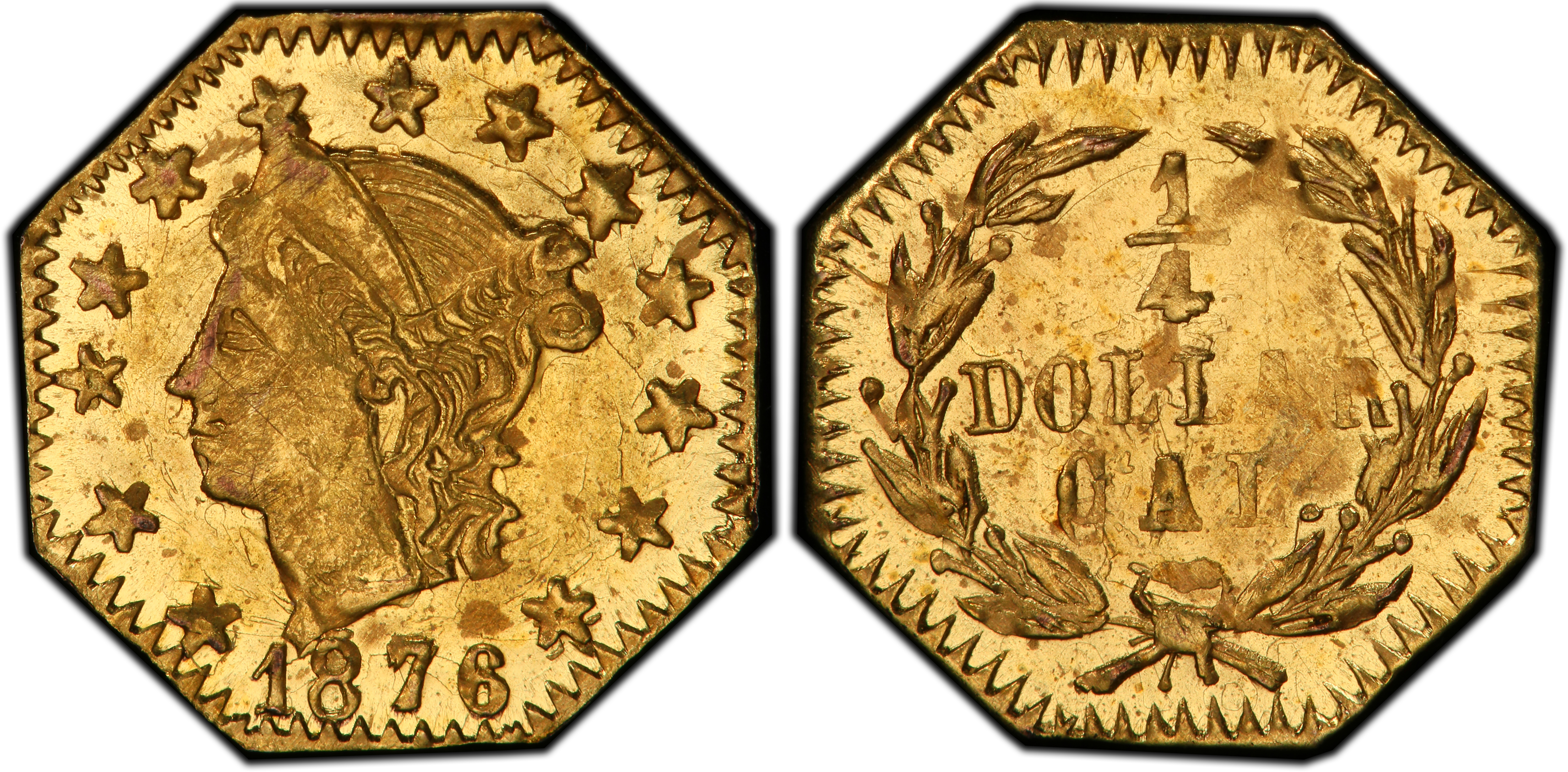
Obverse & Reverse
The 1876 G25C BG-780 is a quintessential example of 'Period Two' California Fractional Gold. By the mid-1870s, the initial, desperate need for small denomination coinage that characterized the Gold Rush's peak in the early 1850s had long subsided. The San Francisco Mint, fully operational since 1854, supplied ample federal coinage for daily commerce. However, the allure of California gold had not faded; it had simply transformed. The transcontinental railroad, completed in 1869, brought a wave of tourists and settlers, creating a robust market for souvenirs and keepsakes of the romanticized Gold Rush era. Private minters, who had once filled a crucial economic void, adapted to this new demand. They produced vast quantities of these miniature gold 'coins,' which were no longer intended for widespread circulation but were sold as novelties, charms for jewelry, and mementos to be sent back East. The Coinage Act of 1864 had explicitly forbidden private coinage, creating a legally precarious environment for these minters. To circumvent the law, many minters, including the likely producer of BG-780, Robert B. Gray & Co., employed legal fictions. They often used earlier, pre-1864 dates on their dies, or, as is the case with many pieces from this era, produced them with a gold content substantially below their face value, technically making them tokens rather than coins intended to pass at par. The 1876 date on this piece is notable as it coincides with the American Centennial, a period of heightened national pride and interest in historical artifacts, which likely boosted its appeal as a souvenir. These tiny octagonal pieces, crudely struck by hand using a hammer method, evoke the rustic conditions of the earlier pioneer period, an image the makers were keen to cultivate for their tourist clientele. Their production continued until the Secret Service began more aggressive enforcement against private mints in the early 1880s, bringing an end to this fascinating chapter of American numismatic history.
Associated EventPost-Gold Rush California Tourism Boom
Reason For MintingPrimarily produced to be sold as souvenirs and keepsakes to tourists and settlers in a post-Gold Rush California.
Minter HistoryRobert B. Gray & Co. was a prominent San Francisco-based firm of manufacturing jewelers active in the latter half of the 19th century. While not a 'mint' in the traditional sense, they, along with other jewelers, were major producers of California Fractional Gold during the 'Period Two' (1859-1882) souvenir era. They utilized their skills in metalworking to create the dies and strike these miniature gold pieces. Their primary business was jewelry and watches, but the fractional gold venture proved to be a lucrative sideline, capitalizing on the romantic image of the Gold Rush for a new generation of visitors. Their name is associated with a wide variety of Breen-Gillio (BG) numbers from this period.
Historical SignificanceThe BG-780 represents the evolution of California Fractional Gold from a necessary medium of exchange to a commercial souvenir. It is a tangible link to the tourism-driven economy of 1870s San Francisco and illustrates the legal gray area in which private minters operated decades after the Gold Rush's peak. Its existence speaks to the enduring legacy and mythology of the Gold Rush in the American imagination.
N/A
Denomination25 Cents
Minting Period1876
Assayer/MinterAttributed to Robert B. Gray & Co.
Geographic OriginSan Francisco, California
Obverse DescriptionA Liberty Head facing left, her hair tied in a bun with a coronet inscribed LIBERTY (often illegible). The head is surrounded by 13 stars, representing the original colonies.
Obverse InscriptionLIBERTY
Reverse DescriptionThe denomination '1/4' is in the center, encircled by the inscription 'CALIFORNIA GOLD' above and the date '1876' below. A decorative wreath-like element is sometimes present.
Reverse InscriptionCALIFORNIA GOLD 1/4 1876
CompositionGold
Stated Fineness Actual FinenessVariable, but typically debased, ranging from 14 to 22 carats. The gold content was intentionally less than the face value, a characteristic of Period Two issues.
Weight0.25 grams
Diameter9.50 mm
EdgePlain
Unknown, as records from private minters were not kept.
Survival Estimate76-150 (R-4). While many were likely produced, their small size made them easy to lose, and many were likely melted or incorporated into jewelry.
Rarity ScaleR-4
This coin is popular for its affordability relative to earlier Period One issues, its classic Liberty Head design, and its historical connection to the American Centennial. Its octagonal shape is a hallmark of pioneer gold and adds to its collector appeal.
Key VarietiesNo major varieties are widely recognized for the BG-780 regular strike itself. However, the broader California Fractional Gold series is defined by its hundreds of Breen-Gillio (BG) die marriage varieties. For this period, there were no known proof restrikes or special collector issues analogous to U.S. Mint products; all were effectively 'business strikes' for the souvenir trade. Some examples may exhibit minor die rotations or cracks.
Authentication TipsAuthentic pieces are die-struck, not cast. Look for sharp, albeit sometimes crude, details. The surfaces should have original mint luster, not the porous or filed appearance of a counterfeit. Many modern replicas exist; these are often gold-plated and feel lighter than genuine gold examples. Comparison with certified examples is the best method of authentication. The tiny size makes diagnostics difficult, so professional grading is highly recommended.
Shopping ConsiderationsA premium quality example will exhibit a bold strike for the issue, with clear details on Liberty's hair and the stars. Luster is key; look for satiny or prooflike surfaces that haven't been harshly cleaned or polished. Original, unblemished surfaces command significant premiums. Common problems include rim bumps, scratches from being mounted in jewelry, and harsh cleanings that strip the surface. Given the hammered striking process, perfectly centered strikes are uncommon and desirable. An example with good eye appeal and a CAC sticker would represent a top-tier coin for the grade.
A coin's grade is its condition, rated on a 1-70 scale. For rare coins, this is the most critical factor in determining value, as a tiny difference in preservation can mean a huge difference in price.
Relevant Grade TypesAll original 1876 G25C BG-780 pieces are business strikes, intended for sale, not circulation. They are found in Circulated grades (AU-50 to AU-58 are common) and, more frequently, in Mint State (MS, 60-70) grades, as many were preserved as souvenirs. No true Proofs were struck during the original period of issue. Any piece described as 'Proof' from this era is a misnomer for a prooflike business strike.
Mint State CharacteristicsUncirculated examples of BG-780 are characterized by their luster, which can range from a soft, satiny glow to deeply prooflike and reflective. Strikes are often weak in the center, particularly on the highest points of Liberty's hair and the '1/4' on the reverse. Bag marks are common, though due to their small size and light weight, they are typically less severe than on larger gold coins. A premium MS example would have a sharp strike, vibrant luster, and minimal distracting marks.
Circulated Wear PatternsAlthough not intended for heavy circulation, some pieces did see handling. Wear first appears on the high points of Liberty's cheek, hair details above the ear, and the coronet. On the reverse, the fraction '1/4' and the digits of the date will show initial flatness. In lower grades (VF and below, which are scarce for this issue), the legends and stars will begin to merge with the fields.
Key Factors For ValueSurface quality is paramount. A coin with original, undisturbed luster and skin will be worth far more than a cleaned, scratched, or polished example of the same grade. Strike sharpness is the second key factor; a well-struck coin with full details is always preferred. Eye appeal, encompassing attractive toning (often a reddish-gold hue) and the overall visual impact, plays a major role. Finally, certification by a top-tier service like PCGS or NGC is essential for market acceptance, and a CAC sticker indicating premium quality for the grade can add a significant premium.
PCGS Price Guide
| Grade | Price | Population |
|---|---|---|
| 55 | $285.00 | 3 |
| 55+ | $295.00 | N/A |
| 58 | $310.00 | 3 |
| 58+ | $325.00 | N/A |
| 60 | $335.00 | 3 |
| 61 | $360.00 | 6 |
| 62 | $385.00 | 18 |
| 62+ | $425.00 | N/A |
| 63 | $450.00 | 20 |
| 63+ | $500.00 | N/A |
| 64 | $650.00 | 19 |
| 64+ | $900.00 | N/A |
| 65 | $1,650.00 | 3 |
| 66 | N/A | N/A |
| 67 | N/A | N/A |