1870 G25C BG-754 (Regular Strike)
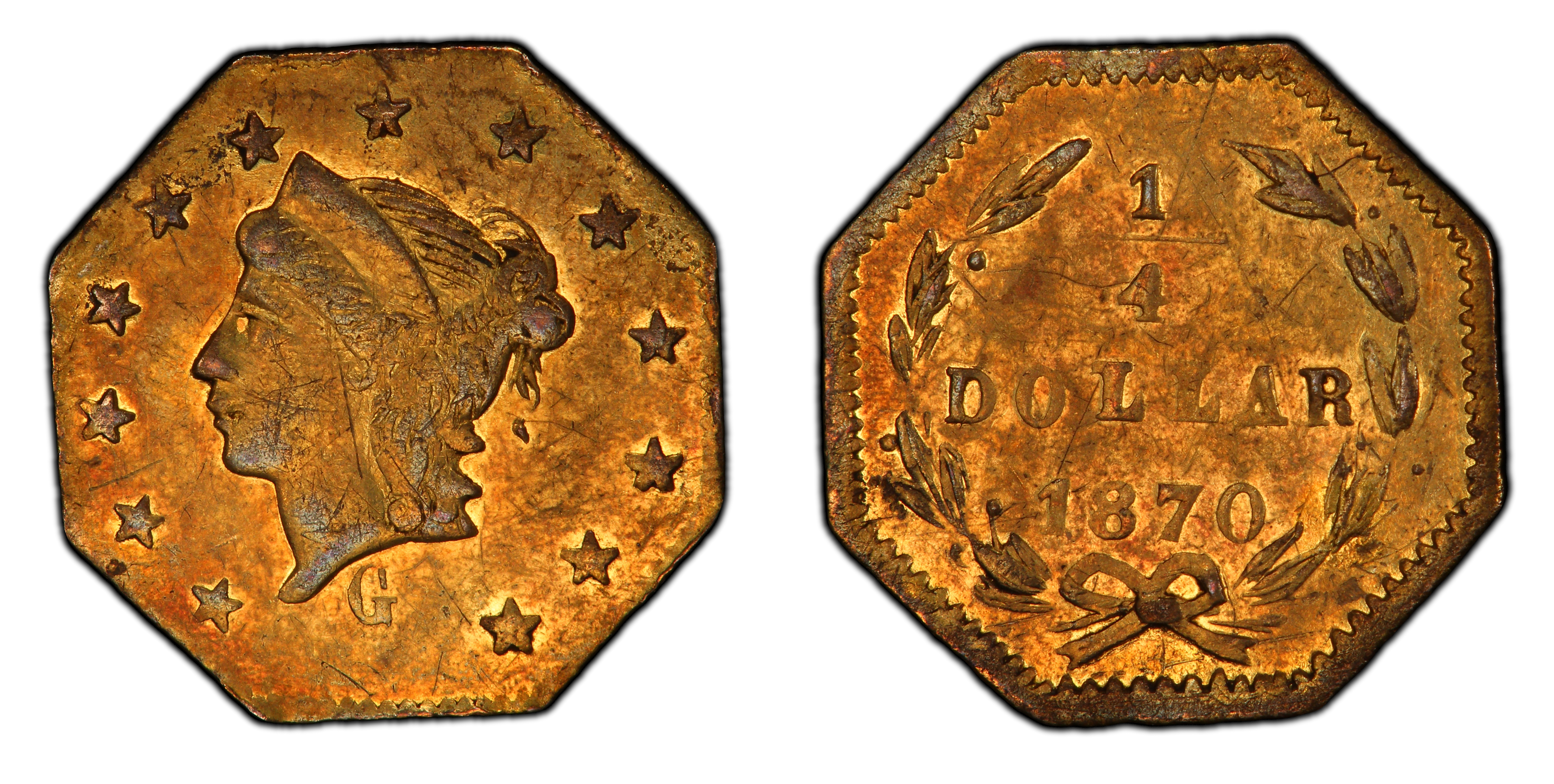
Obverse & Reverse
The 1870 G25C BG-754 is a product of the second period (1859-1882) of California Fractional Gold production, a fascinating and complex chapter in American numismatic history. Born from the acute shortage of small change during the California Gold Rush, the earliest fractional gold pieces of the 1850s were genuine attempts to facilitate commerce. By 1870, however, the landscape had changed. The San Francisco Mint was in full operation, producing ample federal silver and gold coinage, which largely obviated the commercial need for private issues. Consequently, the purpose of fractional gold shifted from utilitarian currency to souvenirs, keepsakes, and jewelry items. These Period Two issues are often collectively termed 'jeweler's issues' because they were primarily produced by jewelers and artisans in San Francisco, rather than dedicated private mints. These pieces were often intentionally underweight relative to their face value, a fact that was of little concern to buyers who purchased them as mementos of the Golden State. The production methods were rudimentary, often involving a sledgehammer to strike a planchet between two hand-cut dies, leading to wide variations in strike quality. The U.S. government took a dim view of private coinage, and the Coinage Act of 1864 officially outlawed the practice. However, enforcement in distant California was lax until the Secret Service finally cracked down on the remaining producers in 1883, bringing the era of California Fractional Gold to a definitive close. The BG-754, like its contemporaries, was a part of this final, quasi-legal phase of production, created for a public enchanted with the allure of gold, however small the quantity.
Associated EventCalifornia Gold Rush Era
Reason For MintingPrimarily created as a souvenir or keepsake for tourists and locals during a period when the original commercial necessity for fractional gold had waned.
Minter HistoryThe specific maker of the BG-754 variety is unknown. This is characteristic of many Period Two 'jeweler's issues' where the producers were often anonymous artisans or small jewelry firms in San Francisco who did not sign their work. Unlike Period One issues, which sometimes bore the initials or names of their makers (e.g., Frontier & Deviercy), these later pieces were sold generically without attribution.
Historical SignificanceThe coin is significant as an artifact of a transitional period in California's economic history, representing the shift of fractional gold from a necessary circulating medium to a popular souvenir item. It embodies the enduring legacy and mythology of the Gold Rush, long after the initial fever had subsided, and is a tangible link to the unofficial, private nature of commerce and memorabilia on the 19th-century American frontier.
N/A
Denomination25 Cents
Minting Period1870
Assayer/MinterUnknown Private Minter
Geographic OriginSan Francisco, California
Obverse DescriptionA crudely rendered Liberty Head facing left, wearing a coronet. The portrait is encircled by thirteen five-pointed stars, which are often weakly struck or irregularly spaced. The style is a miniature and somewhat primitive imitation of contemporary federal gold coinage.
Obverse Inscription Reverse DescriptionWithin a wreath of two olive branches tied with a bow at the bottom, the denomination '1/4' is displayed with a horizontal fraction bar, with 'DOLLAR' below. The date '1870' appears below the bow of the wreath. The wreath itself is typically composed of numerous small leaves.
Reverse Inscription1/4 DOLLAR 1870
CompositionGold
Stated Fineness Actual FinenessVariable, but generally lower than federal standards for the period, consistent with jeweler's issues not intended for strict monetary circulation.
EdgePlain
Unknown, but presumed to be very small.
Survival Estimate7-9 known specimens.
Rarity ScaleR-7
This coin is highly sought after due to its extreme rarity (R-7). As a Period Two octagonal Liberty Head type, it appeals to specialists in the extensive California Fractional Gold series. Its crude charm and historical context as a Gold Rush-era souvenir add to its allure. Completing a set of all known BG varieties is a monumental task, making any individual R-7 variety a significant acquisition.
Key VarietiesThe BG-754 itself is a distinct variety defined by its specific obverse and reverse die pairing. There are no major sub-varieties or special collector issues like proofs or restrikes known for this issue; all known examples are business strikes from the original period of manufacture. The Breen-Gillio reference work catalogs hundreds of distinct die marriages from this era, each considered a separate variety.
Authentication TipsAuthentication requires comparison to known genuine examples, ideally using the photographic plates in the Breen-Gillio/Leonard reference book. Key diagnostics for BG-754, as noted in auction catalogs, include sharp stars, a horizontal fraction bar, a low date positioned just above the wreath's bow, and a denominator with a distinctive stubby crossbar. Counterfeits of this series abound; many are brass tokens or modern fakes. Authentic pieces have a characteristic fabric and strike that differs from modern copies. Any piece with a bear on the reverse is a 20th-century token, not an original fractional gold coin. Certification by a major grading service (PCGS or NGC) is highly recommended.
Shopping ConsiderationsFor a premium quality BG-754, a buyer should prioritize sharpness of strike and pristine surfaces. Given the crude manufacturing process, even Mint State examples can show weakness in the stars or the details of Liberty's hair and the wreath. An example with a bold strike on the central devices (head and denomination) is highly desirable. Look for original, undisturbed luster, which often has a slightly reddish or 'brassy' gold hue. Avoid examples that have been cleaned, polished, or used as jewelry, as this severely impairs value. Pay close attention to the fields for minute scratches or planchet flaws, which are common but should not be distracting. Given the coin's R-7 rarity, any available example is significant, but one with superior eye appeal and a CAC sticker would command a substantial premium.
A coin's grade is its condition, rated on a 1-70 scale. For rare coins, this is the most critical factor in determining value, as a tiny difference in preservation can mean a huge difference in price.
Relevant Grade TypesAll original examples of BG-754 are business strikes, intended for sale as souvenirs. They are found in Circulated (1-58) and, more commonly for surviving specimens, Mint State (MS, 60-70) grades. Due to their nature as keepsakes, a higher proportion survived in uncirculated condition compared to coins made for commerce. No Proof (PR/PF) examples were struck during the original period, and no later-date collector restrikes are known to exist.
Mint State CharacteristicsIn uncirculated condition, the BG-754 typically exhibits a soft, satiny luster, sometimes with prooflike or reflective fields from freshly polished dies. The strike is a key determinant of quality; many are weakly struck, particularly on the peripheral stars and the high points of Liberty's hair. A well-struck piece will show clear separation in the hair strands and sharp details in the wreath leaves. Small planchet flaws, file marks, or die cracks are not uncommon and are part of the coin's character, but large, distracting flaws will detract from the grade. Contact marks, even on MS coins, can be present due to the softness of the gold.
Circulated Wear PatternsWear first appears on the highest points of the design. On the obverse, this includes Liberty's cheek, the hair above the ear, and the coronet. On the reverse, the high points of the wreath leaves and the edges of the numerals and letters will show the first signs of friction. On lower-grade circulated examples, the stars will begin to merge with the fields, and the fine details of the wreath will become flat and indistinct.
Key Factors For ValueFor the BG-754, value is driven almost exclusively by rarity and condition. Given that fewer than ten examples are known, any certified, problem-free coin is a major numismatic prize. The primary value differentiators are the grade (e.g., MS-63 vs. AU-58) and the quality within that grade. A sharp strike is the most important factor for eye appeal. Surface preservation is critical; an example with original, uncleaned surfaces and attractive reddish-gold toning will always be prized over a harshly cleaned or damaged piece. A CAC sticker, indicating premium quality for the grade, adds a significant premium for a rarity of this magnitude.
PCGS Price Guide
| Grade | Price | Population |
|---|---|---|
| 35 | $575.00 | 1 |
| 40 | $600.00 | N/A |
| 45 | $625.00 | N/A |
| 45+ | $650.00 | N/A |
| 50 | $700.00 | 1 |
| 50+ | $725.00 | N/A |
| 53 | $775.00 | N/A |
| 53+ | $875.00 | N/A |
| 55 | $1,000.00 | 3 |
| 55+ | $1,125.00 | N/A |
| 58 | $1,250.00 | 1 |
| 58+ | $1,400.00 | N/A |
| 60 | $1,550.00 | N/A |
| 61 | $1,750.00 | 1 |
| 62 | $2,650.00 | 5 |
| 62+ | $3,000.00 | N/A |
| 63 | $3,250.00 | 2 |
| 63+ | $3,750.00 | N/A |
| 64 | $4,500.00 | 1 |