1868 G25C BG-746 (Regular Strike)
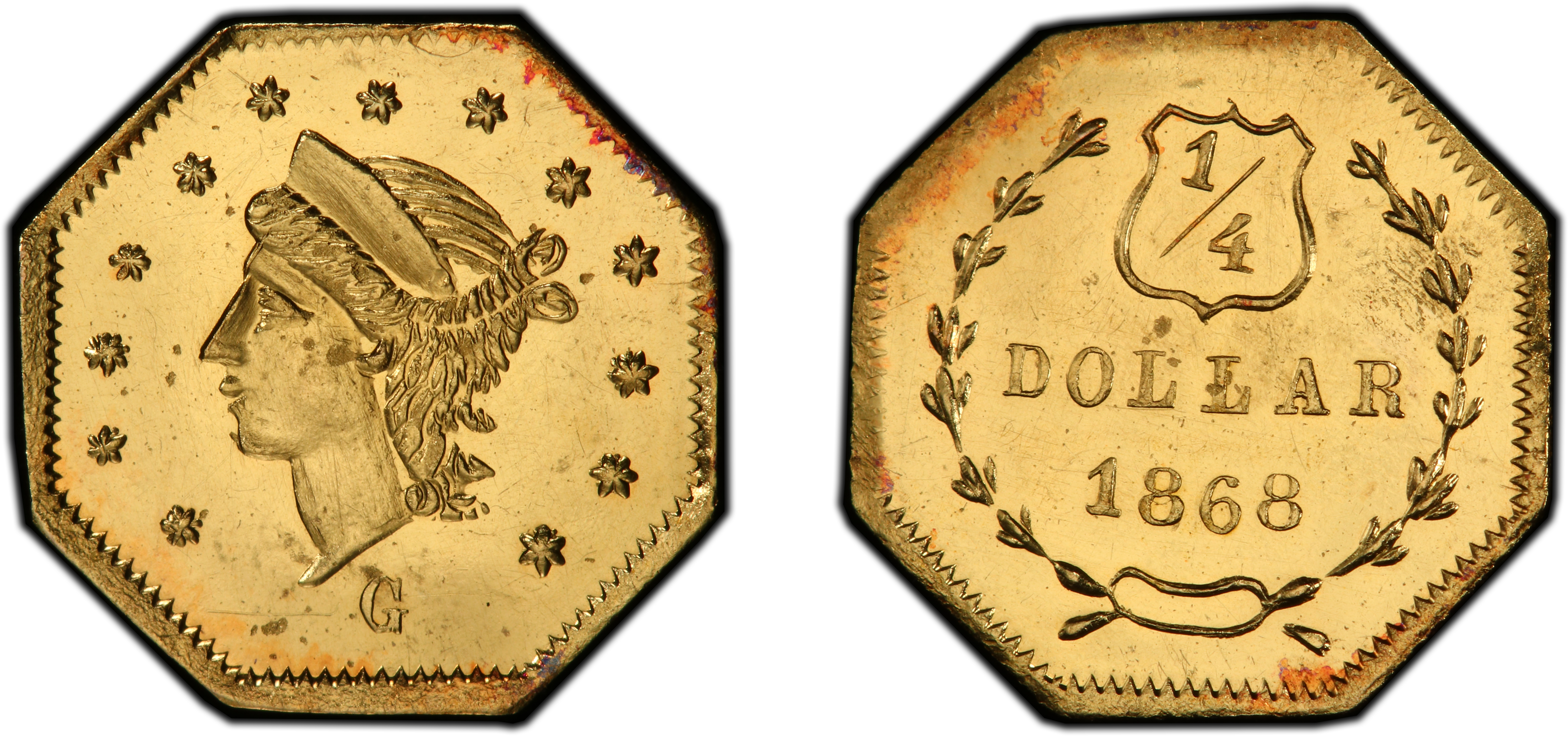
Obverse & Reverse
The 1868 BG-746 octagonal quarter dollar is a quintessential example from 'Period Two' (1858-1882) of California Fractional Gold production, a fascinating and complex chapter in American numismatics. Following the initial California Gold Rush, a severe shortage of small-denomination coinage plagued local commerce. While 'Period One' (1852-1857) issues were struck out of genuine necessity and are believed to have circulated widely, Period Two pieces emerged in a different economic landscape. By 1868, the San Francisco Mint was in full operation, largely satisfying the region's need for official coinage. The impetus for striking these tiny gold pieces shifted from commercial necessity to the burgeoning souvenir and jewelry trade. San Francisco jewelers, like Robert B. Gray & Co., realized there was a robust market for mementos of the Golden State. These pieces were sold to tourists and sent to Eastern contacts as curiosities and keepsakes. The Coinage Act of 1864 had officially outlawed private coinage, but the law was not aggressively enforced by the Secret Service until 1883. This legal gray area allowed jewelers to continue production, often backdating coins to pre-1864 years to feign compliance. Period Two coins are often termed 'Suppressed Jewelers' Issues' for this reason. They were typically lighter and sometimes of lower fineness than their Period One predecessors, functioning more as denominated tokens than true coinage. Despite their semi-legal status, they were produced in significant quantities with a wide variety of designs, capturing the romanticism of the Gold Rush era for a national audience.
Associated EventPost-Gold Rush Economic Expansion
Reason For MintingPrimarily struck to be sold as souvenirs and jewelry charms to tourists and collectors during a period of lax enforcement of private coinage laws.
Minter HistoryRobert B. Gray & Co. was a prominent San Francisco jewelry firm and a prolific producer of Period Two California Fractional Gold. Around 1859, Gray purchased the business of another established jeweler and fractional gold minter, Antoine Louis Nouizillet. Gray continued to use some of Nouizillet's dies while also creating his own, which are often identifiable by a 'G' mintmark or distinctive design elements. His firm was active in this space until 1871, when he sold his interests to the California Jewelry Co. Gray's issues are noted by researchers like Breen and Gillio for being generally heavier and of higher intrinsic value than many other competing jeweler's issues of the period.
Historical SignificanceThe BG-746 represents the transition of private California gold from a necessary medium of exchange to a popular collectible and souvenir. It is a tangible artifact of the post-Gold Rush era's economy, highlighting the lax federal oversight of private minting and the national fascination with the Wild West. Its existence demonstrates a uniquely American form of entrepreneurship in a numismatic gray market.
BG-746
Denomination$0.25 (Quarter Dollar)
Minting Period1868
Assayer/MinterRobert B. Gray & Co.
Geographic OriginSan Francisco, California
Obverse DescriptionA classic Liberty Head portrait facing left, modeled after the contemporary federal gold coinage. The portrait is surrounded by 13 six-pointed stars, representing the original colonies.
Obverse Inscription Reverse DescriptionThe denomination '1/4 DOLLAR' and the date '1868' are arranged in three lines within a continuous wreath. The wreath is composed of two olive branches, and a key diagnostic for the BG-746 variety is that the bow tying the branches at the bottom is uniquely shaped, often described by specialists as resembling a cucumber.
Reverse Inscription1/4 DOLLAR 1868
CompositionGold
Stated Fineness Actual FinenessVaries, typical for Period Two jeweler's issues (approx. 14-21 Karat)
Weight0.24 grams
Diameter9.60 mm
EdgePlain
Unknown
Survival Estimate76-125
Rarity ScaleR-4+
This variety appeals to collectors due to its specific attribution within the vast Breen-Gillio catalog, its octagonal shape, and its origin with a known, high-quality private minter. The clear date and distinctive design diagnostics make it a rewarding piece for specialists.
Key VarietiesThe BG-746 attribution refers to a specific die marriage. There are no major, recognized sub-varieties from the original minting period. No special collector restrikes or patterns are known to exist.
Authentication TipsAuthentication requires careful examination of specific die markers. For a genuine BG-746: 1) The '6' in the date 1868 is punched noticeably low relative to the other digits. 2) The bow on the reverse wreath has a distinct, elongated 'cucumber' shape. 3) The piece must be denominated; fakes and later charms often lack the word 'DOLLAR'. 4) Genuine pieces have a soft, lustrous character from the striking process, while counterfeits often have casting bubbles, a soapy texture, or tool marks from hand-engraving. Any piece featuring a bear on the reverse is a modern replica.
Shopping ConsiderationsA premium quality example for its grade will exhibit a sharp strike, particularly on the stars of the obverse and the lettering on the reverse. Many examples are weakly struck in areas due to the crude 'hammer method' of minting. Look for examples with original, undisturbed surfaces and a pleasing 'green-gold' or reddish-gold patina, often seen on this issue. High-grade examples can be dazzlingly prooflike. Avoid coins that have been harshly cleaned, which strips the original skin and imparts hairline scratches. Also, be wary of pieces that have been previously mounted in jewelry, checking the edges carefully for evidence of soldering or tooling.
A coin's grade is its condition, rated on a 1-70 scale. For rare coins, this is the most critical factor in determining value, as a tiny difference in preservation can mean a huge difference in price.
Relevant Grade TypesAll original 1868 BG-746 pieces were business strikes intended for commercial sale as souvenirs, not for monetary circulation in the traditional sense. They are found in Circulated (1-58) and, more commonly, Mint State (MS, 60-70) grades due to their nature as collectibles from inception. No true Proofs were struck during the original period of issue, and no later-date Proof restrikes are known.
Mint State CharacteristicsUncirculated examples are defined by their luster. High-quality BG-746 specimens often display a vibrant, watery, prooflike (PL) luster. Due to the manual striking process, even high-grade Mint State coins can show areas of strike weakness, particularly in the center of the obverse and on the reverse wreath. Small planchet flaws or adjustment marks are not uncommon and should be assessed for their impact on eye appeal. The tiny size makes these coins susceptible to contact marks, which will appear as minute nicks or scratches in the fields.
Circulated Wear PatternsOn circulated examples, wear first appears on the highest points of the design. For the obverse, this includes Liberty's cheek, hair details above the ear, and the eyebrow. On the reverse, the high points of the wreath's leaves and the numerals of the date will show the first signs of friction and flattening. In lower grades (VF and below), the stars on the obverse will begin to lose their points and the fine details of the wreath will merge.
Key Factors For ValueFor the BG-746, value is driven by several factors. Firstly, a sharp, well-centered strike commands a significant premium, as many are unevenly struck. Secondly, surface quality is paramount; examples with clean, prooflike fields free of distracting marks are highly prized. Thirdly, eye appeal, which is dictated by attractive original toning and luster, can make one MS-63 example worth significantly more than another. Finally, certification by PCGS or NGC is standard for this series, and a CAC sticker indicating premium quality for the grade adds another layer of value.
PCGS Price Guide
| Grade | Price | Population |
|---|---|---|
| 50 | $185.00 | 1 |
| 50+ | $190.00 | N/A |
| 53 | $200.00 | 1 |
| 53+ | $210.00 | N/A |
| 55 | $225.00 | 1 |
| 55+ | $235.00 | N/A |
| 58 | $250.00 | 6 |
| 58+ | $280.00 | N/A |
| 60 | $300.00 | N/A |
| 61 | $325.00 | 8 |
| 62 | $350.00 | 21 |
| 62+ | $385.00 | N/A |
| 63 | $475.00 | 11 |
| 63+ | $650.00 | N/A |
| 64 | $1,800.00 | 4 |