1881 G25C BG-799O (Regular Strike)
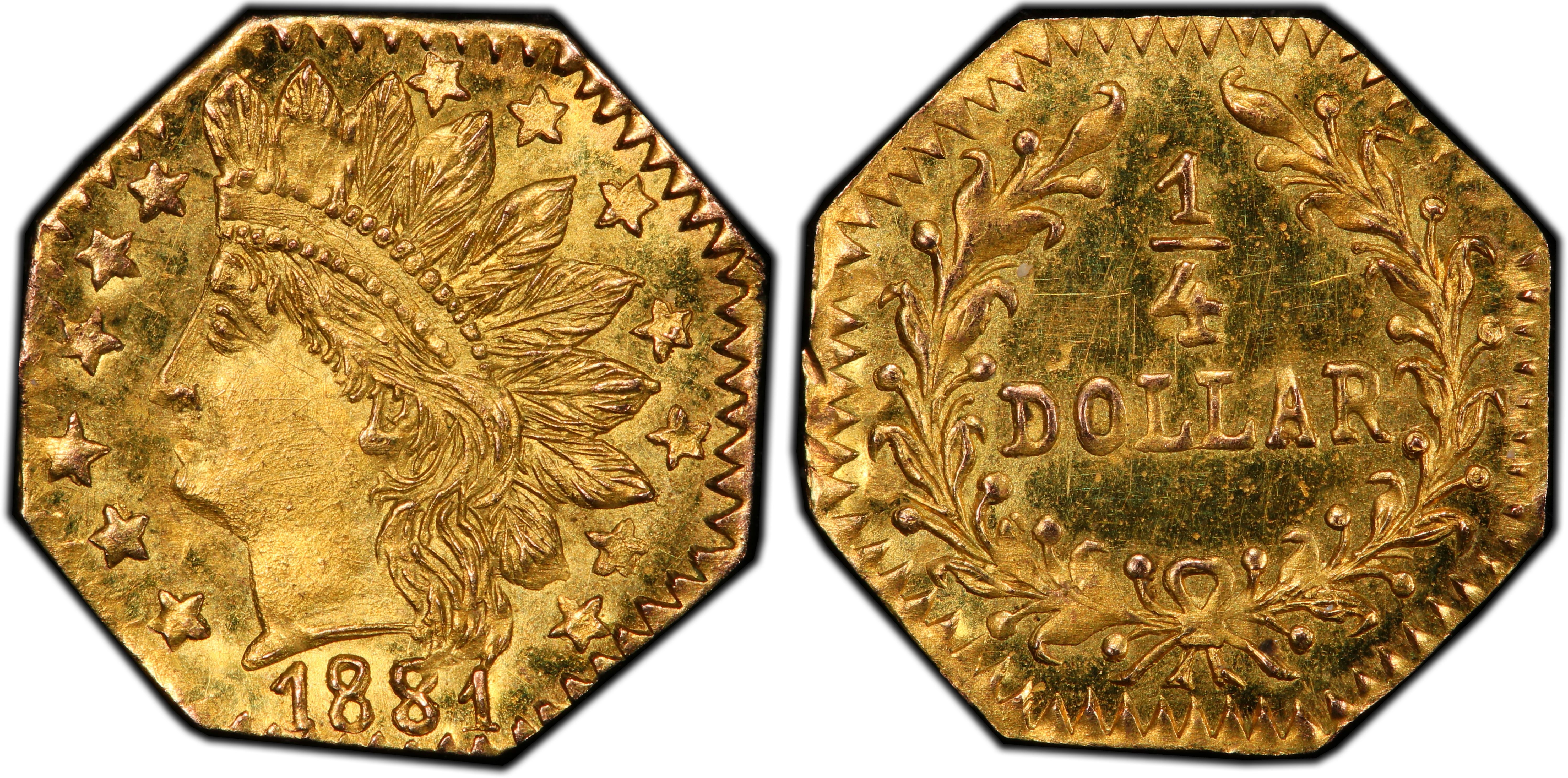
Obverse & Reverse
The 1881 BG-799O 25 Cents represents the twilight of the fascinating California Fractional Gold series. By this late date, the original purpose of these miniature gold pieces—to alleviate the chronic shortage of small denomination coinage during the initial Gold Rush frenzy—had long since passed. The establishment and efficient operation of the San Francisco Mint by the mid-1850s had saturated the region with official federal silver and gold coins, rendering private issues for commerce obsolete. The pieces struck from the late 1850s through the early 1880s, classified by numismatists as 'Period Two' issues, served an entirely different function. They were primarily produced by jewelers and merchants as souvenirs, trinkets, and novelties for a burgeoning tourist trade and for collectors back East who were captivated by the romance of the Gold Rush. Christopher Ferdinand Mohrig, a San Francisco jeweler and one of the most prolific producers of these late-date fractionals, created the BG-799O. His operation, however, was on a collision course with the federal government. The United States Secret Service, under the increasingly zealous direction of Chief James J. Brooks, began to aggressively investigate and suppress the manufacture of private coinage, arguing it violated the government's exclusive constitutional authority. While early issues had circulated out of necessity, these later 'jeweler's issues' were seen as a direct challenge to federal law, particularly the Coinage Act of 1864 which explicitly forbade private minting. Minters often employed tactics to circumvent prosecution, such as backdating coins or, in some cases, omitting the word 'DOLLAR' to argue the pieces were mere tokens. Mohrig himself was arrested in 1876, and his dies and equipment were confiscated, yet production of various pieces by him and others continued sporadically until the final crackdown in 1882-1883 effectively ended the era of private U.S. gold coinage. The BG-799O, dated 1881, stands as one of the very last gasps of this uniquely American numismatic tradition, a beautifully crafted memento from a time when private enterprise directly addressed the monetary needs—and later, the romantic imagination—of a nation.
Associated EventPost-Gold Rush Era / Federal Suppression of Private Coinage
Reason For MintingPrimarily produced as a collectible souvenir for the tourist and collector market, not for general circulation.
Minter HistoryChristopher Ferdinand Mohrig was a prominent San Francisco-based jeweler and die-sinker active in the latter period of California Fractional Gold production. He is responsible for a wide array of varieties cataloged in the Breen-Gillio reference, generally from BG-790 through BG-799V. His work is characterized by high-quality engraving and consistent, often proof-like strikes. Mohrig's operations attracted the attention of the U.S. Secret Service, leading to his arrest in August 1876 for violating the Private Coinage Act of 1864. While his equipment was seized, he and others continued to produce these pieces until federal pressure finally halted all such activities in the early 1880s, making his issues among the last of their kind.
Historical SignificanceThis coin is significant not as a circulating medium, but as a product of the transition from functional pioneer coinage to commercial souvenir. It represents the final chapter of private gold minting in the United States and is a tangible artifact of the legal battle between private minters and the federal government over the right to produce coinage.
N/A
DenominationG25C (25 Cents)
Minting Period1881
Assayer/MinterChristopher Ferdinand Mohrig
Geographic OriginSan Francisco, California
Obverse DescriptionThe obverse features a stylized head of an Indian princess facing left, reminiscent of the contemporary federal Indian Head cent. She wears a feathered headdress, and her hair flows down her neck. The portrait is encircled by thirteen six-pointed stars, representing the original colonies. The date '1881' is positioned below the bust.
Obverse Inscription1881
Reverse DescriptionThe reverse is dominated by a closed wreath composed of two olive branches. Inside the wreath, the denomination is expressed on two lines. This is a 'No Cal' variety, meaning the word 'California' does not appear on the coin.
Reverse Inscription1/4 DOLLAR
CompositionGold
Stated Fineness Actual FinenessVariable, typical for Period Two issues (estimated 14 to 22 karats).
Weight0.25 grams
Diameter9.60 mm
EdgePlain
Unknown
Survival Estimate150-200
Rarity ScaleR-4 (Low Rarity-4)
The BG-799O is highly popular as one of the final issues of the California Fractional Gold series, struck just before federal authorities shut down all private mints. Its appeal lies in its sharp, often proof-like quality, the classic Indian Head design, and its historical context as a 'swan song' piece. High-grade examples are particularly prized for their superb eye appeal.
Key VarietiesThe primary variety is the regular strike as described. A critically important and likely unique related piece exists, struck from the same BG-799O obverse and reverse dies, but with the word 'DOLLAR' omitted from the reverse, which simply reads '1/4'. This token-like piece was almost certainly an attempt by the minter to evade the Private Coinage Act by removing the explicit monetary denomination. No later-date restrikes or patterns are widely recognized for this specific variety.
Authentication TipsAuthentic examples are typically well-struck with sharp details on the portrait and wreath. The surfaces on high-grade pieces are often reflective and proof-like. Be wary of modern replicas which are common in this series; these are often cast, showing pitting and softness of detail, or have incorrect weight and luster. Compare the style of the Indian Head, the shape of the numerals in the date, and the wreath leaves to high-resolution images of certified examples. Period Two originals were die-struck, not cast.
Shopping ConsiderationsA premium quality example for its grade will exhibit flashy, proof-like or deep mirror proof-like (DMPL) surfaces with minimal contact marks. Look for a sharp strike on the high points of the Indian's hair and the feathers of the headdress, as well as on the fine details of the wreath. The small size of these coins makes them susceptible to damage; carefully inspect for any signs of jewelry mounting, tooling, harsh cleaning, or edge impairments, all of which will drastically reduce the value. An attractive, original reddish-gold toning is a plus. Given the prevalence of counterfeits, purchasing examples certified by major grading services (PCGS, NGC) is strongly recommended.
A coin's grade is its condition, rated on a 1-70 scale. For rare coins, this is the most critical factor in determining value, as a tiny difference in preservation can mean a huge difference in price.
Relevant Grade TypesOriginal 1881 BG-799O pieces were business strikes, although struck with care and often sold directly to collectors and tourists, thus many survived in high grade. They are found in Circulated (1-58) and, more commonly, Mint State (MS, 60-70) grades. Due to their manufacturing process, many Mint State examples qualify for Prooflike (PL) or Deep Mirror Prooflike (DMPL) designations, which carry a premium. No true Proofs were struck during the original period of issue.
Mint State CharacteristicsUncirculated examples of BG-799O are known for their exceptional quality. Luster is typically bright, flashy, and highly reflective, hence the common PL and DMPL designations. The strike is usually sharp, though minor weakness might be seen on some of the peripheral stars. As these were handled as novelties, even high-grade specimens may show minor hairlines or small ticks from cabinet friction or light handling over the decades.
Circulated Wear PatternsOn circulated examples, wear first appears on the highest points of the design. For the obverse, check the cheek, the eyebrow, and the feathers in the headdress. On the reverse, the highest leaves and berries of the wreath will show flatness and loss of detail first. In lower grades (VF and below), the stars will begin to merge with the fields and the finer details of the hair will be completely worn away.
Key Factors For ValueThe primary value driver for this coin is its grade and surface quality. A Mint State coin with a PL or DMPL designation will command a significant premium over a standard MS example. Eye appeal is paramount; a coin with brilliant, clean surfaces and attractive original color will be worth far more than a similarly graded piece that is hazy, darkly toned, or has distracting contact marks. A CAC sticker, indicating premium quality for the grade, adds a further, often substantial, premium for this popular issue.
PCGS Price Guide
| Grade | Price | Population |
|---|---|---|
| 58 | $245.00 | 1 |
| 58+ | $250.00 | N/A |
| 60 | $285.00 | N/A |
| 61 | $300.00 | N/A |
| 62 | $325.00 | 8 |
| 62+ | $345.00 | N/A |
| 63 | $375.00 | 21 |
| 63+ | $390.00 | N/A |
| 64 | $450.00 | 46 |
| 64+ | $600.00 | N/A |
| 65 | $900.00 | 36 |
| 65+ | $1,100.00 | N/A |
| 66 | $1,550.00 | 5 |
| 67 | N/A | N/A |