1876 G25C BG-799 (Regular Strike)
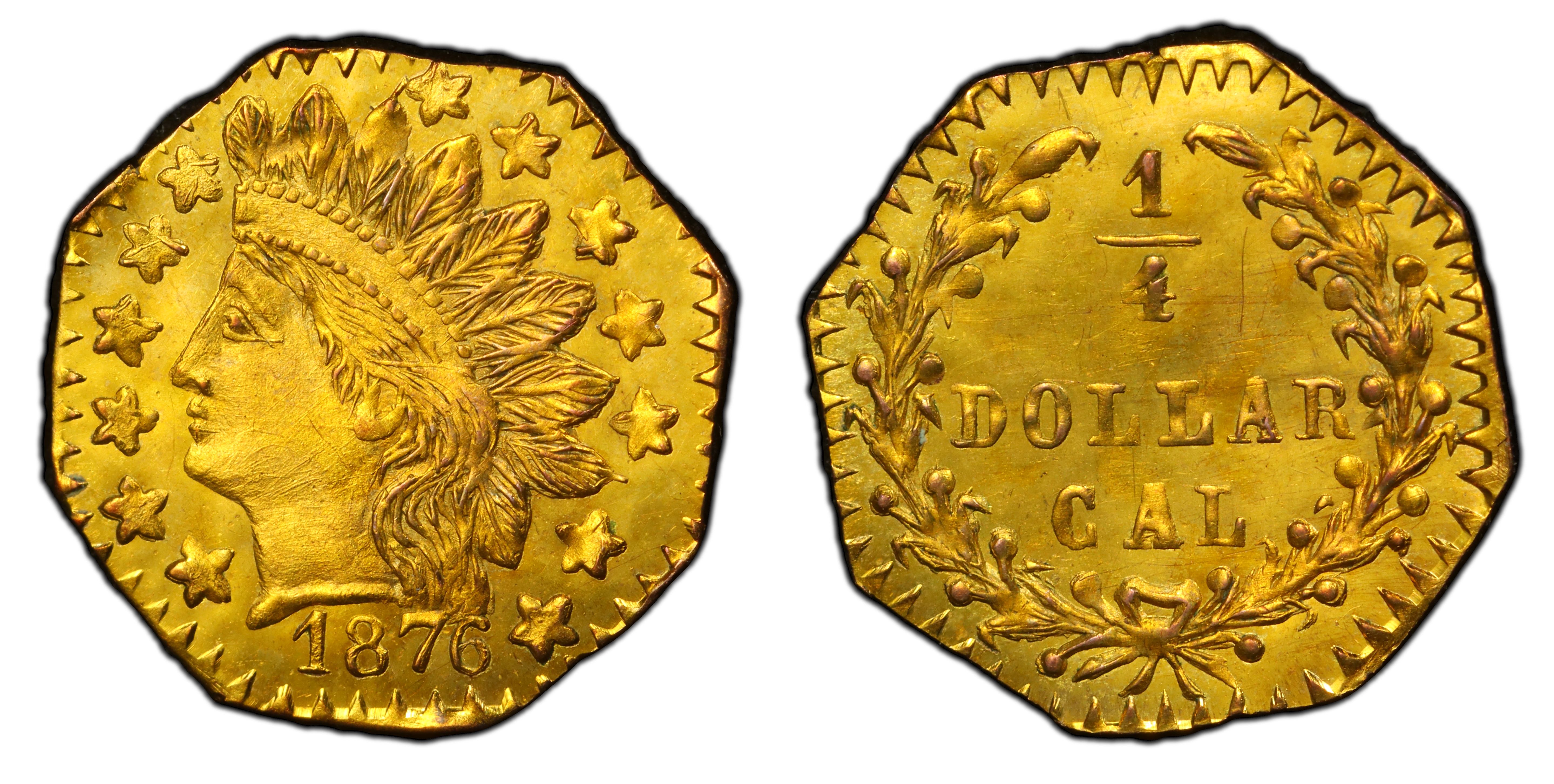
Obverse & Reverse
The 1876 BG-799 25 Cents represents a fascinating chapter in American currency, born from a unique economic environment decades after the initial frenzy of the California Gold Rush. This piece is classified as a 'Period Two' or 'Jeweler's Issue' of California Fractional Gold. By the 1870s, the acute shortage of small change that prompted the initial wave of privately-minted gold 'slugs' and fractional coins had been largely resolved by the output of the official San Francisco Mint. The need for a circulating private currency had vanished. However, the allure of California gold remained potent, transforming these tiny gold pieces from essential monetary instruments into coveted souvenirs, keepsakes, and jewelry items. San Francisco jewelers, many of French origin, stepped in to meet this new demand. They produced a vast array of small-denomination gold pieces, often back-dated to the Gold Rush heyday or bearing contemporary dates like 1876, which coincided with the nation's Centennial celebration, further boosting demand for mementos. These 'Jeweler's Issues' were not intended to and did not circulate as money. Consequently, they were often underweight for their stated value and their gold content could vary significantly, from as low as 14-karat up to near-pure gold. The production method was rudimentary, often involving a sledgehammer to strike the dies, resulting in coins with inconsistent strike quality. The BG-799 is a specific die marriage within a family of similar octagonal Indian Head quarter dollars dated 1876. Its existence is a testament to the cottage industry that thrived on nostalgia for the Gold Rush and the public's desire for miniature gold treasures. The federal government took a dim view of these private issues, viewing them as a violation of its sole authority to coin money. The Coinage Act of 1864 had already forbidden private coinage, but enforcement was lax until the Secret Service finally clamped down on the practice in 1883, bringing the era of California Fractional Gold to an abrupt end. The BG-799, therefore, is a relic from the twilight of this uniquely Californian numismatic tradition, more a commercial product than a coin, yet inextricably linked to the legacy of the western gold fields.
Associated EventPost-Gold Rush Souvenir Market & U.S. Centennial
Reason For MintingPrimarily produced to be sold as souvenirs, keepsakes, and for use in jewelry rather than for monetary circulation.
Minter HistoryThe specific minter for the BG-799 die pair is unknown and unassigned in numismatic references. It was produced by one of the numerous private jewelers operating in San Francisco in the 1870s. These artisans, including figures like M. Deriberpe, Antoine Louis Nouizillet, Frontier & Deviercy, specialized in creating these miniature gold pieces for the robust souvenir market, but definitive attributions for most Period Two varieties have been lost to history.
Historical SignificanceThe BG-799 is significant not as a circulating coin but as a numismatic artifact representing the commercialization of the Gold Rush legacy. It showcases the transition of fractional gold from a necessary private currency to a popular souvenir item, reflecting the changing economic and social landscape of California in the latter half of the 19th century. Its rarity today underscores the limited, demand-driven production and subsequent high attrition rate of these small, easily lost items.
K-N/A
Denomination25 Cents
Minting Period1876
Assayer/MinterUnknown San Francisco Jeweler
Geographic OriginSan Francisco, California
Obverse DescriptionAn Indian Head facing left, surrounded by 13 stars. The portrait is stylized and typical of the 'Jeweler's Issues' of the period, often lacking the fine detail of federal coinage. The date 1876 appears below the bust.
Obverse Inscription1876
Reverse DescriptionThe denomination '1/4' is centered within a wreath of leaves and berries. Unlike many other fractional gold issues, the word 'DOLLAR' or any abbreviation thereof is absent, and the reverse also lacks the 'CAL.' inscription found on some related varieties.
Reverse Inscription1/4
CompositionGold
Stated Fineness Actual FinenessVaries, typically between .585 and .900 (14 to 22 karats)
Weight0.25 grams
Diameter10.00 mm
EdgePlain
Unknown
Survival Estimate19-24 pieces known
Rarity ScaleHigh R-6
The BG-799 is highly prized for its extreme rarity, octagonal shape, and classic Indian Head design. As a dated Centennial issue, it carries additional historical appeal. It is a key variety for advanced specialists of the extensive and challenging California Fractional Gold series.
Key VarietiesThe BG-799 is itself a specific die marriage (variety). The Breen-Gillio reference work catalogs several distinct die pairings for the 1876 octagonal 25 cents Indian Head type, including BG-799A, BG-799B, BG-799C, etc., each distinguished by minor differences in the dies. The 'Regular Strike' BG-799 is the base catalog number for this family. No major sub-varieties of the BG-799 die pair itself are known or collected. No later-date restrikes or special collector issues are known to exist.
Authentication TipsAuthenticity is paramount. Genuine pieces are struck in gold, not brass or gold-plated base metals. The details, while sometimes crude, should be sharp and not have a soft, cast-like appearance. The style of the Indian Head and the wreath must match published photos in the Breen-Gillio reference exactly. Many replicas exist, often with incorrect design elements; a common diagnostic for fakes is the presence of a bear on the reverse, which no genuine pre-1900 fractional gold pieces have. Due to the high rarity and value, authentication by a top-tier grading service (PCGS or NGC) is strongly recommended.
Shopping ConsiderationsFor a premium quality example, seek a piece with a bold strike, particularly on the stars, the details of the headdress, and the wreath on the reverse. Weak strikes are common due to the crude manufacturing process, so well-struck examples command a significant premium. Original, lustrous surfaces are highly desirable and rare; most surviving examples show evidence of cleaning or handling. Look for undisturbed 'skin' and avoid pieces with harsh cleaning, scratches, or evidence of having been mounted in jewelry (though this is common for the series). Attractive, original reddish-gold toning adds to the eye appeal. Given the R-6 rarity, any example, even one with minor impairments, is a significant find.
A coin's grade is its condition, rated on a 1-70 scale. For rare coins, this is the most critical factor in determining value, as a tiny difference in preservation can mean a huge difference in price.
Relevant Grade TypesOriginal issues were business strikes, although not intended for circulation, and are found in both Circulated (1-58) and Mint State (MS, 60-70) grades. Due to their nature as souvenirs, many were preserved in high grades. No Proof (PR/PF) examples were struck during the original period of issue, and no later-date Proof restrikes are known.
Mint State CharacteristicsAn uncirculated BG-799 is defined by the presence of original mint luster, which is typically satiny and sometimes reflective (Prooflike or PL). Strike weakness is common; look for sharpness in the central devices like the Indian's cheek and the numerals on the reverse. Because they were made by jewelers and handled as novelties, even Mint State examples often show minor contact marks or 'chatter' from being stored with other small gold pieces. A superior MS coin will combine a strong strike with clean surfaces and vibrant luster.
Circulated Wear PatternsWear first appears on the highest points of the design. On the obverse, this includes the cheek and the feathers of the headdress. On the reverse, the high points of the wreath's leaves and bow will show initial friction and smoothing. In lower grades (VF and below), the stars will begin to merge with the fields and the finer details of the wreath will be lost.
Key Factors For ValueRarity is the primary driver of value. For a specific example, the grade is critical. However, surface quality and eye appeal can be just as important. A choice, original MS-63 with attractive toning can be more valuable than a harshly cleaned or baggy MS-64. The sharpness of the strike is a key differentiator. A CAC sticker, indicating premium quality for the grade, adds a significant premium for this and other California Fractional Gold issues.
PCGS Price Guide
| Grade | Price | Population |
|---|---|---|
| 55 | $200.00 | 1 |
| 55+ | $205.00 | N/A |
| 58 | $225.00 | 2 |
| 58+ | $240.00 | N/A |
| 60 | $265.00 | N/A |
| 61 | $325.00 | 2 |
| 62 | $400.00 | 21 |
| 62+ | $475.00 | N/A |
| 63 | $525.00 | 36 |
| 63+ | $575.00 | N/A |
| 64 | $650.00 | 25 |
| 64+ | $800.00 | 1 |
| 65 | $1,250.00 | 13 |
| 65+ | $1,500.00 | 1 |
| 66 | $2,000.00 | N/A |
| 67 | N/A | N/A |