1875 G25C BG-777 (Regular Strike)
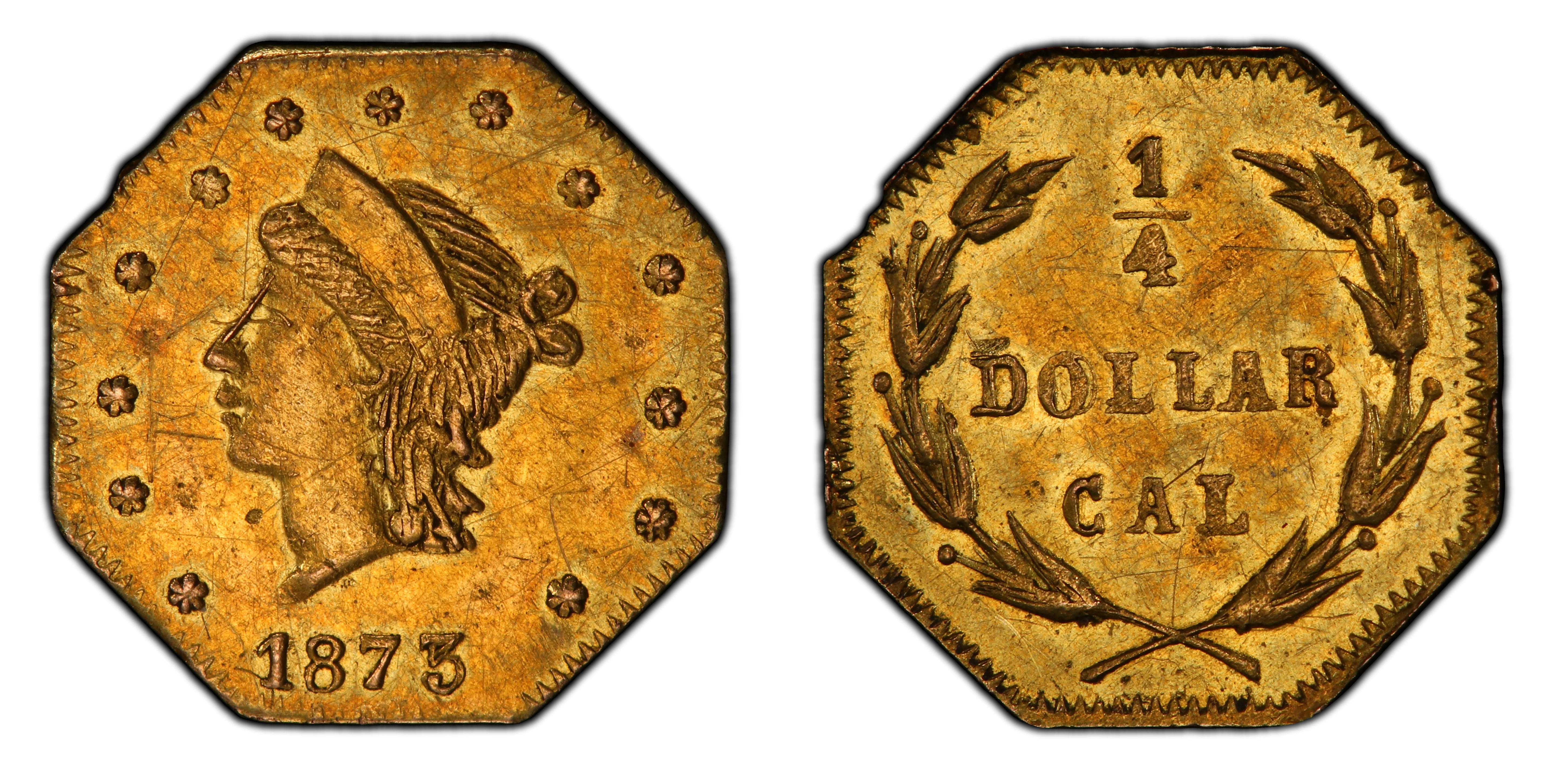
Obverse & Reverse
The 1875 Octagonal Liberty Head Quarter Dollar, cataloged as BG-777 in the Breen-Gillio reference, is a quintessential example of a 'Period Two' California Fractional Gold piece. The history of these fascinating miniatures is deeply rooted in the California Gold Rush, which began in 1848. The initial influx of gold prospectors and settlers created a chaotic economy, flush with gold dust but severely lacking in small-denomination coinage for everyday transactions. To fill this void, private jewelers and metallurgists began striking their own coins in 1852. These early 'Period One' (1852-1857) issues were utilitarian and intended for circulation, closely mimicking federal designs and containing reasonably honest gold content. By the time the San Francisco Mint was fully operational in the late 1850s, the acute need for these private issues had subsided. However, a new market emerged. California had become a major tourist destination, and romanticized souvenirs of the Gold Rush were in high demand. This gave rise to the 'Period Two' issues (1859-1882), often termed 'jeweler's issues.' These pieces, including the BG-777, were not primarily intended to circulate as money but were sold as keepsakes, charms, and curios. They were often significantly underweight for their stated value and exhibited a wide variety of designs, reflecting the creative liberty of their makers rather than a need for monetary uniformity. Struck in the commercial hub of San Francisco, the BG-777 was produced using the primitive 'hammer method,' where dies were struck by hand, leading to variability in strike quality. The passage of the Coinage Act of 1864 technically made private coinage illegal, but the law was not seriously enforced against these small souvenir pieces until the Secret Service cracked down in 1883, effectively ending their production. Today, the BG-777 is prized not as a coin that fueled the Gold Rush economy, but as a tangible link to the era's enduring legacy and the burgeoning tourist trade that followed.
Associated EventCalifornia Gold Rush Aftermath & Tourism Boom
Reason For MintingPrimarily struck to be sold as a souvenir or keepsake of the California Gold Rush, not for general circulation.
Minter HistoryThe specific minter of BG-777 is unrecorded, a common characteristic for many Period Two California Fractional Gold pieces. They were typically produced by various San Francisco jewelers who saw a commercial opportunity in manufacturing nostalgic tokens for the tourist trade. Unlike the more prominent Period One assayers who often hallmarked their work, these later producers were numerous and often anonymous, leaving behind a legacy of fascinating designs but little in the way of corporate records.
Historical SignificanceThis coin is significant as an artifact of the post-Gold Rush era in California, representing the commercialization of the Gold Rush legend. It marks the transition of fractional gold from a necessary component of commerce to a popular souvenir item, reflecting the changing economic and social landscape of the state as it matured and developed a tourist industry.
N/A
Denomination25 Cents
Minting Period1875
Assayer/MinterUnknown private jeweler(s)
Geographic OriginSan Francisco, California
Obverse DescriptionA fairly crude depiction of a Liberty Head, facing left. Thirteen stars encircle the bust, often appearing weak or irregularly spaced due to the nature of the strike. The date, 1875, appears below the bust. An overdate variety, 1875/3, is known.
Obverse Inscription1875
Reverse DescriptionThe denomination '25 CENTS' is displayed within a wreath composed of two branches tied with a bow at the bottom. The wreath is typically open at the top.
Reverse Inscription25 CENTS
CompositionGold
Stated Fineness Actual FinenessVariable, often 14 to 22 karats for Period Two issues.
Weight0.25 grams
Diameter9.50 mm
EdgePlain
Unknown
Survival EstimateFewer than 10 known
Rarity ScaleR-8 (2-3 known) to Low R-7 (10-12 known), indicating extreme rarity.
The BG-777 is highly sought after due to its extreme rarity and connection to the romanticized history of the California Gold Rush. As a Period Two octagonal issue, it appeals to specialists in the fractional gold series who appreciate the diversity and challenge of collecting these jeweler's issues. Its minuscule size is a constant source of fascination.
Key VarietiesThe primary known variety is the 1875/3 overdate. No special collector issues, patterns, or restrikes are known to exist for this specific Breen-Gillio number.
Authentication TipsAuthentic examples must bear a denomination ('25 CENTS'). Post-1882 souvenir tokens often say 'CAL GOLD' but omit a face value to circumvent anti-counterfeiting laws. Look for characteristics of manual striking, such as slight die misalignments or variable strike depth. Many genuine pieces exhibit fine, concentric striations on their surfaces, which are remnants of the planchet preparation process and are a positive indicator of authenticity. Counterfeits are common and are often either cast (showing a porous or soapy surface) or struck from modern dies that lack the crude charm of the originals.
Shopping ConsiderationsA premium quality example for this issue is defined by a sharp, well-centered strike, particularly on the stars and the digits of the date. Seek out specimens with minimal contact marks and original, lustrous surfaces. Some examples are described as prooflike or having satiny fields; these command a significant premium. A slight waviness to the planchet is a known characteristic of some genuine, hand-struck pieces and should not be considered a disqualifying flaw. Avoid examples that have been harshly cleaned, polished, or show evidence of being mounted in jewelry, as this severely impairs their numismatic value.
A coin's grade is its condition, rated on a 1-70 scale. For rare coins, this is the most critical factor in determining value, as a tiny difference in preservation can mean a huge difference in price.
Relevant Grade TypesOriginal examples of BG-777 were business strikes, although their purpose was for sale to collectors and tourists rather than circulation. They are found in Circulated (1-58) and Mint State (MS, 60-70) grades. Due to their nature as souvenirs, high-grade examples are more common than for their Period One counterparts. No Proofs were struck during the original period of issue, and no later-date Proof restrikes are known.
Mint State CharacteristicsAn uncirculated BG-777 is defined by its luster. High-quality examples may exhibit satiny or even prooflike fields. The strike is often weak in areas, particularly on the peripheral stars and the finer details of the wreath; a fully struck specimen is rare and desirable. Due to the softness of the gold and primitive production, even Mint State examples will typically show small, scattered contact marks or planchet flaws. Concentric die striations from planchet finishing are common and not considered a detriment.
Circulated Wear PatternsWear first appears on the highest points of the design. On the obverse, this includes Liberty's cheek, ear, and the hair above the ear and forehead. On the reverse, the leaves and berries of the wreath, along with the bow, will show the first signs of friction. On lower-grade examples, the denomination and date will become soft and eventually merge with the fields.
Key Factors For ValueExtreme rarity is the primary value driver. Beyond that, surface quality is paramount. An example with original, undisturbed luster will be worth multiples of a cleaned or polished coin of the same technical grade. Sharpness of strike, especially on the central devices and date, is a key differentiator. Eye appeal, encompassing attractive original gold toning and well-centered devices, significantly enhances value. A CAC sticker for this issue provides a strong premium, as it confirms both the grade and the quality of the surfaces for that grade.
PCGS Price Guide
| Grade | Price | Population |
|---|---|---|
| 55 | $700.00 | 2 |
| 55+ | $775.00 | N/A |
| 58 | $850.00 | N/A |
| 58+ | $950.00 | N/A |
| 60 | $1,100.00 | N/A |
| 61 | $1,300.00 | 1 |
| 62 | $1,750.00 | 5 |
| 62+ | $2,000.00 | N/A |
| 63 | $2,750.00 | 1 |