1870 G25C BG-757 (Regular Strike)
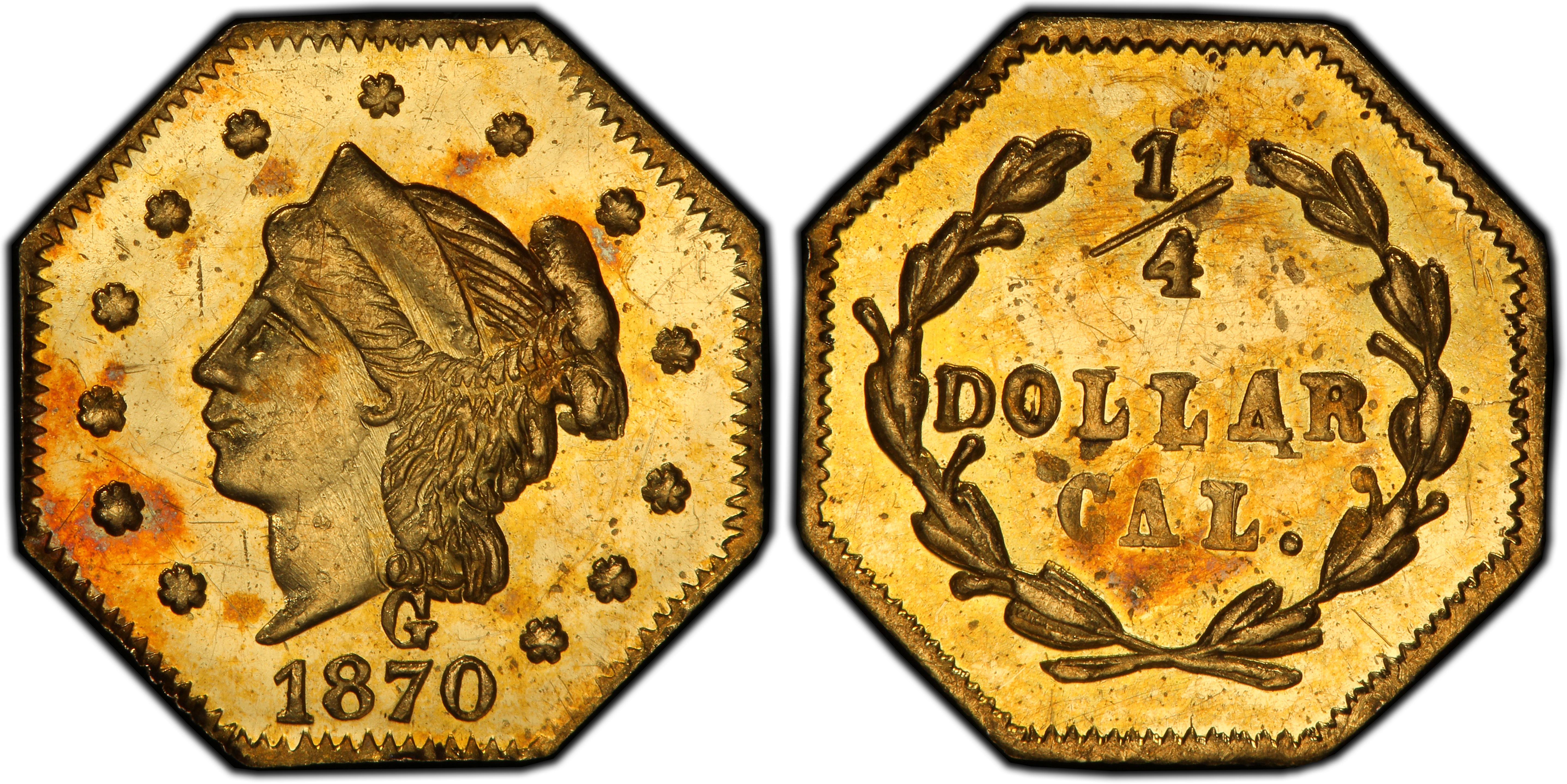
Obverse & Reverse
The 1870 G25C BG-757 is a quintessential example of 'Period Two' California Fractional Gold, a fascinating and complex series born from the unique economic conditions of the American West. Following the initial Gold Rush boom, California suffered from a chronic shortage of small denomination coinage. Federal silver coins were scarce, and the daily needs of commerce were often met with pinches of gold dust or a confusing mix of foreign coins. To fill this void, private jewelers and metallurgists began striking their own tiny gold coins in quarter-dollar, half-dollar, and dollar denominations starting in 1852. These 'Period One' (1852-1857) issues were generally of good weight and intended to circulate. By 1870, the context had shifted dramatically. The San Francisco Mint was in full operation, alleviating the acute coinage shortage. However, the allure of California and the Gold Rush had created a robust tourism and souvenir market. Jewelers like Robert B. Gray & Co. continued to produce fractional gold, but these later pieces were primarily intended for sale as keepsakes, charms, and mementos rather than as circulating currency. The BG-757 belongs to this later era, often termed 'Suppressed Jewelers' Issues.' While the Coinage Act of 1864 had made private coinage illegal, the law was not aggressively enforced against these small, denominated tokens until the early 1880s. These pieces were often struck with lower intrinsic gold value compared to their stated denomination and were manufactured using techniques like the hammer method, resulting in variable strike quality. The tiny size and intricate designs were a testament to the skill of the die sinkers, and their continued production speaks to a persistent demand for tangible, affordable souvenirs of California's golden identity.
Associated EventPost-Gold Rush California Commerce and Tourism
Reason For MintingPrimarily struck to be sold as souvenirs and jewelry items to tourists and locals, capitalizing on the romanticism of the Gold Rush.
Minter HistoryRobert B. Gray & Co. was a prominent San Francisco jewelry firm active in the production of fractional gold. In the late 1850s, Gray acquired the business and equipment of another fractional minter, Antoine Louis Nouzillet. He continued to strike coins, introducing his own dies marked with a distinctive 'G' hallmark, as seen on the BG-757. Gray's pieces are generally considered to be of higher quality and weight than many other Period Two issues. His operations continued until 1871 when he sold his interests to the California Jewelry Co., which itself was a successor to the Levison Brothers, another firm involved in striking fractional gold.
Historical SignificanceThe BG-757 represents the evolution of fractional gold from a necessary medium of exchange to a popular souvenir item. It is a tangible link to the commercial and social history of late 19th-century San Francisco, reflecting a maturing economy where the memory and romance of the Gold Rush itself had become a marketable commodity.
N/A
Denomination25 Cents
Minting Period1870
Assayer/MinterRobert B. Gray & Co.
Geographic OriginSan Francisco, California
Obverse DescriptionA classic Liberty Head motif facing left, stylistically similar to contemporary federal gold coinage. The portrait is surrounded by 13 six-pointed stars. The date '1870' is below the bust, and the minter's initial 'G' is prominently placed in the field, centered directly above the '7' in the date.
Obverse Inscription1870 G
Reverse DescriptionThe central device is a wreath composed of two branches tied together by a bow at the bottom. Inside the wreath, the denomination '1/4' is above the word 'DOLLAR'. The legend 'CALIFORNIA GOLD' follows the upper periphery of the coin's octagonal shape, outside the wreath.
Reverse InscriptionCALIFORNIA GOLD 1/4 DOLLAR
CompositionGold
Stated Fineness Actual FinenessVariable, typically around .800 to .900 fine, but often inconsistent.
Weight0.24 grams
Diameter9.60 mm
EdgePlain
Unknown, but very low.
Survival Estimate19-30 (per Breen-Gillio R-6 rating)
Rarity ScaleR-6
This variety is highly sought after due to its specific attribution to a known maker (Robert B. Gray), its defined rarity (R-6), and its clear diagnostic features. It appeals to specialists in California gold as well as collectors of territorial and private coinage who appreciate its direct connection to post-Gold Rush San Francisco.
Key VarietiesThe BG-757 is itself a key variety. There are no major sub-varieties or special collector issues like restrikes known for this specific BG number. However, the broader 1870 G25C series includes several other BG-numbered die pairings with subtle differences in date placement, lettering, and die states. Collectors often seek examples with prooflike (PL) or deep mirror prooflike (DMPL) surfaces, which command significant premiums.
Authentication TipsAuthentic BG-757 specimens have key diagnostics: the 'G' initial is centered directly above the '7' in the date, and there is clear repunching on the letters 'LA' in DOLLAR on the reverse. The stars on the obverse should be sharp and well-defined. Counterfeits are common in this series; many are brassy in color, have a soapy or cast-like appearance, and lack the fine details of a genuine strike. Any piece with a bear on the reverse is a modern fantasy item. Weight and diameter should be close to the specified 0.24 grams and 9.6 mm.
Shopping ConsiderationsWhen acquiring an 1870 G25C BG-757, strike quality is paramount. A 'premium quality' example will exhibit a sharp strike on the Liberty Head's hair details, the stars, and the reverse lettering. Due to the manufacturing process, it is common to see weakness on the word 'CAL' on the reverse; examples with a stronger strike in this area are desirable. Look for original, undisturbed surfaces with a pleasing golden luster. Avoid examples that have been harshly cleaned, polished, or show evidence of being mounted in jewelry (solder marks, excessive rim damage). Coins with deep, prooflike fields are especially prized and carry a significant premium.
A coin's grade is its condition, rated on a 1-70 scale. For rare coins, this is the most critical factor in determining value, as a tiny difference in preservation can mean a huge difference in price.
Relevant Grade TypesOriginal period issues were business strikes, although their primary purpose was for souvenir sales rather than circulation. They are found in both Circulated (1-58) and Mint State (MS, 60-70) grades. True Proofs from the original minting period are not known to exist for this issue. The terms Prooflike (PL) and Deep Mirror Prooflike (DMPL) are surface designators applied to business strikes that were struck using highly polished dies, resulting in mirror-like fields. These are not a separate striking type but are highly desirable attributes.
Mint State CharacteristicsAn uncirculated (MS) BG-757 is defined by having no wear. Quality is then determined by the strike, surface preservation, and luster. A typical strike may show some softness on the word 'CAL' and on the highest points of the wreath. The luster is typically vibrant and satiny, though some are found with highly reflective, prooflike fields. Small planchet flaws or 'voids' are not uncommon given the private manufacturing process. Bag marks can be distracting on such a small coin, so examples with clean, mark-free surfaces are at a premium.
Circulated Wear PatternsWear first appears on the highest points of the design. On the obverse, friction will dull the luster on Liberty's cheek, hair curls above the eye, and the coronet. On the reverse, the high points of the wreath's leaves and the bow will show initial wear. In lower grades (VF and below), the stars will begin to lose their points and the fine details of the lettering will become soft.
Key Factors For ValueFor the BG-757, value is driven by three main factors. First is grade and surface quality; an MS-64 is exponentially more valuable than an AU-58, and coins with original, uncleaned surfaces command strong premiums. Second is the strike; a sharply struck example with full details, especially on 'CAL,' is always preferred. Third is eye appeal, which includes luster and toning. Examples with brilliant, flashy luster or deep prooflike surfaces are the most valuable. A sticker from CAC (Certified Acceptance Corporation) indicating A-grade quality will add a significant premium, as it confirms the coin's quality for the grade.
PCGS Price Guide
| Grade | Price | Population |
|---|---|---|
| 55 | $300.00 | 1 |
| 55+ | $315.00 | N/A |
| 58 | $340.00 | 6 |
| 58+ | $375.00 | N/A |
| 60 | $450.00 | N/A |
| 61 | $525.00 | 3 |
| 62 | $575.00 | 6 |
| 62+ | $625.00 | N/A |
| 63 | $725.00 | 4 |
| 63+ | $850.00 | N/A |
| 64 | $1,075.00 | 6 |
| 64+ | $1,250.00 | N/A |
| 65 | $1,650.00 | 1 |
| 66 | N/A | N/A |