1870 G25C BG-789, PL (Regular Strike)
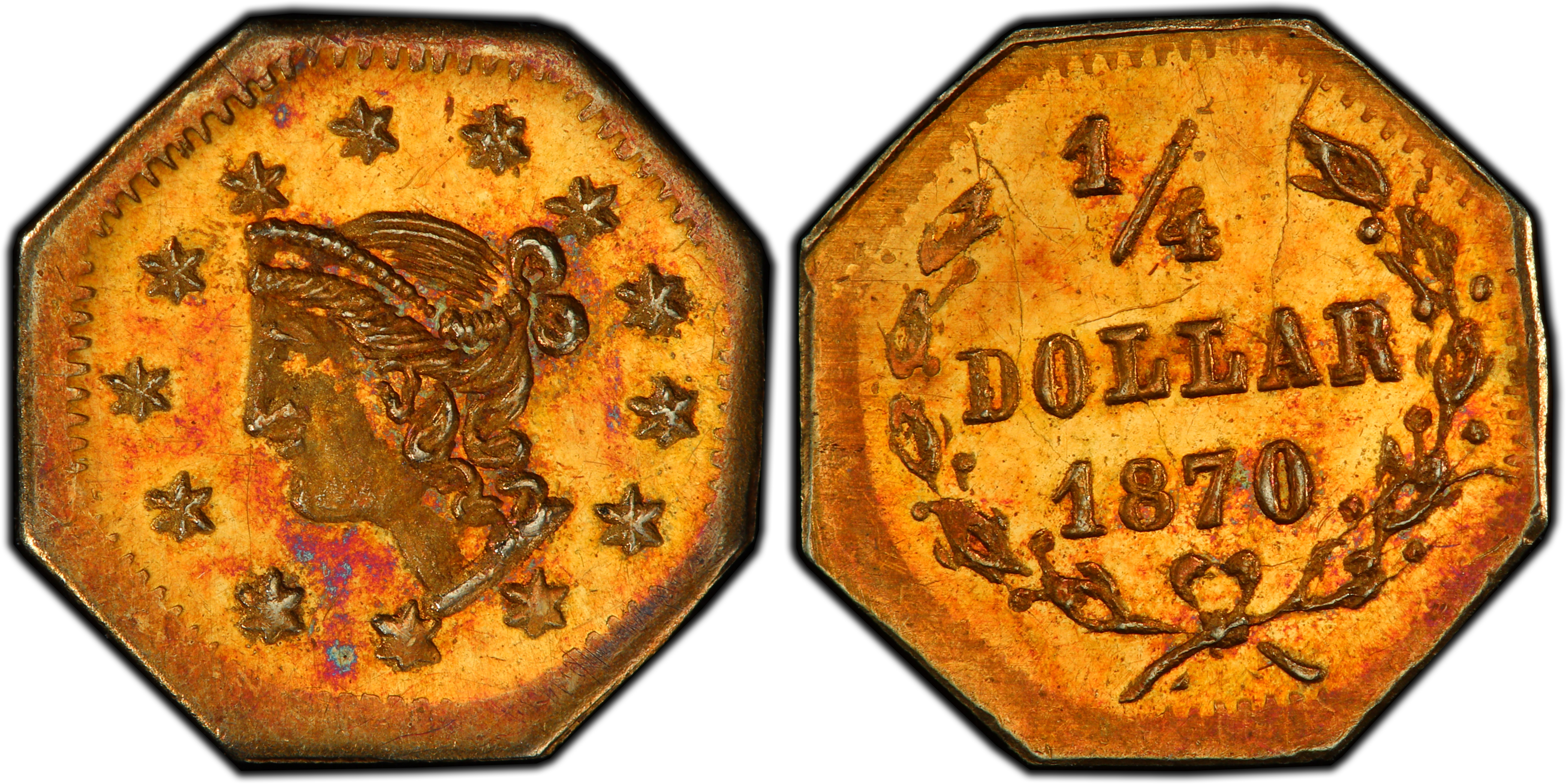
Obverse & Reverse
The 1870 octagonal 25 cents, cataloged as BG-789, is a distinctive product of the second period (1858-1882) of California fractional gold production. Unlike the 'Period One' issues (1852-1857), which were struck out of genuine commercial necessity to alleviate a shortage of small change during the initial Gold Rush, the Period Two pieces were created primarily as souvenirs and for use in jewelry. By 1870, the San Francisco Mint was in full operation, producing ample federal coinage for daily transactions. The demand for privately minted fractional gold had thus shifted from commerce to novelty. San Francisco jewelers, many of French origin, recognized a burgeoning market among tourists, easterners, and even Europeans who were captivated by the romance of the California Gold Rush. These tiny gold pieces were affordable, easily transportable mementos of the Golden State. The BG-789 is nicknamed the 'Goofy Head' for its crude, almost cartoonish rendering of the Liberty portrait, a stark departure from the more formal, classic designs of federal coinage or even earlier fractional issues. This amateurish engraving style is characteristic of many 'jewelers' issues,' which were often produced with less skill and on lighter planchets than their Period One predecessors. The production method was typically manual, with a top die being struck by a sledgehammer onto a planchet resting on a bottom die, leading to inconsistencies in strike and centering. Despite their unofficial status, these pieces were denominated, a practice that flew in the face of the Coinage Act of 1864 which prohibited private coinage. However, the law was not strictly enforced by the Secret Service in California until 1883, allowing for nearly two more decades of this prolific souvenir production. The BG-789, with its memorable moniker and distinct appearance, stands as a tangible link to this fascinating but legally ambiguous chapter of American numismatic history, representing the transition of fractional gold from a circulating medium to a cherished collectible.
Associated EventPost-Gold Rush California Economy
Reason For MintingPrimarily struck to be sold as souvenirs and used in jewelry, capitalizing on the public's fascination with the California Gold Rush.
Minter HistoryThe specific minter or jeweler who created the BG-789 'Goofy Head' variety is currently unknown to numismatic researchers. Period Two issues were produced by a variety of jewelers in San Francisco, many of whom did not sign their work. The crude engraving style suggests a smaller, less-established maker compared to more prominent firms like Frontier, Deviercy & Co. or Antoine Louis Nouzillet who were active in the earlier period.
Historical SignificanceThe BG-789 is significant as a prime example of a 'Period Two' California fractional gold piece, illustrating the evolution of these private issues from necessities of commerce to popular souvenirs. Its existence highlights the lax enforcement of federal coinage laws in 19th-century California and the enduring romantic appeal of the Gold Rush.
BG-789
Denomination25 Cents
Minting Period1870
Assayer/MinterUnknown
Geographic OriginSan Francisco, California
Obverse DescriptionAn amateurishly engraved, crude bust of Liberty facing left, which gives the coin its 'Goofy Head' nickname. She wears a coronet, and her hair is loosely tied. Surrounded by thirteen stars of varying quality. The date 1870 is below the bust.
Obverse Inscription1870
Reverse DescriptionThe denomination '25 CENTS' is enclosed within a wreath of two branches tied with a bow at the bottom. The wreath is typically composed of numerous leaves and berries.
Reverse Inscription25 CENTS
CompositionGold
Stated Fineness Actual FinenessVaries, but typically underweight and of lower fineness compared to federal issues, often in the 14 to 21-karat range.
Diameter9.50 mm
EdgePlain
Unknown
Survival Estimate75-125
Rarity ScaleR-4
The 'Goofy Head' is highly popular with collectors due to its memorable, whimsical nickname and distinctly crude engraving, which contrasts sharply with other more formal designs. Its status as a denominated Period Two issue adds to its historical interest. Many examples come with attractive prooflike surfaces, enhancing their eye appeal.
Key VarietiesThe primary variations for BG-789 are identified by die states. Breen and Gillio note different states, with later states showing progressive die cracks, particularly on the reverse. A cud (a raised lump of metal from a broken die) can form at the upper right on the reverse in the latest die states. No official restrikes or patterns are known.
Authentication TipsAuthentic examples must have a denomination; pieces without '25 CENTS' are likely modern replicas or tokens. The engraving, while crude, should match the known die characteristics of BG-789. The weight and size should be reasonably close to other authenticated examples. Modern fakes often have a soapy, cast-like appearance, incorrect details, or are simply gold-plated base metal. Comparison with high-resolution images from major grading services is essential.
Shopping ConsiderationsA premium quality example for this variety would exhibit sharply struck central devices, which is uncommon given the crude manufacturing. Highly sought-after pieces possess deep, reflective prooflike (PL) or Deep Mirror Prooflike (DMPL) fields. Look for specimens with minimal contact marks, as the small size and soft gold make them susceptible to damage. Be aware of the known die cracks; while they are part of the coin's character, excessively cracked examples may be less desirable to some. Avoid coins that have been harshly cleaned, which strips the original surface and luster, or those that show evidence of being mounted in jewelry.
A coin's grade is its condition, rated on a 1-70 scale. For rare coins, this is the most critical factor in determining value, as a tiny difference in preservation can mean a huge difference in price.
Relevant Grade TypesAll original 1870 BG-789 coins were business strikes intended for sale as souvenirs, not for circulation in the traditional sense. They are found in both Circulated (AU-50 to AU-58, from light handling) and, more commonly, Mint State (MS, 60-70) grades. No true Proofs were struck during the original period. The term 'Prooflike' (PL) is a designation added to Mint State grades to describe coins with highly reflective, mirror-like surfaces, a characteristic for which this variety is well-known.
Mint State CharacteristicsIn uncirculated grades, the BG-789 often presents with surprisingly good luster, frequently with deep prooflike fields. The strike is a key determinant of quality; many are weakly struck on the stars or the details of the wreath due to the crude manufacturing process. A well-struck example with full details is a condition rarity. Small, planchet-related flaws or die cracks are common and should be noted but do not necessarily detract from the grade unless severe. Bag marks can be a problem, appearing as tiny nicks or scratches on the fragile gold surfaces.
Circulated Wear PatternsFor the few examples that show wear from handling, friction first appears on the highest points: Liberty's cheek, hair above the eye, and the coronet on the obverse. On the reverse, the high points of the wreath's leaves and the bow will show the first signs of abrasion. In lower grades, the finer details of the hair and wreath would begin to merge.
Key Factors For ValueThe primary value driver for the BG-789 is the quality of its surfaces. A high-grade example with deep, clean prooflike or DMPL fields commands a significant premium. Strike quality is the next most important factor; a sharp, well-centered strike is highly desirable. Eye appeal, including attractive original gold toning and a lack of distracting marks or planchet flaws, is crucial. A CAC sticker, indicating premium quality for the grade, will add a substantial premium for this issue, as it validates the eye appeal and surface preservation.
PCGS Price Guide
| Grade | Price | Population |
|---|---|---|
| 64 | $1,000.00 | 1 |