1869 G25C BG-749 (Regular Strike)
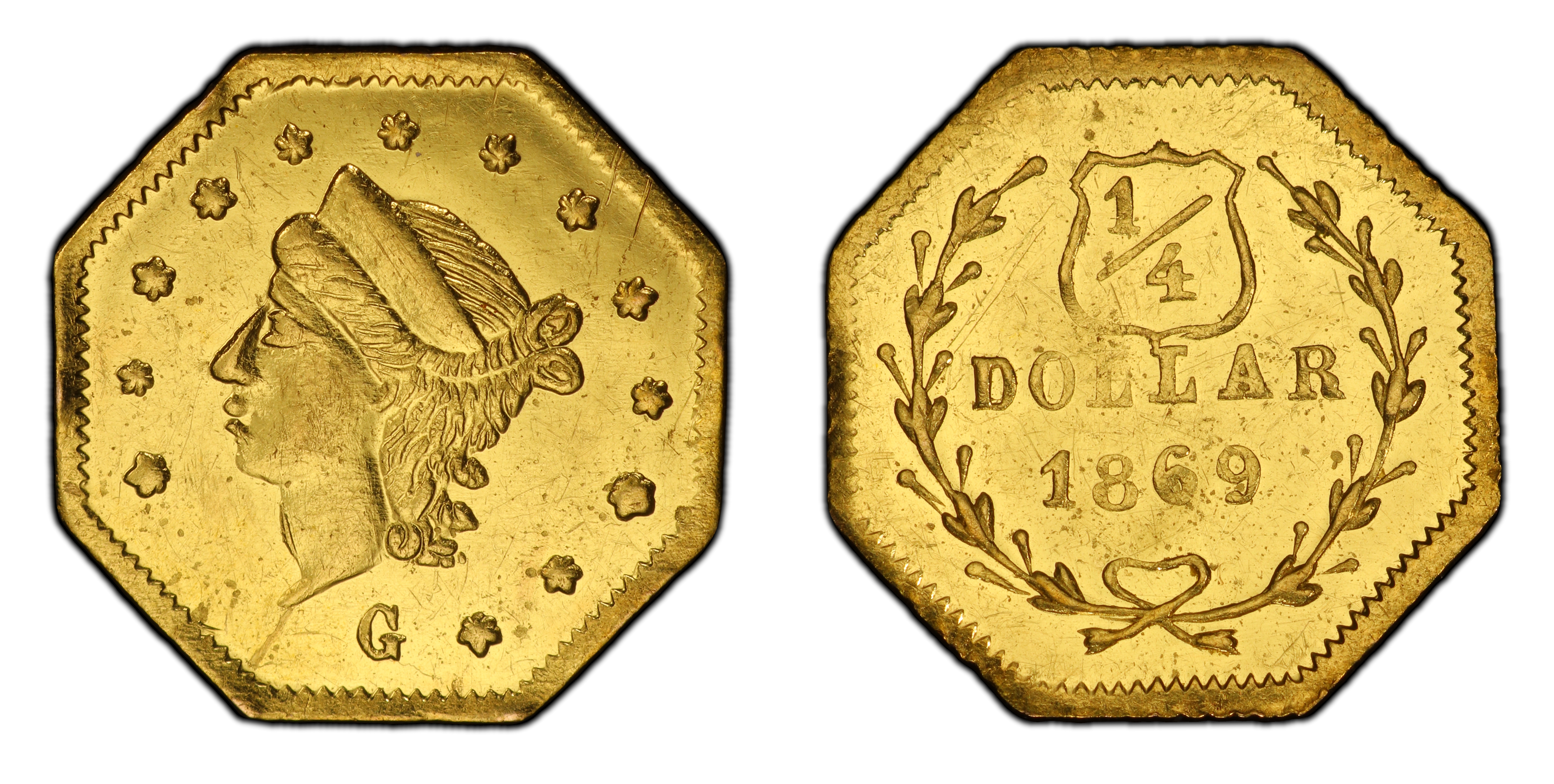
Obverse & Reverse
The 1869 G25C BG-749 emerges from the second major period of California Fractional Gold production (1859-1882), a fascinating era that followed the initial gold rush fervor. By the late 1860s, the California economy had matured, but a chronic shortage of small-denomination federal coinage persisted, particularly on the West Coast. The U.S. Mint in San Francisco, which began full operations in 1854, focused on larger denominations, leaving a void for everyday transactions. Local jewelers and metallurgists stepped in to fill this gap, producing tiny 25-cent, 50-cent, and dollar pieces. Unlike the earlier 'Period One' issues (1852-1856), which were intended to be functional currency and more closely resembled federal coinage, these 'Period Two' pieces, often termed 'jeweler's issues,' were typically underweight for their stated value and featured a wider variety of designs. They served a dual purpose: facilitating small commerce and acting as popular souvenirs for a growing tourist trade and as keepsakes for locals. The Coinage Act of 1864 had prohibited private coinage, but enforcement was lax, allowing production to continue for nearly two decades. These pieces were manufactured using hand-operated presses or even the hammer method, resulting in coins of varying strike quality. The BG-749 variety, with its classic Liberty Head design, is a quintessential example of this period's output. Its existence is a direct reflection of the unique economic conditions of post-Gold Rush California, where the lingering abundance of gold and scarcity of small change created a niche market for private minters. These tiny gold pieces circulated to some extent but were also cherished as miniature symbols of California's gold-based prosperity, eventually becoming highly sought-after collectibles.
Associated EventPost-California Gold Rush Economic Development
Reason For MintingTo alleviate a persistent shortage of small denomination federal coinage for daily commerce and to serve as popular local souvenirs.
Minter HistoryThe specific minter of BG-749 is not definitively known, a common trait for many 'Period Two' issues as makers sought to avoid potential legal trouble. However, numismatic research by specialists like Mike Locke has pointed towards Robert B. Gray & Co. of San Francisco as a likely candidate for this and other related varieties. Gray was a prominent die sinker and producer of tokens, medals, and other private issues in San Francisco during this period. The stylistic attributes and punch-links to known Gray products form the basis of this attribution, although it remains circumstantial.
Historical SignificanceThe BG-749 is a tangible artifact of a unique period in American monetary history where private enterprise filled a circulating currency void left by the federal government. It represents the transition of fractional gold from purely utilitarian coinage to items of commerce and souvenir appeal, reflecting California's evolving economy and identity after the initial Gold Rush boom.
N/A
DenominationG25C (25 Cents)
Minting Period1869
Assayer/MinterUnknown, possibly Robert B. Gray & Co.
Geographic OriginSan Francisco, California
Obverse DescriptionA Liberty Head, facing left, with thirteen stars surrounding the portrait. The design is a miniature version of the motif used on contemporary federal gold coinage.
Obverse Inscription[None, stars only]
Reverse DescriptionThe denomination '1/4' is in the center, surrounded by the inscription 'CALIFORNIA GOLD' in a circle around the periphery. A decorative element or 'G' mintmark for Gold is sometimes noted, though often weak.
Reverse InscriptionCALIFORNIA GOLD 1/4
CompositionGold
Stated Fineness Actual FinenessVaries, but typically between .500 and .750 fine. Period Two issues were known for being underweight and of lower purity than their face value suggested.
Diameter9.80 mm
EdgePlain
Unknown
Survival Estimate76-150 known
Rarity ScaleR-5+
This coin is highly appealing due to its octagonal shape, classic Liberty Head design, and status as an authentic privately-minted gold piece from the Old West. Its high rarity (R-5+) makes it a challenge and a prize for specialists in the popular California Fractional Gold series.
Key VarietiesThe primary variety is the Regular Strike BG-749. No original proof strikings are known. Collectors should be aware of the broader California Fractional Gold series, which includes Period One (1852-56) issues intended more for circulation, and Period Three (post-1882) issues which were clandestine souvenirs backdated to avoid legal issues. There are no known official restrikes of BG-749, but a vast number of contemporary counterfeits and modern replicas exist for the series as a whole.
Authentication TipsAuthentic BG-749 specimens often exhibit a somewhat crude, manual strike. Look for sharp details on the stars and letters, but don't be surprised by some softness in the center. Counterfeits are common and often appear soapy, greasy, or have incorrect lettering fonts. Genuine pieces will have the word 'GOLD' or an abbreviation like 'DOL.'; many fakes or tokens will lack this or feature a bear on the reverse, a design not used on genuine Period One or Two fractionals. Third-party grading by PCGS or NGC is highly recommended for authentication.
Shopping ConsiderationsA premium quality example of BG-749 would exhibit a sharp strike for the variety, particularly on Liberty's hair details and the reverse lettering. Look for clean, lustrous surfaces without significant distracting marks; tiny planchet flaws or adjustment marks are not uncommon and can be acceptable. Avoid examples that have been harshly cleaned, which strips the original patina, or those with evidence of being used as jewelry (solder marks, rim damage). Eye appeal is paramount; a coin with a pleasing, original reddish-gold hue will command a significant premium over a dull or washed-out specimen.
A coin's grade is its condition, rated on a 1-70 scale. For rare coins, this is the most critical factor in determining value, as a tiny difference in preservation can mean a huge difference in price.
Relevant Grade TypesOriginal 1869 issues were business strikes intended for circulation and as souvenirs; they are found in Circulated (1-58) and Mint State (MS, 60-70) grades. No original Proof (PR/PF) examples of BG-749 were struck. While some fractionals are found with prooflike surfaces (PL), these are a result of polished dies used for regular striking and are not true Proofs.
Mint State CharacteristicsAn uncirculated BG-749 typically displays a soft, satiny luster. Strike quality varies significantly due to the manual minting process; many examples are weakly struck in the center, affecting the details of Liberty's hair and the fraction '1/4'. A well-struck example is a rarity and highly desirable. Small planchet imperfections or die cracks are common and do not necessarily detract from the grade. Contact marks are frequent due to the small size and handling over time.
Circulated Wear PatternsWear first appears on the highest points of the design: Liberty's cheek, the hair above her eye, and the coronet. On the reverse, the fraction '1/4' and the letters in 'GOLD' will show the first signs of flattening. In lower grades (VF and below), the stars on the obverse will begin to merge with the fields and the peripheral lettering on the reverse will become faint.
Key Factors For ValueFor the BG-749, the key value drivers are rarity, grade, and eye appeal. A sharply struck coin with minimal marks and original, undisturbed luster will always command the highest prices. Surface quality is critical; collectors heavily favor pieces with original 'skin' over those that have been cleaned or polished. The octagonal shape adds to the appeal, so examples with sharp, unimpaired corners are preferred. A CAC sticker for this issue indicates premium quality for the grade and will result in a significant price jump.
PCGS Price Guide
| Grade | Price | Population |
|---|---|---|
| 55 | $350.00 | 2 |
| 55+ | $375.00 | N/A |
| 58 | $425.00 | 3 |
| 58+ | $475.00 | N/A |
| 60 | $550.00 | 2 |
| 61 | $700.00 | 2 |
| 62 | $825.00 | 10 |
| 62+ | $1,050.00 | N/A |
| 63 | $1,750.00 | 8 |
| 63+ | $2,000.00 | N/A |
| 64 | $2,750.00 | 1 |
| 65 | N/A | N/A |