1875 G25C BG-796 (Regular Strike)
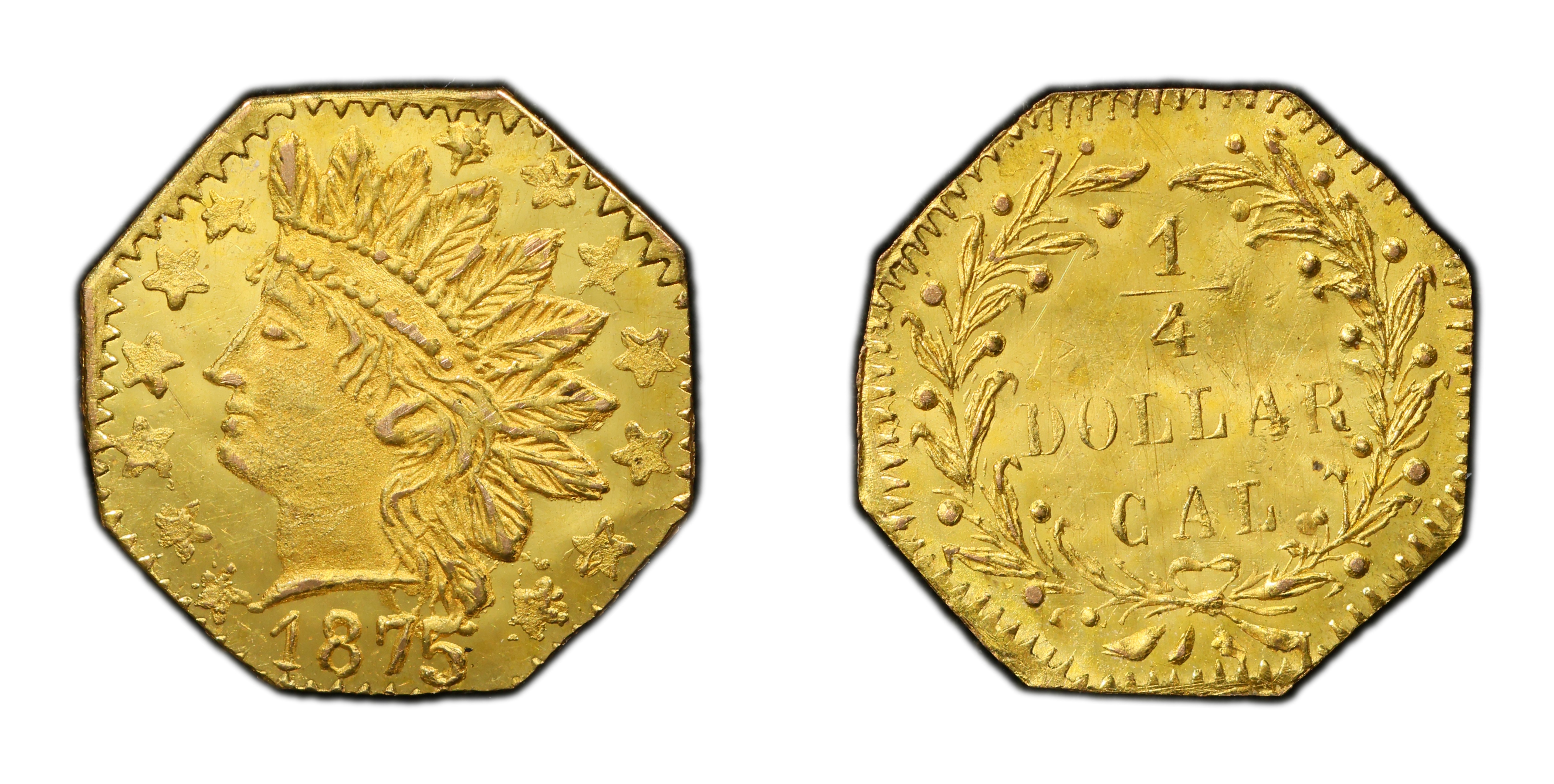
Obverse & Reverse
The 1875 Octagonal 25 Cents, cataloged as Breen-Gillio 796, is a quintessential example of a 'Period Two' California Fractional Gold piece. By the mid-1870s, the initial, desperate need for small denomination coinage that characterized the Gold Rush's peak had subsided with the full-scale operation of the San Francisco Mint. However, the allure of California gold had not faded. The primary purpose of these tiny gold pieces shifted from circulation to commerce of a different kind: the burgeoning tourist and souvenir trade. Jewelers in San Francisco, many of whom were French immigrants, continued to produce these miniature coins to sell as keepsakes, mementos, and for use in jewelry. The socio-economic landscape of California had matured; the transcontinental railroad, completed in 1869, brought a steady stream of visitors eager to take home a piece of the romanticized 'Old West.' These 'jeweler's issues' were typically lighter and often of lower fineness than their stated value, a fact that was of little concern to purchasers who valued them for their novelty rather than their intrinsic worth. The Coinage Act of 1864 had prohibited private coinage, but enforcement was lax, and production continued until the early 1880s, with minters often backdating their creations to pre-1864 dates to circumvent the law. The BG-796, dated 1875, is a testament to this ongoing practice. Produced by hand using hammer-striking methods on octagonal planchets, quality varied immensely. The Indian Head motif was a popular design choice, mimicking the design of the official U.S. cent and gold dollar, adding a veneer of legitimacy and popular appeal. Today, these pieces are not just numismatic curiosities but tangible artifacts of a transitional period in California's history, bridging the raw frontier economy of the Gold Rush with its emergence as a center of commerce and tourism.
Associated EventPost-Gold Rush California Commerce & Tourism
Reason For MintingPrimarily created for the souvenir and jewelry trade in a post-Gold Rush California, serving as popular mementos for tourists.
Minter HistoryThe specific minter or jeweler responsible for the BG-796 variety is not definitively known, a common trait for many Period Two issues. These coins were produced by a number of San Francisco-based jewelers and artisans, such as Antoine Louis Nouzillet or M. Deriberpie, though direct attribution for this variety is lost to history. These craftsmen operated small-scale minting operations, creating dies and striking coins often by hand, leading to a wide array of styles, mules, and levels of quality across the fractional gold series.
Historical SignificanceThe BG-796 represents the evolution of fractional gold from a necessary medium of exchange to a commercial souvenir product. Its existence in 1875, well after federal coinage was established in the region and private minting was technically illegal, highlights a unique chapter in American numismatics where private enterprise continued to fill a niche market for tangible symbols of the California Gold Rush legend.
N/A
Denomination25 Cents
Minting Period1875
Assayer/MinterUnknown Jeweler
Geographic OriginSan Francisco, California
Obverse DescriptionFeatures a stylized bust of a Native American princess facing left, wearing a feathered headdress. The portrait is surrounded by thirteen stars, representing the original colonies.
Obverse Inscription[No Inscription - Stars Only]
Reverse DescriptionA simple wreath design surrounds the denomination. The date is located within the wreath, above the denomination.
Reverse Inscription1/4 DOLLAR 1875
CompositionGold
Stated Fineness Actual FinenessVaries, but typically lower than U.S. Mint standards for the period.
EdgePlain
Unknown
Survival Estimate11-30 (based on R-6 rating)
Rarity ScaleR-6
This variety is sought after for its distinctive octagonal shape, popular Indian Head design, and high rarity. High-grade examples with prooflike surfaces are particularly prized for their beauty and command significant premiums.
Key VarietiesNo major varieties of the BG-796 itself are widely recognized. Unlike some other territorial issues, there are no known official, later-date restrikes from the original dies. All genuine examples are considered vintage 'jeweler's issues' from the 1875-1882 period. Modern replicas and fantasy pieces exist but are easily distinguished by their crude workmanship and base metal composition.
Authentication TipsAuthenticity is paramount. Genuine pieces will exhibit a sharp, albeit sometimes uneven, strike from steel dies. Look for die flow lines and a fineness that is consistent with gold, not brassy like modern copies. The style of the engraving, particularly the details in the feathers and the numerals of the date, should match known genuine examples. Be wary of pieces with a 'CAL' inscription, which is often a feature of modern fantasy tokens. Any casting signs, such as a seam on the edge or a pockmarked, porous surface, are immediate red flags.
Shopping ConsiderationsFor a premium quality BG-796, look for a sharp strike, especially on the high points of the Indian's cheek and the feathers, which are often softly impressed. Luster is key; top-tier examples exhibit deeply mirrored, prooflike (PL) or deep mirror prooflike (DMPL) fields with frosted devices, creating a stunning cameo contrast. The original reddish-gold toning is highly desirable. Avoid examples that have been harshly cleaned, which will appear unnaturally bright and show hairlines. Also, inspect carefully for evidence of having been mounted in jewelry, such as rim damage or solder marks, which drastically reduces the value.
A coin's grade is its condition, rated on a 1-70 scale. For rare coins, this is the most critical factor in determining value, as a tiny difference in preservation can mean a huge difference in price.
Relevant Grade TypesAll original period issues of BG-796 were business strikes, although many were struck with polished dies to enhance their appeal as souvenirs. They are found in Circulated (1-58) and, more commonly for this later period, Mint State (MS, 60-70) grades. No true Proofs were struck during the original minting period. High-grade examples designated as Prooflike (PL) or Deep Mirror Prooflike (DMPL/DPL) are not a separate striking but rather a quality of the business strike finish and are highly desirable.
Mint State CharacteristicsAn uncirculated BG-796 is defined by its luster and lack of wear. The quality of this luster varies from satiny to deeply prooflike. A typical weakness of this variety is softness in the strike on the high points of the Indian's portrait. Contact marks, even small ones, can be prominent on the mirrored fields, so a 'clean' field is a significant value driver. The color should be a natural, rich gold, sometimes with reddish hues.
Circulated Wear PatternsOn circulated examples, wear first appears on the highest points of the design. For the obverse, this is the cheek, brow, and the tips of the feathers in the headdress. On the reverse, the highest points of the wreath and the numerals of the date and fraction will show friction first. In lower grades, the stars and legends will become indistinct.
Key Factors For ValueThe primary value driver for an 1875 BG-796 is its grade and surface quality. A high-grade Mint State coin will be worth exponentially more than a circulated one. Within Mint State grades, the distinction between a standard MS, a Prooflike (PL), and a Deep Mirror Prooflike (DMPL) example is critical, with each designation adding a significant premium. Eye appeal is paramount; a sharply struck coin with clean, reflective fields and original, untampered surfaces will always command the most interest. A CAC sticker adds a further premium, confirming the coin is solid for the grade.
PCGS Price Guide
| Grade | Price | Population |
|---|---|---|
| 58 | $300.00 | 2 |
| 58+ | $320.00 | N/A |
| 60 | $340.00 | N/A |
| 61 | $350.00 | 1 |
| 62 | $400.00 | 12 |
| 62+ | $420.00 | N/A |
| 63 | $550.00 | 21 |
| 63+ | $600.00 | N/A |
| 64 | $750.00 | 19 |
| 64+ | $900.00 | N/A |
| 65 | $1,350.00 | 1 |
| 65+ | $1,750.00 | N/A |
| 66 | $2,750.00 | 2 |