1874 G25C BG-774 (Regular Strike)
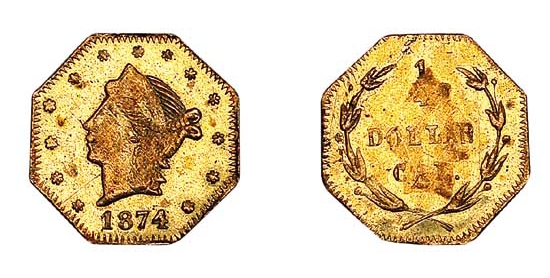
Obverse & Reverse
The 1874 BG-774 25 Cent piece emerges from the second major phase of California Fractional Gold production, often termed 'Period Two' (circa 1859-1882). By this era, the acute, desperate need for small change that characterized the initial Gold Rush (Period One, 1852-1857) had largely subsided. The establishment and high output of the San Francisco Mint, which began operations in 1854, had saturated the region with official federal silver and gold coinage. Consequently, the purpose of fractional gold shifted dramatically. No longer essential for commerce, these miniature gold pieces transitioned into novelties, souvenirs for a burgeoning tourist trade, and cherished keepsakes. Private minters, predominantly jewelers in San Francisco, continued to produce them, but with significant changes. Unlike the full-weight Period One issues that were intended to circulate at face value, Period Two pieces were consistently and intentionally underweight, containing significantly less gold than their stated 25-cent value. Their manufacture was a commercial enterprise aimed at a different market—one that valued the charm and romance of a tiny gold coin over its intrinsic worth. The Coinage Act of 1864 had explicitly prohibited private coinage, but enforcement was lax, particularly concerning these small, token-like pieces. Minter-jewelers operated in a legal gray area, creating a wide array of imaginative designs, often featuring Liberty or Indian heads, in both round and octagonal formats. These 'jeweler's issues' are characterized by a wider variety of die work, often cruder than their Period One predecessors, and were typically struck by hand using a hammer method. The BG-774 variety is one of many such distinct die pairings from this fascinating and legally ambiguous period of American numismatic history, representing a tangible link to post-Gold Rush California's evolving economy and culture.
Associated EventPost-Gold Rush California Tourism & Commerce
Reason For MintingPrimarily created as souvenirs and novelty items for tourists and collectors, rather than to fill a circulating coinage need.
Minter HistoryThe specific minter or jeweler responsible for the BG-774 variety, like most Period Two issues, is unknown. Production during this time was largely anonymous to avoid potential legal entanglements with the U.S. government. These pieces were typically made in the back rooms of jewelry shops in San Francisco, with makers rarely placing identifiable marks on their work.
Historical SignificanceThe BG-774 is significant not as a coin of the realm, but as a cultural and economic artifact. It represents the commercial ingenuity of California jewelers and the popular romanticism of the Gold Rush that persisted for decades. As a Period Two issue, it illustrates the transition of fractional gold from a circulating medium of necessity to a privately-produced souvenir token, a numismatic niche that thrived in the shadow of official U.S. Mint coinage.
N/A
Denomination25 Cents
Minting Period1874
Assayer/MinterUnknown private minter
Geographic OriginSan Francisco, California
Obverse DescriptionBased on similar octagonal Liberty Head issues of the period, the obverse likely features a female head representing Liberty, facing left, with hair tied back. She is likely surrounded by a number of stars (often 13, but the exact count can be a key diagnostic) with the date '1874' below. The precise details of the portrait and star placement are specific to the BG-774 die.
Obverse Inscription1874
Reverse DescriptionThe reverse design common to this type features the denomination '1/4' within a wreath of leaves and berries. The wreath is open at the top. Above the wreath, the inscription 'CALIFORNIA GOLD' would typically appear, often abbreviated.
Reverse Inscription1/4 CALIFORNIA GOLD
CompositionGold
Stated Fineness Actual FinenessTypically varied between .400 and .600 fine for Period Two issues, but the specific fineness for BG-774 is not documented.
EdgePlain
Unknown
Survival EstimateUnknown, but likely very few. Most Period Two varieties are considered rare.
Rarity ScaleLikely R-6 or R-7 (4-30 known)
This variety appeals to specialists in the vast and complex series of California Fractional Gold. Its allure lies in its date, octagonal shape, and the challenge of acquiring a specific, rarely-offered Breen-Gillio variety from the popular Period Two era. Each BG number represents a unique piece of the puzzle for the completist.
Key VarietiesThe primary variety is the BG-774 regular strike itself. No known patterns, restrikes, or major die states are recorded for this specific, obscure variety. The broader 1874 G25C series includes numerous other BG numbers with variations in obverse (Liberty vs. Indian), shape (Round vs. Octagonal), and fine details of the dies.
Authentication TipsAuthentic Period Two pieces often have a slightly crude, handmade look. Check for sharp, albeit sometimes uneven, hammer-striking characteristics. The gold color should be consistent with the lower-fineness alloys used in this period, often appearing slightly brassy or reddish compared to federal gold. Die diagnostics, such as the exact placement of stars, date numerals, and letters, are critical for confirming the BG-774 attribution. Modern counterfeits are common and often appear too perfect, with tool marks around the devices or a soapy, cast-like surface texture. Compare with high-resolution images of certified examples if possible.
Shopping ConsiderationsFor a Period Two fractional piece, a 'premium quality' example is defined by a sharp, well-centered strike, which is uncommon due to the hand-hammering process. Look for examples with minimal distracting marks and original, uncleaned surfaces that may exhibit a gentle, reddish-gold toning. Weakness in the central devices or legends is common and should be evaluated in context. Avoid specimens that have been harshly cleaned, polished, or used as jewelry, as evidenced by solder marks, excessive scratching, or rim damage. Given the obscurity of BG-774, any example appearing on the market would be a significant find, and third-party certification by PCGS or NGC is virtually essential for authentication and market acceptance.
A coin's grade is its condition, rated on a 1-70 scale. For rare coins, this is the most critical factor in determining value, as a tiny difference in preservation can mean a huge difference in price.
Relevant Grade TypesOriginal 1874 issues were business strikes, although they were not intended for prolonged circulation and were sold as souvenirs. They are found in Circulated (1-58) grades, though this is less common, and more frequently in Mint State (MS, 60-70) grades. No original proofs from 1874 are known. While some fractional gold varieties were restruck later for collectors, there are no documented special collector restrikes of the BG-774 variety.
Mint State CharacteristicsAn uncirculated BG-774 would be judged on the quality of its strike and the originality of its surfaces. Luster on these pieces is typically semi-prooflike or satiny, a result of the polished dies and striking method. A superior MS example would show sharp details on Liberty's hair and the leaves of the wreath. Small planchet flaws or adjustment marks are not uncommon and may not significantly detract from the grade if they are original to the minting process. Contact marks, even on high-grade examples, are common due to their small size and handling over the years.
Circulated Wear PatternsWear would first appear on the highest points of the design: Liberty's cheek, hairline, and the high points of the wreath leaves on the reverse. On lower-grade circulated examples, the stars on the obverse and the letters in the legends would begin to lose their sharpness and merge with the fields.
Key Factors For ValueFor the BG-774, value is driven primarily by its rarity as a specific, seldom-seen BG variety. Beyond that, a sharp, full strike is the most important quality, as many were weakly struck. Surface preservation is key; an example with original, lustrous surfaces will command a significant premium over one that has been cleaned or damaged. Eye appeal, including attractive original toning and a well-centered strike, also plays a major role. A CAC sticker would provide strong validation of quality for the assigned grade and would add a substantial premium.
PCGS Price Guide
| Grade | Price | Population |
|---|---|---|
| 58 | $900.00 | 1 |
| 58+ | $975.00 | N/A |
| 60 | $1,100.00 | N/A |
| 61 | $1,250.00 | N/A |
| 62 | $1,575.00 | 1 |
| 62+ | $2,000.00 | N/A |
| 63 | $2,750.00 | 3 |