1870 G25C BG-760 (Regular Strike)
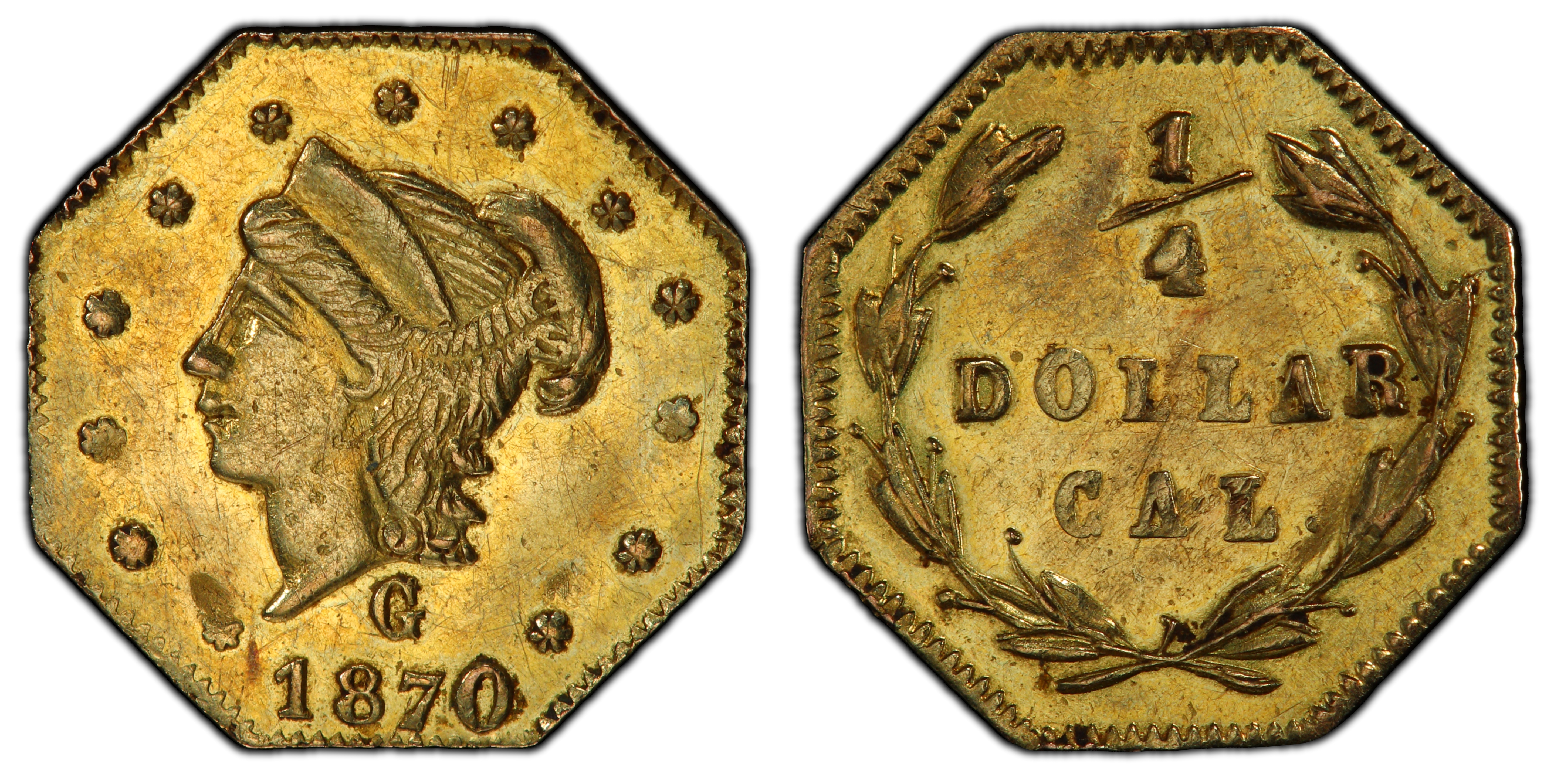
Obverse & Reverse
The 1870 G25C BG-760 is a classic example of a 'Period Two' California Fractional Gold piece, a fascinating and complex series born from the California Gold Rush. The initial wave of fractional gold, known as Period One (1852-1857), was struck to alleviate a severe shortage of small change for daily commerce. These early issues were generally of good quality and circulated widely. However, by 1870, the context had shifted dramatically. The San Francisco Mint was in full operation, producing ample federal coinage and mitigating the initial need for private issues. The Coinage Act of 1864 had officially declared private coinage illegal, pushing such activities into a legal gray area. Consequently, Period Two fractionals, including BG-760, were not primarily intended to serve as circulating currency. Instead, they were produced by jewelers and merchants as souvenirs, keepsakes for tourists, and novelty items for a public still enchanted by the allure of the Gold Rush. These later pieces were often deliberately underweight and of lower fineness than their stated face value, functioning more as tokens than true coinage. The BG-760 is an artifact of this later era, representing the commercial adaptation of a numismatic tradition. Struck in the workshop of San Francisco jeweler Robert B. Gray, it showcases the delicate craftsmanship of the time, though on a minuscule scale. Its extreme rarity today suggests a very limited original production, likely made as part of a small batch for private sale. Astonishingly, the BG-760 variety was unknown to the numismatic community until its discovery by researcher David Doering between 1980 and 1982, adding a modern chapter to its quiet history and underscoring the potential for new discoveries within this intricate series.
Associated EventCalifornia Gold Rush (Later Period)
Reason For MintingPrimarily created as a souvenir or novelty item for the jewelry trade rather than for general circulation, which had become illegal.
Minter HistoryRobert B. Gray was a prominent San Francisco jeweler. He acquired the business of another well-known fractional gold producer, Antoine Louis Nouizillet, around 1859. Gray continued the practice of striking these small gold pieces, often marked with a 'G' initial, until he sold his firm to the California Jewelry Company in 1871, ending his numismatic endeavors.
Historical SignificanceAs a 'Period Two' issue, BG-760 is significant for what it represents: the transition of fractional gold from essential circulating coinage to commercial souvenir. Its illegality at the time of minting and its subsequent rediscovery in the 1980s make it a numismatic curiosity. It is a tangible link to the jeweler-minters of post-Gold Rush San Francisco and a testament to the era's entrepreneurial spirit.
BG-760
Denomination25 Cents
Minting Period1870
Assayer/MinterRobert B. Gray & Co.
Geographic OriginSan Francisco, California
Obverse DescriptionA Liberty Head facing left, with pointed curls in her hair. She is surrounded by thirteen stars. The date '1870' is below the bust, distinguished by a characteristically low '7' and a tall '0'.
Obverse Inscription1870
Reverse DescriptionThe denomination '1/4' is enclosed within a wreath of leaves and berries, tied with a bow at the bottom. The reverse die was a stock die used for multiple varieties of 1870-71 quarters.
Reverse Inscription1/4
CompositionGold
Stated Fineness Actual FinenessVaries; Period Two issues are typically less than face value.
EdgePlain
Extremely low, but unknown.
Survival Estimate5 to 7 pieces known.
Rarity ScaleHigh R-7
The BG-760 holds immense appeal due to its extreme rarity and intriguing history. As a 'rediscovery' piece, unknown for over a century, it carries a special mystique. It is a key variety for advanced collectors of California Fractional Gold, particularly those specializing in Period Two issues or the works of Robert B. Gray.
Key VarietiesThe primary issue is the business strike. No patterns, proofs, or special collector restrikes from the original period or later (e.g., Bashlow) are known or documented for the specific BG-760 die pair. The variety itself is defined by its unique obverse die married to a common reverse die.
Authentication TipsAuthentication requires expert examination. Key diagnostics include the specific positioning of the date, particularly the low '7' and tall '0'. The pointed hair curls are another identifier. On the reverse, the die characteristics should match those of other 1870-71 quarters made with the same stock die. A common production flaw seen on most known examples are two shallow, planchet-related 'ghost' depressions on the lower obverse field, which are considered as-made and can be a marker of authenticity. Counterfeits of fractional gold are rampant; genuine examples have a sharp, albeit sometimes uneven, strike quality that is difficult for forgers to replicate on such a small scale.
Shopping ConsiderationsFor a potential buyer, any available example is a major acquisition. A 'premium quality' example would be one that is well-centered and sharply struck, particularly on Liberty's hair and the digits of the date. Given their purpose as jewelry items, many fractionals were cleaned or damaged; finding an example with original, undisturbed surfaces and bright, prooflike fields is a paramount goal. The shallow 'ghost' depressions on the obverse are a known characteristic of the variety and should not be considered a post-strike flaw. Due to the coin's high value and the prevalence of counterfeits, purchasing a specimen certified by a top-tier grading service (PCGS or NGC) is not just recommended, but essential.
A coin's grade is its condition, rated on a 1-70 scale. For rare coins, this is the most critical factor in determining value, as a tiny difference in preservation can mean a huge difference in price.
Relevant Grade TypesAll known examples are original business strikes, though many were made with prooflike surfaces for the souvenir trade. They are found in Circulated (1-58) and, more commonly for this variety, Mint State (MS, 60-70) grades. The term 'Prooflike' (PL) is often applied to high-grade examples with reflective surfaces. No true Proofs were struck during the original period of issue, and no later-date Proof restrikes of this specific variety are known to exist.
Mint State CharacteristicsAn uncirculated BG-760 is defined by its luster, which is typically bright and satiny, often with prooflike or even deep mirror prooflike fields. The strike can be inconsistent; a full strike on the high points of Liberty's hair and the wreath is desirable but not always present. A common characteristic is a relative weakness in the reverse legend opposite the high relief of Liberty's bust. Due to the softness of the gold and the tiny size, even high-grade examples may show minuscule handling marks, but any significant abrasion would be detrimental to the grade.
Circulated Wear PatternsOn circulated examples, wear would first appear on the highest points: Liberty's cheek, the hair above the ear, and the tips of the leaves in the wreath on the reverse. The delicate digits of the date would be the next area to show flattening. Due to the extreme rarity and souvenir nature of the coin, heavily circulated examples are virtually unknown.
Key Factors For ValueExtreme rarity is the primary value driver. Beyond that, the grade is critical. Surface quality is paramount; an example with original, lustrous, 'greasy' gold surfaces will command a significant premium over one that has been cleaned, polished, or previously mounted in jewelry. Eye appeal is crucial; coins with brilliant, prooflike fields and a sharp strike are highly prized. A CAC sticker for this issue would be a major value enhancer, signifying premium quality for the assigned grade.
PCGS Price Guide
| Grade | Price | Population |
|---|---|---|
| 58 | $1,750.00 | 1 |
| 58+ | $2,500.00 | N/A |
| 60 | $3,250.00 | N/A |
| 61 | $3,750.00 | N/A |
| 62 | $5,250.00 | 2 |
| 62+ | $6,000.00 | N/A |
| 63 | $6,750.00 | 1 |
| 63+ | $7,500.00 | N/A |
| 64 | $9,500.00 | 2 |
| 64+ | $13,500.00 | N/A |
| 65 | $16,500.00 | 1 |