1867 G25C BG-742 (Regular Strike)
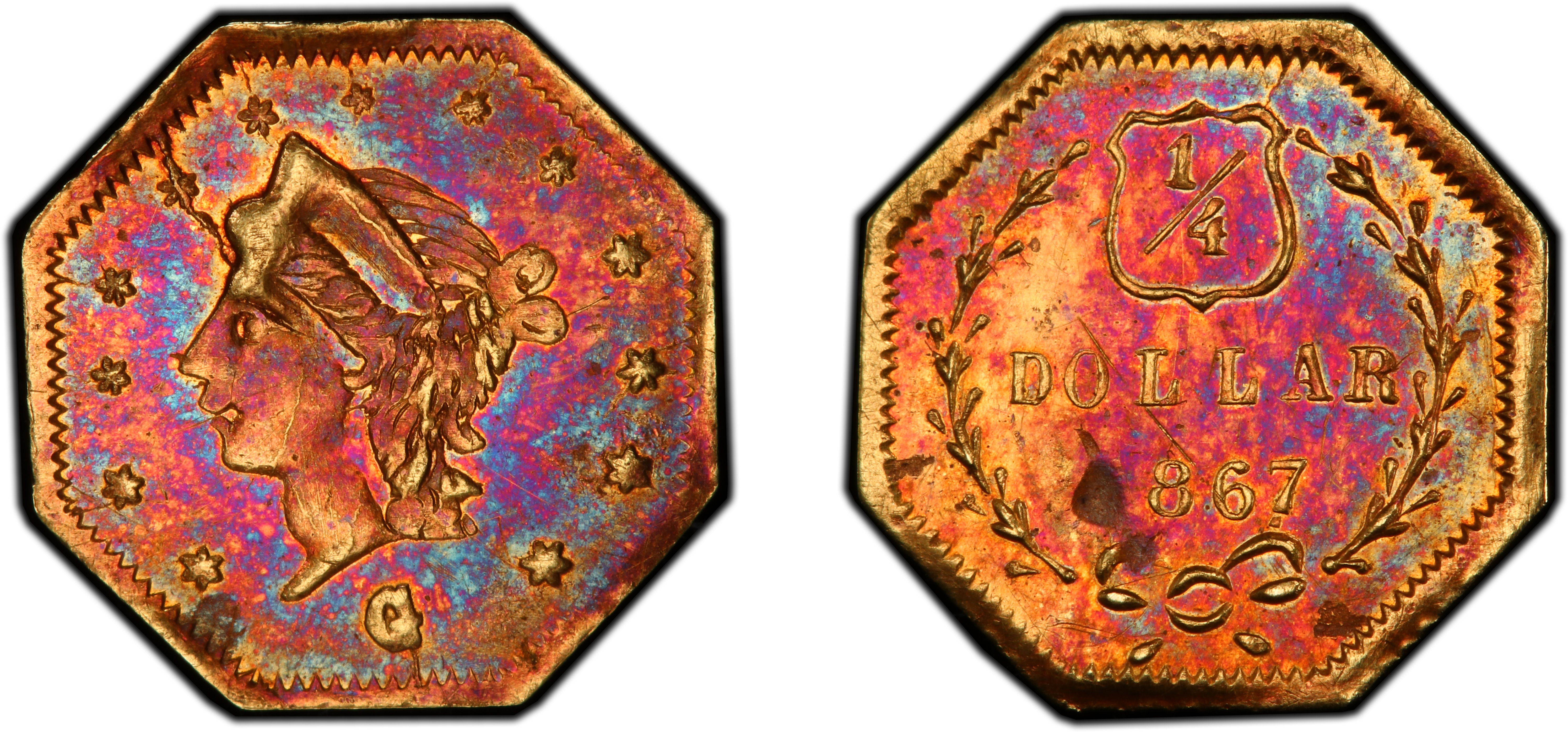
Obverse & Reverse
The 1867 BG-742 25 Cents is a product of what numismatists classify as 'Period Two' of California Fractional Gold production (1859-1882). Unlike the earlier 'Period One' pieces (1852-1856), which were struck out of genuine commercial necessity to alleviate a severe shortage of small change during the initial Gold Rush, Period Two issues served a dual purpose. By the late 1860s, the United States Branch Mint in San Francisco was producing ample federal coinage for the region. However, the allure of California gold was potent, and a robust market for souvenirs and curiosities had developed, driven by tourism and a romanticized view of the '49er era. Local jewelers, many of whom were highly skilled metallurgists and engravers, stepped in to meet this demand. These 'jeweler's issues' were not intended to circulate as money in the same way as their predecessors, but rather as mementos and private tokens. The Coinage Act of April 22, 1864, had made the private minting of coins illegal, but this law was not strictly enforced against these small, denominational tokens until 1883. This legal gray area allowed for their continued production. The BG-742 is a quintessential example of this era's output: privately struck, bearing a denomination, and echoing the designs of federal coinage, yet ultimately a commercial product rather than a necessity. The extreme rarity of the BG-742 variety today suggests its original production was very limited, likely the work of a single small-scale jeweler whose identity is now lost to history. These pieces represent the sunset of private minting in California, a final echo of the economic autonomy and frontier spirit of the Gold Rush.
Associated EventPost-Gold Rush Economic Expansion
Reason For MintingPrimarily struck to be sold as souvenirs and curiosities, capitalizing on the romanticism of the Gold Rush, while also filling a minor, lingering niche for small transactions.
Minter HistoryThe specific minter for the BG-742 variety is unknown, a common trait for Period Two California Fractional Gold. These pieces were typically produced by entrepreneurial jewelers and goldsmiths in San Francisco who did not sign their work. Their operations were small-scale, and their primary business was not coinage but the creation of jewelry and other gold items. They possessed the skills and equipment to create dies and strike these miniature gold pieces for a clientele of tourists and local citizens who cherished them as keepsakes.
Historical SignificanceThe BG-742, like other Period Two issues, represents the transition of California Fractional Gold from a necessary form of currency to a commercial numismatic product. Its existence highlights the lasting cultural and economic impact of the Gold Rush and the legal ambiguities surrounding private coinage in the latter half of the 19th century. Its profound rarity makes it an important artifact of this specialized and fascinating corner of American numismatics.
N/A
Denomination25 Cents
Minting Period1867
Assayer/MinterUnknown Private Minter
Geographic OriginSan Francisco, California
Obverse DescriptionFeatures a Liberty Head facing left, her hair tied in a bun. She is surrounded by thirteen stars, representing the original colonies. The date '1867' is positioned below the bust. The design is a miniature homage to the contemporary federal gold coinage of the era.
Obverse Inscription1867
Reverse DescriptionThe central device is the fraction '1/4' enclosed within a wreath of two olive branches tied with a bow at the bottom. The legend 'DOLLAR' appears below the wreath, and 'CAL.' is above.
Reverse InscriptionCAL. 1/4 DOLLAR
CompositionGold
Stated Fineness Actual FinenessVariable, typically between .500 and .800 fine gold, consistent with other jeweler's issues of the period.
EdgePlain
Unknown, but extremely small.
Survival Estimate4 to 6 known examples.
Rarity ScaleR-7 (Low)
This coin is highly sought after due to its extreme rarity and connection to the romantic history of the California Gold Rush. As one of the rarest of all Period Two octagonal quarter dollars, it appeals to advanced specialists of the series who seek to acquire the most elusive varieties.
Key VarietiesThere are no known major varieties of the BG-742 from the original minting period, as it is itself a unique die marriage. No later-date restrikes or special collector issues are known to exist.
Authentication TipsAuthentication requires expert examination. Genuine examples exhibit a characteristic soft, slightly prooflike luster from polished dies. The strike is often uneven, with some areas of weakness, particularly on the stars and the finer details of the wreath. The lettering style and the shape of the numerals in the date are specific to this die pair. Most dangerous are modern replicas, which are often brassy in color, have a soapy or tool-marked appearance under magnification, and may have incorrect design details. Any piece with a bear on the reverse is a 20th-century fantasy piece.
Shopping ConsiderationsFor a 'premium quality' example, a buyer should prioritize originality of the surfaces. Look for a coin with minimal distracting marks and a pleasing, undisturbed original skin, which may range from a bright yellow-gold to a deeper reddish-orange hue. Given the typical production quality, a sharp strike for the grade is a significant plus. Pay close attention to the high points of Liberty's hair and the wreath for the first signs of wear. Avoid examples that have been harshly cleaned, polished, or mounted in jewelry, as this drastically reduces their numismatic value. A coin certified by a top-tier grading service (PCGS or NGC) is essential for a transaction of this rarity level.
A coin's grade is its condition, rated on a 1-70 scale. For rare coins, this is the most critical factor in determining value, as a tiny difference in preservation can mean a huge difference in price.
Relevant Grade TypesOriginal period issues were business strikes, although often struck with polished dies giving them a prooflike appearance. They are found in Circulated (1-58) and Mint State (MS, 60-70) grades. No true Proofs were struck during the original period of issue, and no later-date Proof restrikes are known.
Mint State CharacteristicsUncirculated examples of BG-742 are characterized by a soft, satiny to semi-prooflike luster. The strike is a key determinant of quality; many examples are weakly struck in the centers or on the peripheral stars. A well-struck piece with full definition on Liberty's hair and the wreath's leaves would command a significant premium. Due to the softness of the gold alloy, even high-grade Mint State examples will typically show some light handling marks or 'chatter' from brief contact with other pieces.
Circulated Wear PatternsWear first appears on the highest points of the design: Liberty's cheek, the hair above her eye, and the knot of the bow on the reverse wreath. As wear progresses, the stars will begin to lose their sharpness, and the 'CAL.' and 'DOLLAR' legends will become softer. In lower grades (VF and below), the date and stars may become partially obliterated.
Key Factors For ValueRarity is the primary value driver for this issue. After that, surface preservation is paramount. An example with original, uncleaned surfaces and attractive eye appeal will always be worth more than a technically similar but cleaned coin. Sharpness of the strike is the next key factor; a well-detailed coin is far more desirable than a weakly struck one. Finally, given the tiny population, any example, regardless of grade, is a significant numismatic prize. A CAC sticker on a certified coin would provide an additional layer of confidence and likely add a premium, confirming the quality and originality of the surfaces for the assigned grade.
PCGS Price Guide
| Grade | Price | Population |
|---|---|---|
| 53 | $650.00 | 1 |
| 53+ | $725.00 | N/A |
| 55 | $800.00 | 1 |
| 55+ | $950.00 | N/A |
| 58 | $1,200.00 | 3 |
| 58+ | $1,300.00 | N/A |
| 60 | $1,600.00 | N/A |
| 61 | $1,800.00 | 1 |
| 62 | $2,050.00 | 4 |
| 62+ | $2,500.00 | N/A |
| 63 | $3,500.00 | 1 |