1876 25C BG-799C (Regular Strike)
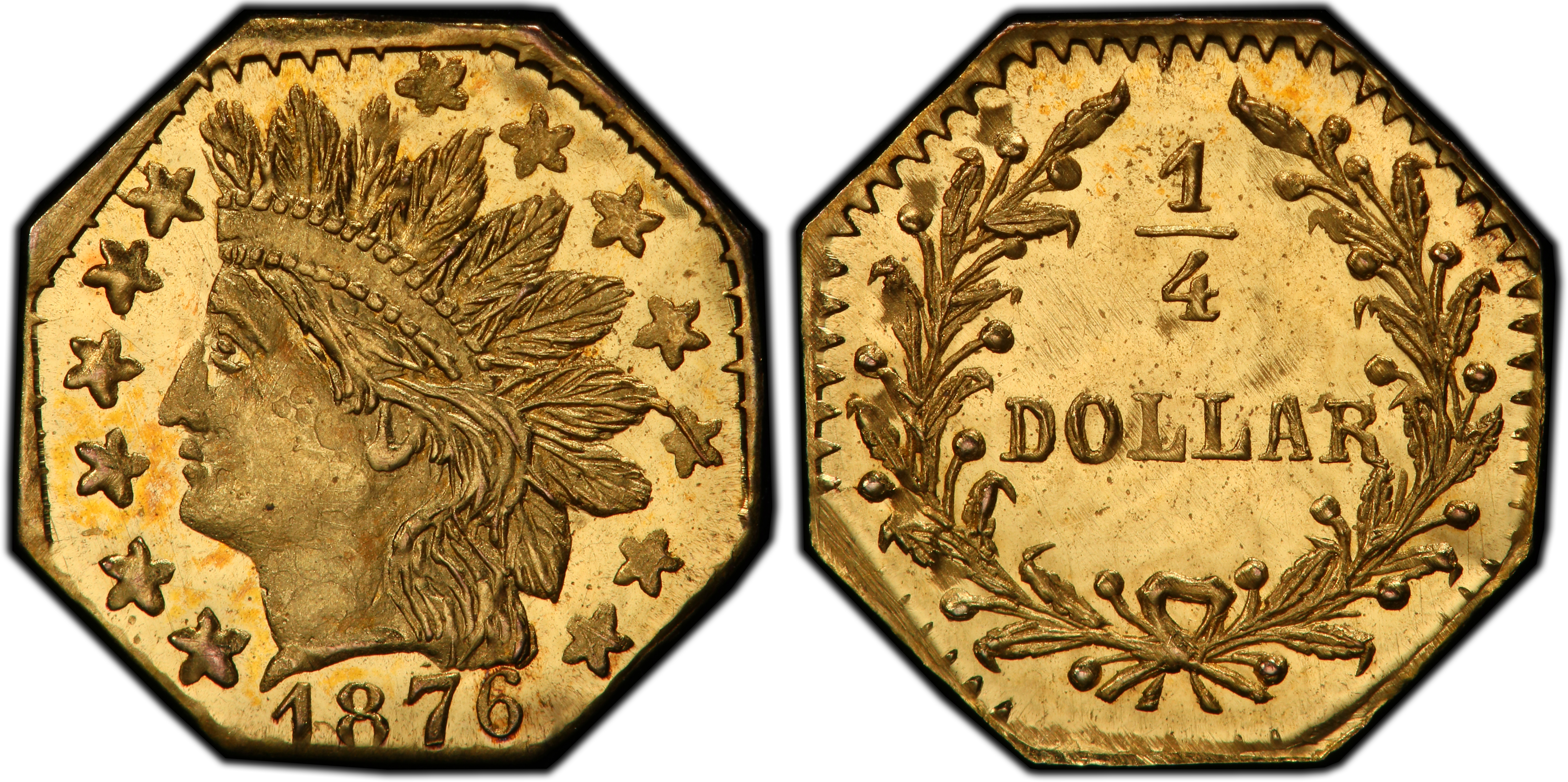
Obverse & Reverse
The 1876 BG-799C 25 Cents is a quintessential example of 'Period Two' California fractional gold. By the mid-1870s, the initial, desperate need for small circulating coinage that characterized the Gold Rush (Period One, 1852-1857) had long subsided, thanks to the ample output of the San Francisco Mint. However, the allure of California and the romance of the Gold Rush had created a robust tourism and souvenir market. Enterprising jewelers in San Francisco capitalized on this by producing miniature gold coins, often backdated or with popular designs like the 'Indian Head', to sell as keepsakes and novelty items. These 'jeweler's issues' were not intended to, and largely did not, fulfill a monetary need. Their production existed in a legal gray area. The Private Coinage Act of 1864 had prohibited such private issues, but enforcement was lax for decades. These tiny gold pieces were immensely popular, often mounted into jewelry, which explains why many surviving examples are damaged. The makers were not official mints but private businesses, meaning quality, weight, and fineness could vary significantly, though they were generally produced with enough gold to be attractive to buyers. In 1883, a crackdown by the U.S. Secret Service, concerned about potential confusion with legal tender and small-scale fraud, finally brought an end to the production of denominated fractional gold, cementing the 1852-1882 period as a closed and highly collectible chapter in American numismatics. The BG-799C, dated for the nation's Centennial, would have been an especially popular souvenir, linking the excitement of the West with the patriotic fervor of the era.
Associated EventPost-Gold Rush California Tourism
Reason For MintingPrimarily produced for sale as souvenirs and keepsakes for the tourist and jewelry trade.
Minter HistoryThe specific minter or jeweler responsible for the BG-799C die pair is unknown. During 'Period Two' (1859-1882), dozens of private firms, many operated by French or German immigrant jewelers in San Francisco, produced fractional gold. Unlike some 'Period One' issues which bore identifying initials (e.g., 'G' for Robert Gray & Co.), most Period Two pieces are anonymous, making specific attribution impossible. These minters typically used hand-cut dies and manual screw presses or hammer striking, resulting in significant variation in strike quality.
Historical SignificanceThis coin is historically significant not as circulating money, but as a tangible artifact of California's burgeoning tourism industry and the romantic mythology of the Gold Rush in the late 19th century. It represents the final phase of tolerated private coinage in the United States before federal enforcement ended the practice.
BG-799C
Denomination25C
Minting Period1876
Assayer/MinterUnknown San Francisco Jeweler
Geographic OriginSan Francisco, California
Obverse DescriptionFeatures a stylized Indian Head facing left, a popular motif for the period. The portrait is typically surrounded by 13 stars, representing the original colonies. The date '1876' appears below the bust.
Obverse Inscription1876
Reverse DescriptionA wreath of two branches tied with a bow at the bottom encircles the denomination. The design is simple, with the fraction '1/4' prominently in the center, the word 'DOLLAR' below it, and 'CAL.' for California above.
Reverse InscriptionCAL. 1/4 DOLLAR
CompositionGold
Stated Fineness Actual FinenessVariable, often between .500 and .800 fine, though not precisely documented for this variety.
Weight0.24 grams
Diameter9.60 mm
EdgePlain
Unknown
Survival EstimateFewer than 100
Rarity ScaleR-4+ (High R-4)
This coin is sought after for its connection to the Centennial year of 1876, its classic octagonal shape, and the popular Indian Head design. As a 'Period Two' issue, it is more affordable than the earlier circulating types, making it an accessible entry point into the fascinating world of California fractional gold.
Key VarietiesThe BG-799 die marriage itself is the key identifier. No major, intentional varieties, patterns, or special collector restrikes from the period of issue are known or documented for BG-799C. The entire series of post-1882 fractional 'tokens' (without denominations) could be considered a related collecting area.
Authentication TipsAuthentic pieces must have a denomination (e.g., '1/4 DOLLAR'). Replicas often omit this, saying '1/4 CAL GOLD CHARM' instead. No authentic California fractionals feature a bear. The strike on genuine pieces can be uneven, with some softness in the details, whereas modern fakes often have a sharp, uniform, 'too perfect' appearance. The luster on originals is often prooflike or satiny, distinct from the brassy look of many copies.
Shopping ConsiderationsA premium quality example for its grade will possess sharp central details on the Indian's headdress and the wreath. Many surviving examples are prooflike (PL) or deep prooflike (DPL) due to being struck from polished dies; specimens with deep, clear reflectivity command significant premiums. Avoid examples that have been obviously used as jewelry, looking for evidence of solder, tooling, or harsh cleaning which will obliterate the delicate luster. Original, reddish-gold toning is highly desirable and adds to the eye appeal.
A coin's grade is its condition, rated on a 1-70 scale. For rare coins, this is the most critical factor in determining value, as a tiny difference in preservation can mean a huge difference in price.
Relevant Grade TypesOriginal period issues were business strikes, although primarily intended for collectors and tourists rather than circulation. They are found in both Circulated (1-58) and, more commonly, Mint State (MS, 60-70) grades. No true Proofs were struck during the original period of issue. The highly polished dies used for these souvenir pieces often result in coins with prooflike (PL) or deep prooflike (DPL) surfaces, which are designations added to the MS grade, not a separate grade type.
Mint State CharacteristicsUncirculated examples of BG-799C are characterized by their luster, which is frequently prooflike. Due to the manual striking process, the sharpness can vary. A well-struck piece will show clear definition in the feathers of the headdress and the individual leaves of the wreath. Small planchet flaws or 'struck-through' debris are not uncommon and may not detract significantly if minor. Contact marks from handling are the primary determinant of the specific MS grade (e.g., MS-63 vs. MS-65).
Circulated Wear PatternsOn circulated examples, wear first appears on the high points of the Indian's cheek, the feathers in the headdress, and the knot of the bow on the reverse. As wear progresses, the stars on the obverse will begin to lose their sharp points and the letters in the inscriptions will become soft. In lower grades (VF and below), the date and finer details of the wreath will start to merge with the fields.
Key Factors For ValueBeyond the numerical grade, value is driven by surface quality and eye appeal. A coin with original, undisturbed prooflike surfaces is far more valuable than a cleaned or hairlined piece of the same grade. Strike sharpness is critical; a fully struck specimen is always preferred. Attractive, subtle toning can enhance value. For this series, a CAC sticker carries a significant premium, as it confirms both the grade and the superior quality for that grade.
PCGS Price Guide
| Grade | Price | Population |
|---|---|---|
| 60 | N/A | N/A |
| 62 | $325.00 | 6 |
| 62+ | $335.00 | N/A |
| 63 | $375.00 | 18 |
| 63+ | $405.00 | N/A |
| 64 | $525.00 | 28 |
| 64+ | $575.00 | N/A |
| 65 | $875.00 | 17 |
| 65+ | $1,250.00 | N/A |
| 66 | $2,500.00 | 2 |