1855 G25C BG-227 (Regular Strike)
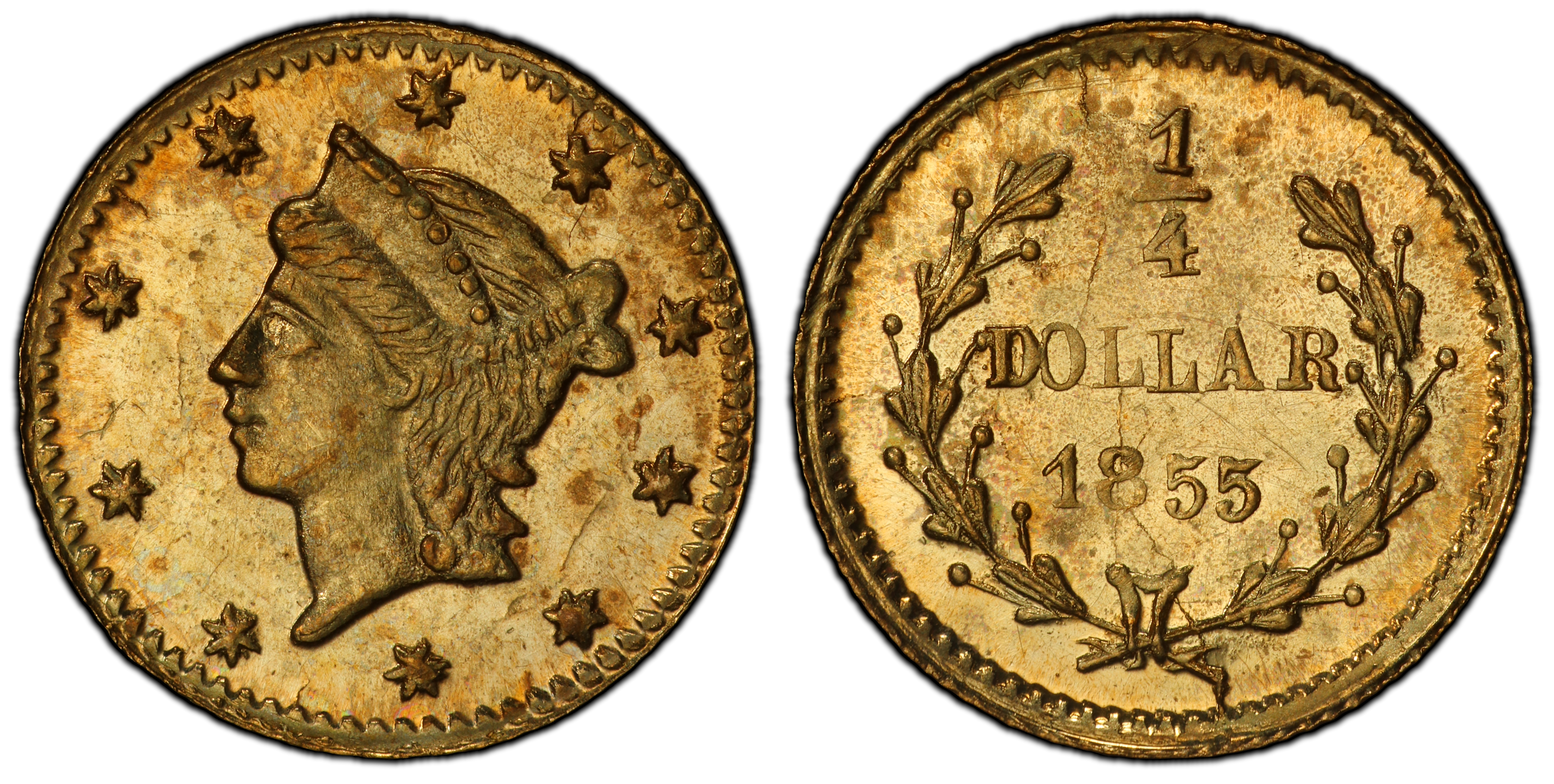
Obverse & Reverse
The 1855 BG-227 25 Cents is a quintessential example of 'Period One' California Fractional Gold, a fascinating and historically significant series born from economic necessity. Following the 1848 gold discovery, California was inundated with prospectors and entrepreneurs, creating a vibrant, cash-rich economy. However, this rapid growth far outpaced the supply of official United States coinage, especially for small-value transactions. Gold dust, while abundant, was impractical and often inequitable for minor purchases like a drink or a meal. With the San Francisco Mint not yet fully operational in striking sufficient small change, a void emerged. Into this gap stepped a handful of enterprising jewelers and metalsmiths, many of French origin, who began privately minting their own small-denomination gold coins. Among the most prolific of these was Antoine Louis Nouizillet, a San Francisco jeweler responsible for the BG-227 variety. These 'Period One' issues (1852-1856) were created with the genuine intent of serving as circulating currency. They were generally accepted in local commerce, not because they contained their full face value in gold (they were notoriously underweight), but because the need for a convenient medium of exchange was so acute that the public tolerated the discrepancy. The production process was crude by federal mint standards; dies were hand-cut and the coins were typically struck by the 'hammer method,' where a sledgehammer blow impressed the design onto a blank planchet. This resulted in frequent weak strikes, clashed dies, and other irregularities that are now cherished by collectors as part of their character. By 1856-1857, the San Francisco Mint's increased output of official silver and gold coinage rendered the private fractionals obsolete for circulation. Many were likely melted down, contributing to their present-day rarity. The BG-227, as a product of this unique period, is a tangible relic of the Gold Rush's chaotic, formative economy, representing a private solution to a public monetary crisis.
Associated EventCalifornia Gold Rush
Reason For MintingTo alleviate a severe shortage of official small-denomination coinage for daily commercial transactions in Gold Rush-era San Francisco.
Minter HistoryAntoine Louis Nouizillet was a French jeweler and one of the most significant private minters of California Fractional Gold during Period One (1852-1856). Operating in San Francisco, he was responsible for a wide array of quarter, half-dollar, and dollar varieties. His work is often identified by stylistic similarities in the engraving of his dies. Like many of his contemporaries, he operated in a legal gray area, producing coins that were technically tokens but served the function of currency. His business was eventually purchased around 1858 by Robert B. Gray & Co., another local jeweler who would continue striking fractional gold pieces, sometimes using Nouizillet's original dies. Nouizillet's issues are critical components of the Period One series and are highly studied by specialists.
Historical SignificanceThe BG-227 and its brethren are historically important as they represent a period of private, de facto currency that was essential for the functioning of California's early economy. They underscore the limitations of the federal government's reach on the western frontier and the ingenuity of local entrepreneurs. Numismatically, they form one of the most complex and avidly collected series of U.S. private coinage.
BG-227
Denomination25 Cents
Minting Period1855
Assayer/MinterAntoine Louis Nouizillet
Geographic OriginSan Francisco, California
Obverse DescriptionA Liberty Head facing left, her hair tied in a bun. She is surrounded by 13 six-pointed stars, which are typically weakly struck. The date, 1855, appears below the bust. The portrait style is crude but distinct to this series of private issues.
Obverse Inscription1855
Reverse DescriptionThe denomination '1/4 DOLLAR' is enclosed within a simple wreath composed of two branches tied together by a bow at the bottom. The lettering is often unevenly spaced and struck.
Reverse Inscription1/4 DOLLAR
CompositionGold
Stated Fineness Actual FinenessVariable, typically made from native California gold which contained silver and other elements, leading to a fineness generally between .800 and .900.
Weight0.25 grams
Diameter9.50 mm
EdgePlain
Unknown
Survival Estimate75-100
Rarity ScaleR-6
This coin is highly prized as a representative of the scarce and historically rich 'Period One' California Fractional Gold series. Its connection to the Gold Rush, its status as a privately minted coin intended for circulation, and its high rarity (R-6) make it a key target for specialists in territorial and pioneer gold.
Key VarietiesThe primary variety is the BG-227 business strike. There are no known major sub-varieties from the original minting period, nor are there any known officially sanctioned later-date restrikes, patterns, or trial pieces produced from these specific dies. The dies for this variety were subject to clashing, so examples showing evidence of clashed dies are common and considered characteristic rather than a separate variety.
Authentication TipsGenuine examples are struck, not cast. Look for characteristic weakness in the strike, especially on the stars and the wreath. The surfaces of authentic pieces often show fine die polishing lines and may exhibit evidence of die clashing. The lettering style and the specific shape of the Liberty portrait are key diagnostic points; compare with high-resolution images of certified examples. Counterfeits are common and are often either underweight modern replicas or cast copies with mushy details and porous surfaces. Be wary of pieces with an unnaturally yellow color, as genuine examples made from native gold often have a slightly greenish or reddish hue.
Shopping ConsiderationsA premium quality example for the grade will exhibit a stronger-than-average strike, particularly on the stars and the details of the wreath. The surfaces should be clean for the grade, without distracting marks or evidence of harsh cleaning, which can strip the original 'skin' and luster. Eye appeal is paramount; pieces with original, unmolested surfaces and a pleasing reddish or greenish-gold toning command significant premiums. Check carefully for evidence of having been mounted in jewelry, such as solder marks or rim damage, which is a common impairment for this series. A coin certified by a major third-party grading service is highly recommended for this issue due to the prevalence of counterfeits.
A coin's grade is its condition, rated on a 1-70 scale. For rare coins, this is the most critical factor in determining value, as a tiny difference in preservation can mean a huge difference in price.
Relevant Grade TypesOriginal issues of BG-227 were business strikes intended for circulation. They are found in Circulated grades (AG-3 to AU-58) and, more frequently, in Mint State (MS, 60-70), as many were saved as curiosities. There is no evidence of Proof (PR/PF) examples being struck by Nouizillet during the original period of issue. Any coin claiming to be a Proof restrike should be regarded with extreme skepticism, as no such official issues are known to exist for this variety.
Mint State CharacteristicsUncirculated examples are defined by the presence of original mint luster. This luster is typically soft and satiny rather than deeply prooflike, although some examples with reflective fields exist. Due to the crude manufacturing process, even high-grade Mint State coins will often display areas of striking weakness, particularly on the peripheral stars and the finer details of the wreath. Contact marks are common due to the softness of the gold. A superior MS example is one that combines good luster with an unusually sharp strike and minimal, well-hidden contact marks.
Circulated Wear PatternsWear first appears on the highest points of the design. On the obverse, friction will first dull the luster on Liberty's cheek, the hair above her eye, and the ear. On the reverse, the highest points of the leaves in the wreath and the bow will show wear first. On lower grade examples, the stars will begin to merge with the fields, and the date and legends will become progressively weaker.
Key Factors For ValueThe primary value drivers for this coin are grade and surface quality. An example with original, uncleaned surfaces and attractive natural toning is far more valuable than a cleaned or polished coin of the same grade. Strike quality is also critical; a sharply struck BG-227 is a rarity and will command a substantial premium over a weakly struck counterpart. Finally, certification by a top-tier service (PCGS or NGC) is essential for market acceptance. A CAC sticker, indicating premium quality for the grade, adds yet another significant layer of value.
PCGS Price Guide
| Grade | Price | Population |
|---|---|---|
| 50 | $350.00 | N/A |
| 50+ | $355.00 | N/A |
| 53 | $375.00 | N/A |
| 53+ | $380.00 | N/A |
| 55 | $400.00 | 8 |
| 55+ | $410.00 | N/A |
| 58 | $440.00 | 13 |
| 58+ | $465.00 | N/A |
| 60 | $500.00 | 4 |
| 61 | $575.00 | 7 |
| 62 | $700.00 | 28 |
| 62+ | $750.00 | N/A |
| 63 | $850.00 | 26 |
| 63+ | $1,150.00 | N/A |
| 64 | $2,500.00 | 5 |
| 64+ | $2,850.00 | 1 |
| 65 | $4,500.00 | 1 |