1853 G50C BG-410 Eagle (Regular Strike)
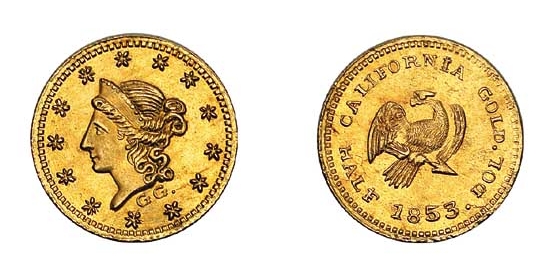
Obverse & Reverse
The California Gold Rush, initiated by the discovery at Sutter's Mill in 1848, created a chaotic and dynamic economy almost overnight. A massive influx of prospectors and merchants flooded the region, but circulating coinage was critically scarce. Gold dust and nuggets became the primary medium of exchange, an inefficient and often inaccurate system prone to spillage and theft. To address this desperate need for a more convenient form of currency, dozens of private minters began striking coins in various denominations, from 25 cents to 50 dollars. Among the most prolific and enduring of these were the small-denomination 'California Fractional Gold' pieces. These tiny coins, valued at 25 cents, 50 cents, and one dollar, facilitated everyday transactions, allowing a miner to buy a drink or a meal without resorting to the clumsy process of weighing gold dust. The 1853 Gold 50 Cents, cataloged as Breen-Gillio 410 (BG-410), emerged from this environment. Struck by an unknown private minter in San Francisco, its simple yet functional design featuring a heraldic eagle was a familiar motif for Americans. These coins were not legal tender but were widely accepted due to the purity of their gold and the overwhelming need for a circulating medium. The production of such pieces was technically illegal after the U.S. established a branch mint in San Francisco in 1854, but the demand was so great that jewelers and private assayers continued to produce them surreptitiously for decades. The BG-410 is a quintessential example of this fascinating period, representing a grassroots solution to a severe economic problem. Its small size is a testament to the high value of gold, and its very existence speaks to the ingenuity and frontier spirit that defined Gold Rush California. Today, these pieces are highly sought after as tangible links to one of the most transformative periods in American history.
Associated EventCalifornia Gold Rush
Reason For MintingTo provide a convenient medium of exchange for small, everyday transactions due to a severe shortage of official U.S. government coinage in California.
Minter HistoryThe specific minter of the BG-410 variety is unknown. Research by numismatists like Robert D. Leonard Jr. suggests potential attribution to Frontier, Deviercy & Co., a prominent San Francisco jewelry and assaying firm active during the period. They were known to have produced other fractional gold pieces, and the style and planchet characteristics of the BG-410 are consistent with their known work. However, the attribution remains speculative, as many of these private minters operated without clear identifying marks to avoid legal repercussions from the federal government.
Historical SignificanceThe BG-410, like all California Fractional Gold, represents a critical chapter in American monetary history, demonstrating how private enterprise filled a void left by the federal government during a period of rapid economic expansion. It is a physical artifact of the daily commerce of the Gold Rush, used by miners, merchants, and settlers to conduct business in a society starved for coinage.
N/A
Denomination50 Cents
Minting Period1853
Assayer/MinterUnknown, possibly Frontier, Deviercy & Co.
Geographic OriginSan Francisco, California
Obverse DescriptionA heraldic eagle, similar to the contemporary design on federal gold coinage, with its head turned to the right. A shield is on its breast, and it clutches an olive branch and arrows in its talons. Above the eagle are 13 stars arranged in an arc.
Obverse Inscription Reverse DescriptionThe denomination '1/2' is in the center, surrounded by the inscription 'CALIFORNIA GOLD' in an arc above. The date '1853' is below, separated from the text by two star-like ornaments or dots.
Reverse InscriptionCALIFORNIA GOLD 1/2 1853
CompositionGold
Stated Fineness Actual FinenessApproximately .875 to .900
Weight0.25 grams
Diameter10.00 mm
EdgePlain
Unknown
Survival Estimate250-400
Rarity ScaleR-5
The BG-410 is highly popular with collectors due to its classic 'eagle' design, which evokes federal coinage, its status as a genuine 'Period One' (1852-1857) issue, and its relative affordability compared to rarer fractional gold varieties. It serves as an accessible entry point into the fascinating world of Gold Rush-era currency.
Key VarietiesThe primary variety is the regular business strike. There are no known original proof strikings or official restrikes. However, collectors should be aware of numerous contemporary counterfeits and later-made souvenir tokens that mimic this design. These are typically made of brass or gold-plated base metal and are numismatically distinct from genuine issues.
Authentication TipsGenuine BG-410 pieces have a distinctive die crack that often runs from the rim through the 'C' in CALIFORNIA on the reverse. The stars and lettering, while crude by federal mint standards, should be sharp and well-defined, not mushy or cast-looking. The weight should be very close to 0.25 grams. Counterfeits often have incorrect details, a soapy or porous appearance from being cast, or are made of brass. Third-party certification by PCGS or NGC is highly recommended for authentication.
Shopping ConsiderationsA premium quality BG-410 will exhibit a sharp strike, particularly on the eagle's feathers and the shield's lines. Seek out examples with minimal distracting marks; given their small size, even minor scratches can be prominent. Original, uncleaned surfaces with a touch of reddish-gold toning are highly desirable. Avoid coins that have been harshly cleaned, polished, or mounted in jewelry, as this significantly impairs their value. Pay close attention to the reverse lettering; weakly struck legends are common, so a piece with bold 'CALIFORNIA GOLD' commands a premium.
A coin's grade is its condition, rated on a 1-70 scale. For rare coins, this is the most critical factor in determining value, as a tiny difference in preservation can mean a huge difference in price.
Relevant Grade TypesAll original BG-410 issues were business strikes intended for circulation. They are found in Circulated grades (AG-3 to AU-58) and Mint State grades (MS-60 to MS-70). No proofs were struck during the original period of issue, and any piece described as a 'Proof' is either a modern fabrication or a misattribution of a high-quality business strike.
Mint State CharacteristicsAn uncirculated BG-410 will display full, unbroken mint luster, often with a slightly satiny texture. The strike is a key determinant of quality; many were weakly struck, so an MS example with sharp details on the eagle's head, shield, and the digits of the date is rare. High-grade examples are susceptible to tiny planchet flaws or adjustment marks, which are common for privately minted coins of this era and should be noted but do not necessarily preclude a Mint State grade.
Circulated Wear PatternsWear first appears on the highest points: the eagle's head and the upper portion of the shield on the obverse. On the reverse, the fraction '1/2' and the date '1853' will show initial flatness. In grades of VF and below, the eagle's feathers will become indistinct, and the letters in the legends will start to merge with the fields. On heavily worn examples (G-VG), the eagle will be a near-silhouette and the date may be partially or fully obliterated.
Key Factors For ValueFor the BG-410, value is driven by three main factors: grade, surface quality, and strike. A sharply struck coin in a high grade (AU-55 or better) with clean, original surfaces will command a significant premium. Eye appeal is paramount; collectors pay more for pieces with attractive, undisturbed reddish-gold coloration versus those that are bright and appear to have been cleaned or dipped. The presence of a CAC sticker, indicating premium quality for the grade, adds a substantial premium, as it confirms the coin's superior eye appeal and originality.
PCGS Price Guide
| Grade | Price | Population |
|---|---|---|
| 62 | $32,500.00 | N/A |
| 64 | $47,500.00 | 1 |