1853 G$1 BG-518 (Regular Strike)
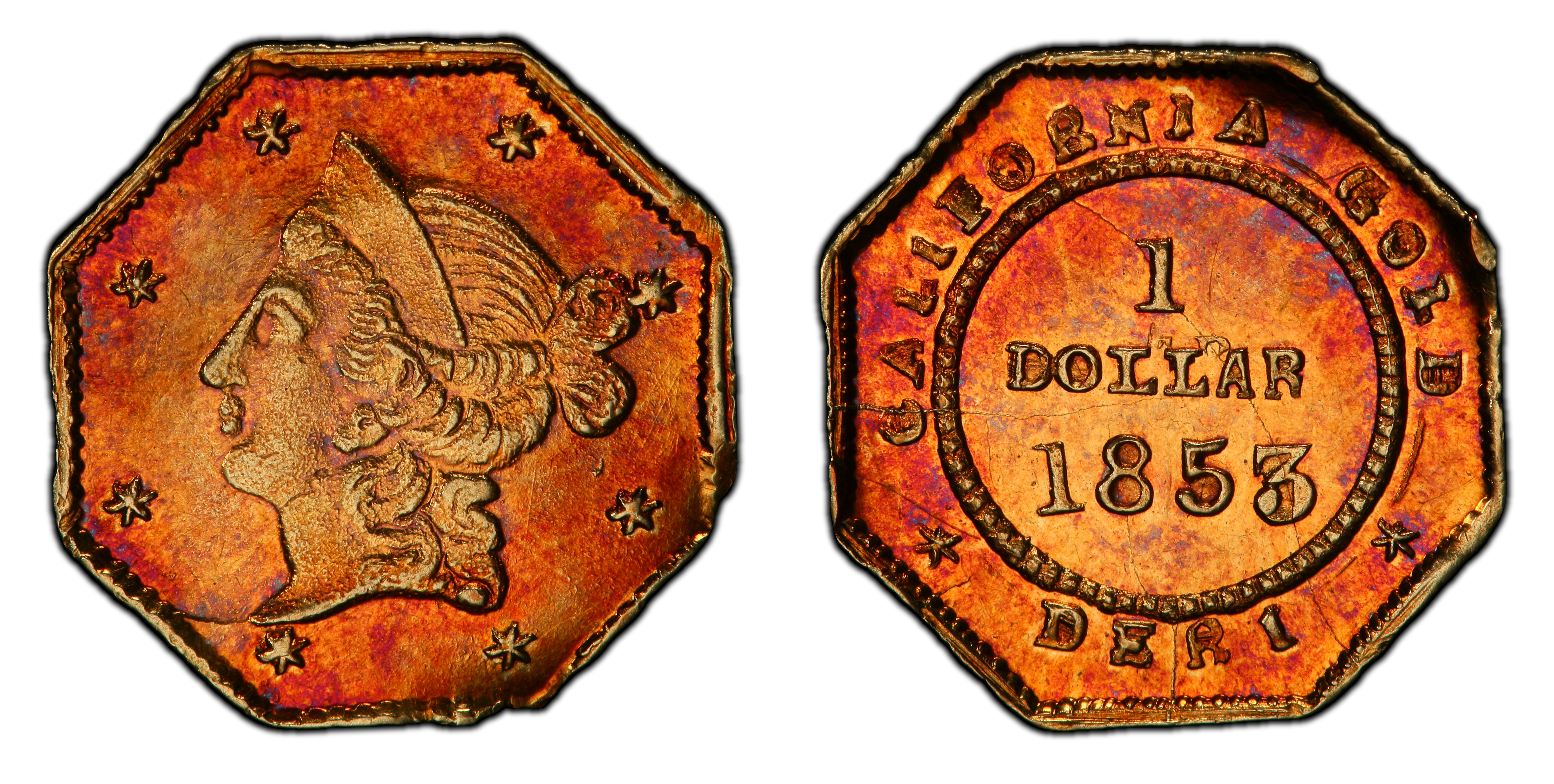
Obverse & Reverse
The 1853 G$1 BG-518 is a quintessential artifact from 'Period One' (1852-1857) of the California Fractional Gold series, a period defined by legitimate commercial necessity. In the aftermath of the 1848 gold discovery at Sutter's Mill, California was flooded with over 300,000 prospectors and entrepreneurs. This explosive population growth created a dynamic economy that was severely hampered by a chronic shortage of small-denomination coinage. Commerce was conducted with pinches of gold dust, a chaotic and imprecise system, or with a confusing influx of foreign silver coins of inconsistent value. While private assayers like Moffat & Co. and Wass, Molitor & Co. produced larger denomination gold coins ($5 to $50), the public desperately needed pocket change. The United States Mint in San Francisco would not be fully operational until 1854, and even then, its initial output of small coins was woefully inadequate. Into this monetary vacuum stepped a number of San Francisco jewelers and engravers, many of French origin. M. Deriberpie, identified by the 'DERI' inscription on the reverse, was one such craftsman. He and his contemporaries began striking quarter-dollar, half-dollar, and one-dollar pieces to facilitate daily trade. These coins were not government-sanctioned but were tolerated due to their essential role. They were typically produced by hand, using the crude but effective 'hammer method' where dies were struck with a sledgehammer. The gold was locally sourced placer gold, which naturally contained a high percentage of silver, giving the coins a lighter color than federal issues. Though intended for circulation, their minuscule size made them impractical, and by late 1853, many were already being kept as curiosities or sent back East in letters as tangible souvenirs of the Gold Rush. As the San Francisco Mint ramped up production of federal coinage in 1855-56, the need for these private issues waned, and the era of 'necessity money' drew to a close, cementing the status of Period One fractionals as genuine relics of the Gold Rush boomtown economy.
Associated EventCalifornia Gold Rush
Reason For MintingTo alleviate a severe shortage of small-denomination coinage for daily commerce in Gold Rush-era San Francisco before the U.S. Mint began adequate local production.
Minter HistoryM. Deriberpie was a San Francisco jeweler and engraver active during the Gold Rush. His name appears in James M. Parker's 1852-53 San Francisco directory. Like other French artisans in the city, such as Antoine Nouizillet and the firm of Frontier & Deviercy, Deriberpie applied his skills to meet the region's desperate need for small change. His work is identified by the 'DERI' mark on the reverse of the coins he produced. Evidence from the shipwreck of the S.S. Winfield Scott, which sank in December 1853, confirms the circulation of his pieces alongside other Period One fractionals; six octagonal dollars by Deriberpie were recovered from the wreckage. He was part of a small, crucial group of craftsmen whose private issues formed the backbone of small commerce in the boom's early years.
Historical SignificanceThe BG-518 is a tangible link to the chaotic but vibrant economy of Gold Rush San Francisco. As a 'Period One' issue, it is considered a legitimate circulating medium of exchange, created out of necessity, unlike later 'Period Two' issues which were primarily made as souvenirs. It represents the ingenuity of private entrepreneurs in addressing a systemic failure of currency supply and serves as a key example of the diverse and fascinating world of U.S. private and territorial coinage.
N/A
Denomination$1
Minting Period1853
Assayer/MinterM. Deriberpie
Geographic OriginSan Francisco, California
Obverse DescriptionA fairly crude but classic Liberty Head portrait facing left, modeled after the contemporary federal gold dollars of James B. Longacre. The head is adorned with a coronet. The field is surrounded by thirteen six-pointed stars, which are notably larger than those on the similar BG-517 variety.
Obverse Inscription[NONE]
Reverse DescriptionThe denomination '1' and 'DOLLAR' are enclosed within a wreath of 21 leaves and 6 berries. The date '1853' appears within the wreath, just above the bow. In the exergue below the wreath's bow is the minter's mark, 'DERI'. The planchet is octagonal.
Reverse Inscription1 DOLLAR 1853 DERI
CompositionGold (with natural silver alloy)
Stated Fineness Actual FinenessVariable, typical for Period One issues using unrefined native gold, ranging from 14 to 22 karats (.583 to .917 fine). Generally accepted to be underweight for their face value.
Weight1.10 grams
Diameter12.20 mm
EdgePlain
Unknown
Survival Estimate16 to 30 coins
Rarity ScaleR-6 (Low)
This variety is highly sought after as a genuine 'Period One' circulating issue with a known maker. Its octagonal shape, clear attribution to Deriberpie, and high rarity make it a prized possession for specialists in California gold and territorial coinage.
Key VarietiesThe BG-518 is a distinct die marriage. No major sub-varieties from the period of issue are known. It is important to distinguish this from the similar BG-517, which uses the same reverse die but features a different obverse with smaller stars. No known special collector issues, patterns, or official restrikes exist.
Authentication TipsAuthentication requires careful die study. Key diagnostics for BG-518 include: 1) The obverse stars are noticeably larger than on BG-517. 2) This variety shares its reverse die with BG-517. 3) The 'DERI' mark in the reverse exergue is a critical feature. 4) The overall strike is often somewhat crude, and many authentic examples are found on slightly wavy or uneven planchets. Modern counterfeits often have a soapy, artificial look, incorrect lettering fonts, or exhibit repeating depressions ('Repetitive Stress Marks') from modern production methods not consistent with hand-hammered striking.
Shopping ConsiderationsA premium quality example for its grade will exhibit a bold strike, particularly on Liberty's coronet, the date, and the 'DERI' inscription. Original, uncleaned surfaces with some remaining mint luster command a significant premium. The color should be a pleasing light, slightly brassy or greenish-gold, consistent with the natural silver alloy of California placer gold. Look for coins that are free from distracting rim bumps, scratches, or evidence of having been mounted in jewelry. Because many were hand-struck, planchet quality varies; a flat, well-made planchet is desirable, but a slightly wavy nature can be characteristic of the issue and should not be seen as a flaw unless it is severe. Avoid examples that have been harshly cleaned, polished, or show evidence of tooling or repairs.
A coin's grade is its condition, rated on a 1-70 scale. For rare coins, this is the most critical factor in determining value, as a tiny difference in preservation can mean a huge difference in price.
Relevant Grade TypesAll original examples of BG-518 are business strikes, intended for circulation. They are found in Circulated grades (AG-3 to AU-58) and, very rarely, in Mint State grades (MS-60 to MS-70). No Proof examples were struck during the original period of issue, and there are no known later-date Proof restrikes.
Mint State CharacteristicsUncirculated examples are exceptionally rare. A true Mint State BG-518 would exhibit frosty, satiny, or semi-prooflike luster, though it may be subdued due to the gold's alloy. The strike is often uneven, so a coin may have sharp details in one area and softness in another; a full strike on the central devices (Liberty's hair, wreath details) is highly desirable. Small planchet flaws or adjustment marks made prior to striking are common and generally accepted for the issue. Contact marks are expected given the softness of the gold, but large, distracting marks in prime focal areas like Liberty's face will diminish the grade.
Circulated Wear PatternsWear first appears on the highest points of the design. On the obverse, this includes the hair above Liberty's eye and ear, the cheek, and the details of the coronet. The stars will also show early friction and lose their sharpness. On the reverse, the highest points of the wreath's leaves and the bow will show the first signs of smoothing. In lower grades (Fine and below), the 'DERI' inscription, date, and denomination become faint and can be difficult to read.
Key Factors For ValueFor the BG-518, value is driven by three main factors: rarity, grade, and surface quality. As an R-6 coin, any example is valuable. The jump in price from circulated to Mint State grades is immense. Surface quality is paramount; an example with original, unmolested 'skin' and pleasing eye appeal will always be worth more than a cleaned or damaged coin of the same technical grade. The sharpness of the strike, especially on the 'DERI' mark, is a critical factor for specialists. A CAC sticker, indicating premium quality for the grade, adds a significant premium to this issue.
PCGS Price Guide
| Grade | Price | Population |
|---|---|---|
| 20 | $700.00 | 1 |
| 25 | $725.00 | N/A |
| 30 | $750.00 | N/A |
| 35 | $775.00 | N/A |
| 40 | $800.00 | 1 |
| 45 | $850.00 | 1 |
| 45+ | $875.00 | N/A |
| 50 | $925.00 | 2 |
| 50+ | $950.00 | N/A |
| 53 | $975.00 | 1 |
| 53+ | $1,000.00 | N/A |
| 55 | $1,050.00 | 11 |
| 55+ | $1,100.00 | N/A |
| 58 | $1,200.00 | 6 |
| 58+ | $1,350.00 | N/A |
| 60 | $1,500.00 | N/A |
| 61 | $1,700.00 | 3 |
| 62 | $1,850.00 | 12 |
| 62+ | $2,500.00 | N/A |
| 63 | $3,750.00 | 4 |
| 63+ | $4,250.00 | N/A |
| 64 | $5,750.00 | 3 |