1853 G50C BG-418 (Regular Strike)
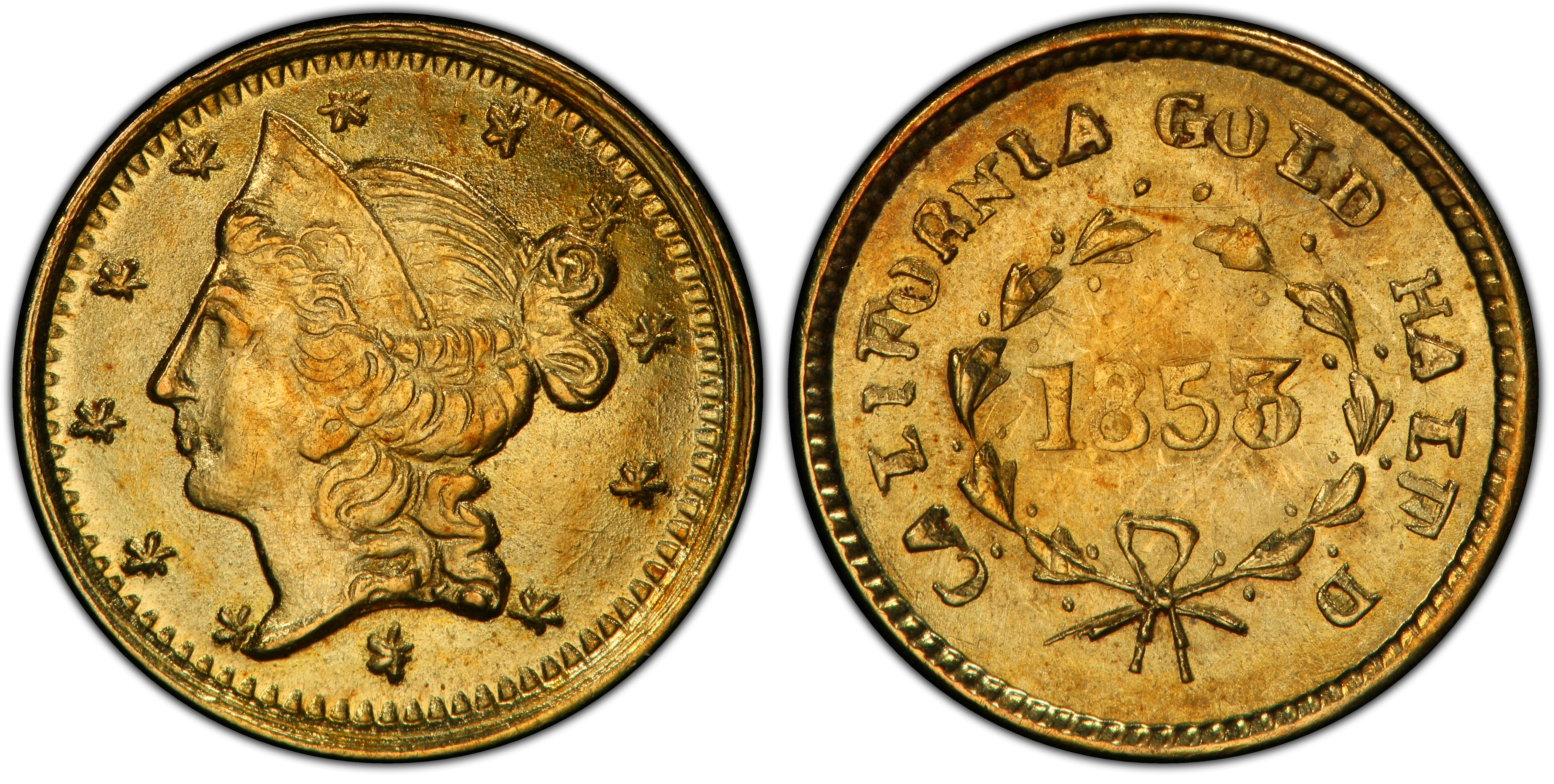
Obverse & Reverse
The 1853 BG-418 half dollar is a tangible relic of the chaotic and economically vibrant California Gold Rush. Following the discovery of gold at Sutter's Mill in 1848, a massive influx of over 300,000 people descended upon California, creating a booming economy virtually overnight. This rapid expansion, however, created a severe and persistent problem: a shortage of small-denomination coinage for daily transactions. Gold dust, weighed or estimated by a 'pinch,' served as a clumsy medium of exchange, but its lack of standardization and the difficulty in handling it for minor purchases created a significant barrier to commerce. Federal coinage was scarce on the West Coast, as the arduous journey from the Philadelphia Mint was slow and perilous. While private firms like Moffat & Co. began striking larger denomination gold coins, the need for fractional currency—quarters, halves, and dollars—remained acute. Into this monetary vacuum stepped a number of San Francisco jewelers and artisans who, beginning in 1852, began privately producing small-denomination gold coins. These pieces, now known as California Fractional Gold, were a direct response to market demand. The BG-418 is a 'Period One' issue, a designation for coins struck between 1852 and 1857 that were genuinely intended to circulate and alleviate the change shortage. Unlike later 'Period Two' and 'Period Three' issues, which were often underweight and made primarily as souvenirs, Period One pieces were generally of honest weight and fineness, containing gold from the very mines that fueled the boom. These tiny coins, often produced by crude hammer-striking methods, were indispensable for everyday life, allowing a miner to buy a drink or a meal without resorting to imprecise pinches of gold dust. The production of these fractionals was a gray area legally but was tolerated out of sheer necessity until the San Francisco Mint began full-scale operations in 1854 and its coins finally saturated the region, rendering the private issues obsolete. The BG-418, by its very existence, tells the story of a frontier economy creating its own solutions in the absence of federal infrastructure, a testament to the ingenuity and pragmatism of the Gold Rush era.
Associated EventCalifornia Gold Rush
Reason For MintingTo alleviate a severe shortage of small-denomination circulating coinage for daily commercial transactions in Gold Rush-era California.
Minter HistoryThe precise maker of the BG-418 variety remains unidentified, a common trait for many California Fractional Gold issues. However, numismatic scholarship, notably by Donald Kagin, has speculated that the San Francisco jewelry firm of Braverman & Levy may be responsible. This attribution is based on stylistic similarities and the known activities of engravers associated with the firm during this period. Braverman & Levy, like other jewelers such as Antoine Nouizillet and M. Deriberpe, were well-positioned with the necessary skills in metallurgy and die engraving to meet the public's demand for coinage. They operated in the heart of the commercial boom, where the need for small change was most pressing.
Historical SignificanceAs a 'Period One' issue, the BG-418 is significant as a genuine circulating medium of exchange from the height of the Gold Rush. It represents a grassroots solution to a systemic economic problem and is a direct link to the daily lives of miners and merchants in 1850s San Francisco. Its extreme rarity today underscores the heavy use and eventual attrition these small, easily lost coins endured.
BG-418
Denomination50 Cents
Minting Period1853
Assayer/MinterUnknown, possibly Braverman & Levy
Geographic OriginSan Francisco, California
Obverse DescriptionA large, finely engraved Liberty Head facing left, her hair tied in a bun at the back. She is surrounded by thirteen evenly spaced six-pointed stars, representing the original colonies. The date, 1853, is centered below the bust.
Obverse Inscription1853
Reverse DescriptionThe central device is a simple wreath. The inscription 'HALF DOL.' is inside the wreath. The legend 'CALIFORNIA GOLD' is inscribed around the periphery, outside the wreath. Auction records note that the lettering in the peripheral legend is often crude and unevenly spaced on this variety.
Reverse InscriptionHALF DOL. CALIFORNIA GOLD
CompositionGold
Stated Fineness Actual FinenessTypically .880 to .900 fine, consistent with unrefined native California gold which contained a high percentage of silver.
Weight0.85 grams
Diameter11.00 mm
EdgeWidely Reeded
Unknown, but extremely small.
Survival EstimateFewer than 15 known. The Breen-Gillio reference lists 14 specimens, noting probable duplication.
Rarity ScaleLow R-7
The BG-418 is a classic rarity in the California Fractional Gold series. Its appeal stems from its status as a circulating 'Period One' issue, its attractive Liberty Head design, its extreme scarcity (Low R-7), and the historical romance of the Gold Rush. It is a prized possession for specialists in Territorial gold.
Key VarietiesThe BG-418 is itself a distinct die variety. There are no major sub-varieties from the original minting period. No special collector issues, patterns, or restrikes are known for this specific variety. Collectors should distinguish it from other 1853 Round Half Dollar varieties, such as BG-417 or BG-419, by carefully examining the die characteristics of the portrait, stars, and lettering.
Authentication TipsAuthentic Period One pieces like BG-418 must be denominated; fakes and later souvenir 'charms' often lack a face value or use phrases like 'CAL GOLD' instead of 'DOLLAR' or 'DOL.'. Genuine pieces often have a slightly soft, uneven strike due to being hammer-struck. Replicas are often sharply struck with modern tooling and may have a soapy or prooflike luster unlike the satiny flow lines of originals. For BG-418 specifically, verify the widely reeded edge and the characteristic crude, uneven spacing of the reverse legend. The gold color should have the slightly pale, silvery tint common to unrefined California gold. Any piece with a bear on the reverse is a modern fantasy item.
Shopping ConsiderationsFor a Low R-7 variety, any example is a major acquisition. A 'premium quality' specimen would be one that is well-centered and sharply struck, particularly on Liberty's hair and the details of the wreath. Look for original, uncleaned surfaces with a 'crusty' or frosty olive-gold luster. Avoid examples that have been holed, heavily cleaned, or show evidence of tooling or repairs, as these significantly impair value. Given the crude manufacturing, some planchet roughness or minor striking weakness may be acceptable, but major, distracting marks should be cause for a lower price. Eye appeal is paramount; a choice coin will have a pleasing, original look that has not been stripped or brightened by harsh cleaning.
A coin's grade is its condition, rated on a 1-70 scale. For rare coins, this is the most critical factor in determining value, as a tiny difference in preservation can mean a huge difference in price.
Relevant Grade TypesOriginal BG-418s were business strikes intended for circulation and are found in Circulated grades (AG-3 to AU-58) and, very rarely, in Mint State (MS-60 to 70). No proofs were struck during the original period of issue. Any piece described as a 'Proof' is either a modern replica or a misattribution of a business strike with prooflike surfaces.
Mint State CharacteristicsUncirculated examples of BG-418 are exceptionally rare. A true Mint State coin will exhibit full, frosty mint luster in the fields. The strike is often somewhat soft in the centers, particularly on the highest points of Liberty's hair and the bow of the wreath, due to the hammer-striking process. The surfaces, being soft gold, are highly susceptible to contact marks; even a choice MS example may have scattered light abrasions. The quality of luster—whether it is vibrant and frosty versus subdued—is a key determinant of grade.
Circulated Wear PatternsWear first appears on the highest points of the design. On the obverse, look for friction on the hair above Liberty's eye and ear, and on her cheekbone. On the reverse, the high points of the wreath's leaves and the bow will show rubbing first. In lower grades (Fine and below), the stars will begin to merge with the field, and the fine details of the hair will be completely worn away. The legends will remain legible until the lowest grades.
Key Factors For ValueFor the BG-418, rarity is the primary driver of value. After that, grade and surface quality are paramount. An example with original, uncleaned 'skin' commands a massive premium over a cleaned or polished coin of the same grade. Strike quality is also critical; a coin with a bold strike on the central devices is highly desirable. Eye appeal, encompassing attractive natural toning and a lack of distracting marks, plays a huge role. Given its rarity, a CAC sticker signifying premium quality for the grade would add a significant premium at auction.
PCGS Price Guide
| Grade | Price | Population |
|---|---|---|
| 45 | $1,250.00 | N/A |
| 45+ | $1,300.00 | N/A |
| 50 | $1,350.00 | N/A |
| 50+ | $1,400.00 | N/A |
| 53 | $1,450.00 | N/A |
| 53+ | $1,500.00 | N/A |
| 55 | $1,550.00 | 1 |
| 55+ | $1,625.00 | N/A |
| 58 | $1,750.00 | 4 |
| 58+ | $1,850.00 | N/A |
| 60 | $2,250.00 | N/A |
| 61 | $3,000.00 | 1 |
| 62 | $3,750.00 | 3 |
| 62+ | $4,500.00 | N/A |
| 63 | $7,000.00 | 1 |
| 63+ | $8,250.00 | N/A |
| 64 | $13,500.00 | 3 |