1856 G25C BG-107 (Regular Strike)
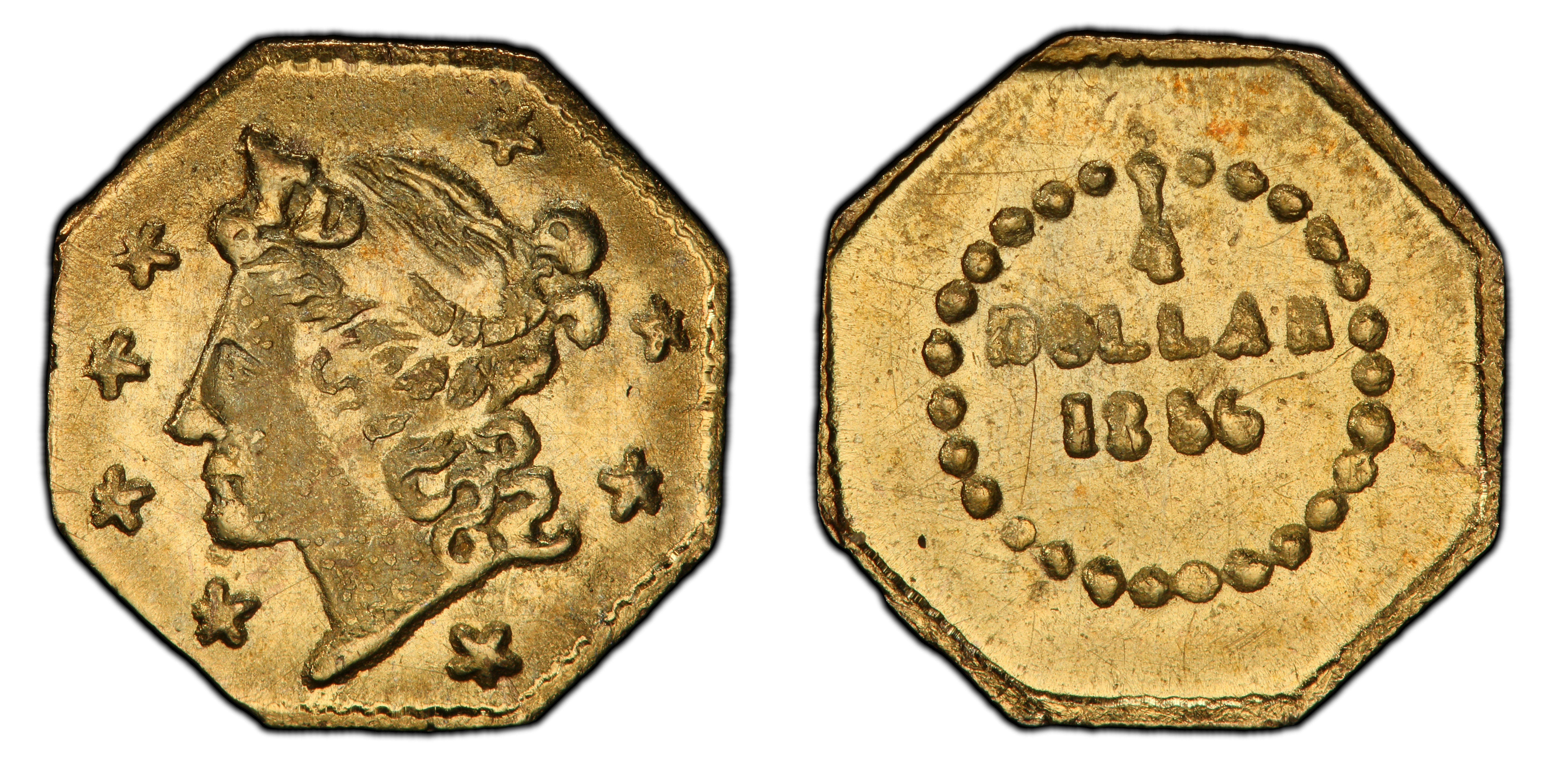
Obverse & Reverse
The 1856 Octagonal Gold Quarter Dollar, cataloged as Breen-Gillio 107, represents a fascinating chapter in the economic history of the American West. It emerged during what numismatists classify as 'Period One' (1852-1857) of California Fractional Gold production. This era was born of pure necessity. The massive influx of population during the California Gold Rush created a vibrant, booming economy, yet it was crippled by a severe shortage of small-denomination coinage. While federal mints and private assayers like Moffatt & Co. produced larger denomination gold coins, the daily commerce of buying a drink, a meal, or other small goods was frustrated by the lack of circulating cents, dimes, and quarters. Gold dust, the primary medium of exchange, was imprecise and prone to spillage and theft. In response to this commercial crisis, jewelers and metalsmiths in San Francisco began striking their own tiny gold coins in quarter-dollar, half-dollar, and dollar denominations. These pieces were not intended as competitors to federal coinage but as facilitators of local trade. The BG-107 variety is attributed to Frontier, Deviercy & Co., one of the more prolific producers of these essential coins. Unlike earlier, heavier issues, by 1856 the production of fractional gold was beginning its transition from a purely utilitarian response to a coinage shortage to a burgeoning souvenir trade, as the establishment and increasing output of the San Francisco Mint began to alleviate the scarcity of federal silver coins. The BG-107 is particularly notable for its crude workmanship, a hallmark of this variety. The dies were evidently of very low quality, possibly rusted or heavily used, resulting in coins with notoriously poor detail and rough surfaces, even on the highest-grade surviving examples. This crudeness, paradoxically, now serves as a key diagnostic for authentication. The coin's existence highlights the chaotic and entrepreneurial spirit of Gold Rush California, where private citizens stepped in to solve fundamental economic problems the federal government was too slow to address, creating a unique and highly collectible numismatic legacy in the process.
Associated EventCalifornia Gold Rush
Reason For MintingTo alleviate a severe shortage of small change for daily commercial transactions in Gold Rush-era California.
Minter HistoryFrontier, Deviercy & Co. was a San Francisco-based firm of jewelers and watchmakers active during the 1850s. Like many of their contemporaries, they recognized the critical need for small-denomination coinage and leveraged their metallurgical skills to fill the void. They became one of the key private minters of 'Period One' California Fractional Gold, producing a range of octagonal and round pieces. Their maker's mark, 'FD', can sometimes be found incorporated into the design, such as on the coronet of Liberty on this BG-107 variety. Their issues are characterized by a wide variance in quality, with some being well-executed while others, like the BG-107, are noted for their crude die work.
Historical SignificanceThe BG-107, as a Period One California Fractional Gold piece, is a tangible artifact of the ad-hoc monetary system that developed out of necessity on the American frontier. It represents a direct solution by private enterprise to a failure in the supply of official government coinage. Its crude manufacture and status as a plated issue (gold over a lower-karat core) also tells a story of the evolving purpose of these coins, as practicality began to merge with the creation of profitable souvenirs for those back East who were captivated by the Gold Rush.
N/A
Denomination25 Cents
Minting Period1856
Assayer/MinterFrontier, Deviercy & Co.
Geographic OriginSan Francisco, California
Obverse DescriptionA crude Liberty Head, facing left, with the letters 'FD' (for Frontier & Deviercy) sometimes visible within the coronet. The head is surrounded by thirteen five-pointed stars, often weakly defined or misshapen due to the poor die quality. The entire design is enclosed within a beaded or dotted border on the octagonal planchet.
Obverse Inscription Reverse DescriptionThe denomination '1/4 DOLLAR' is displayed in two lines within a wreath of leaves and berries. The date '1856' appears below the wreath. The design is often poorly centered and weakly struck, with elements of the wreath and lettering being indistinct. The field is often rough, indicative of rusted dies.
Reverse Inscription1/4 DOLLAR 1856
CompositionGold plated over a lower-karat gold core.
Stated Fineness Actual FinenessVariable; a composite of a higher-karat plating and a lower-karat core.
EdgePlain
Unknown
Survival Estimate75-125
Rarity ScaleR-4 (Scarce)
This coin is highly sought after as a representative of the genuine, circulating 'Period One' fractional gold. Its appeal lies in its direct connection to the California Gold Rush economy, its distinctive octagonal shape, and the charming crudeness of its manufacture, which tells a story of frontier minting. It is one of the more obtainable, yet still genuinely scarce, varieties from the era.
Key VarietiesThe BG-107 is a single, distinct die marriage. There are no major varieties from the original minting period, nor are there any known official restrikes or patterns associated with this specific variety. All known examples are considered business strikes. Collectors should be aware of contemporary counterfeits and modern replicas, which are common for the series as a whole.
Authentication TipsThe primary diagnostic for a genuine BG-107 is the extremely crude quality of the dies. Authentic examples will exhibit rough, almost grainy surfaces in the fields, a feature resulting from heavily rusted dies. This is often described by grading services as 'low quality dies.' Details, especially in the wreath and stars, will be soft. Be wary of examples with sharp, perfect details and smooth fields, as these are likely modern replicas. The maker's mark 'FD' on the coronet is a key feature, though it may be weak or obscured. Compare any potential purchase against high-resolution images from major auction houses or grading services. Genuine pieces must have a denomination; pieces without 'DOLLAR' or 'CENTS' are later tokens or charms.
Shopping ConsiderationsFor this specific variety, a 'premium quality' example is defined differently than for a regular U.S. Mint product. A prospective buyer should look for an example that, despite the crude dies, retains as much design detail as possible. Look for a clear date and denomination. While the fields will be rough, avoid coins with excessive, distracting contact marks or damage. Original, uncleaned surfaces are paramount. High-grade examples (MS-63 and above) often exhibit a pleasing prooflike or semi-prooflike flash, creating an interesting contrast between the mirrored fields and the softly-struck devices. An example with this visual 'pop' commands a significant premium. Given the coin's small size, avoid pieces that have been bent, holed, or used as jewelry, as this damage is magnified.
A coin's grade is its condition, rated on a 1-70 scale. For rare coins, this is the most critical factor in determining value, as a tiny difference in preservation can mean a huge difference in price.
Relevant Grade TypesAll original BG-107 coins were struck as business strikes for potential circulation. They are found in Circulated grades (AG-3 to AU-58) and Mint State grades (MS-60 to MS-70). No true Proofs were struck during the original period of issue. The term 'Prooflike' (PL) is a designator applied to business strikes with mirrored surfaces, and high-grade examples of BG-107 are frequently found with this characteristic.
Mint State CharacteristicsAn uncirculated BG-107 is defined by its lack of wear, not by the quality of its strike. A key challenge is distinguishing a weak strike from circulation wear. Luster is typically satiny or prooflike. The defining characteristic of this variety, even in high MS grades, is the roughness of the fields from the deteriorated dies. Small planchet flaws or adjustment marks are common and not always considered detrimental. The highest quality pieces will have minimal contact marks and strong prooflike contrast.
Circulated Wear PatternsWear first appears on the highest points of the design. On the obverse, friction will dull the luster on Liberty's cheek, hair, and the coronet. On the reverse, the high points of the wreath's leaves and the numerals of the fraction will show smoothing and loss of detail first. In lower grades (Fine and below), the date and stars will become faint and may merge with the fields.
Key Factors For ValueFor the BG-107, value is driven by several factors beyond just the numerical grade. Surface preservation is paramount; an example with original, lustrous, and uncleaned surfaces will always be worth more than a cleaned coin of the same grade. The quality of the strike, while inherently weak for this variety, still matters—a coin with an unusually bold strike for the issue is highly desirable. Eye appeal is critical; examples with attractive prooflike surfaces and a pleasing original gold color command significant premiums. Finally, a CAC sticker on a certified coin provides third-party verification of quality for the assigned grade and can add a substantial premium for this series.
PCGS Price Guide
| Grade | Price | Population |
|---|---|---|
| 50 | $230.00 | 1 |
| 50+ | $240.00 | N/A |
| 53 | $250.00 | N/A |
| 53+ | $260.00 | N/A |
| 55 | $270.00 | 2 |
| 55+ | $280.00 | N/A |
| 58 | $300.00 | 9 |
| 58+ | $315.00 | N/A |
| 60 | $330.00 | 1 |
| 61 | $350.00 | 5 |
| 62 | $375.00 | 25 |
| 62+ | $400.00 | N/A |
| 63 | $450.00 | 47 |
| 63+ | $475.00 | N/A |
| 64 | $550.00 | 28 |
| 64+ | $800.00 | N/A |
| 65 | $1,350.00 | 7 |
| 65+ | $1,700.00 | N/A |
| 66 | $3,000.00 | 1 |