1864 25C BG-706 (Regular Strike)
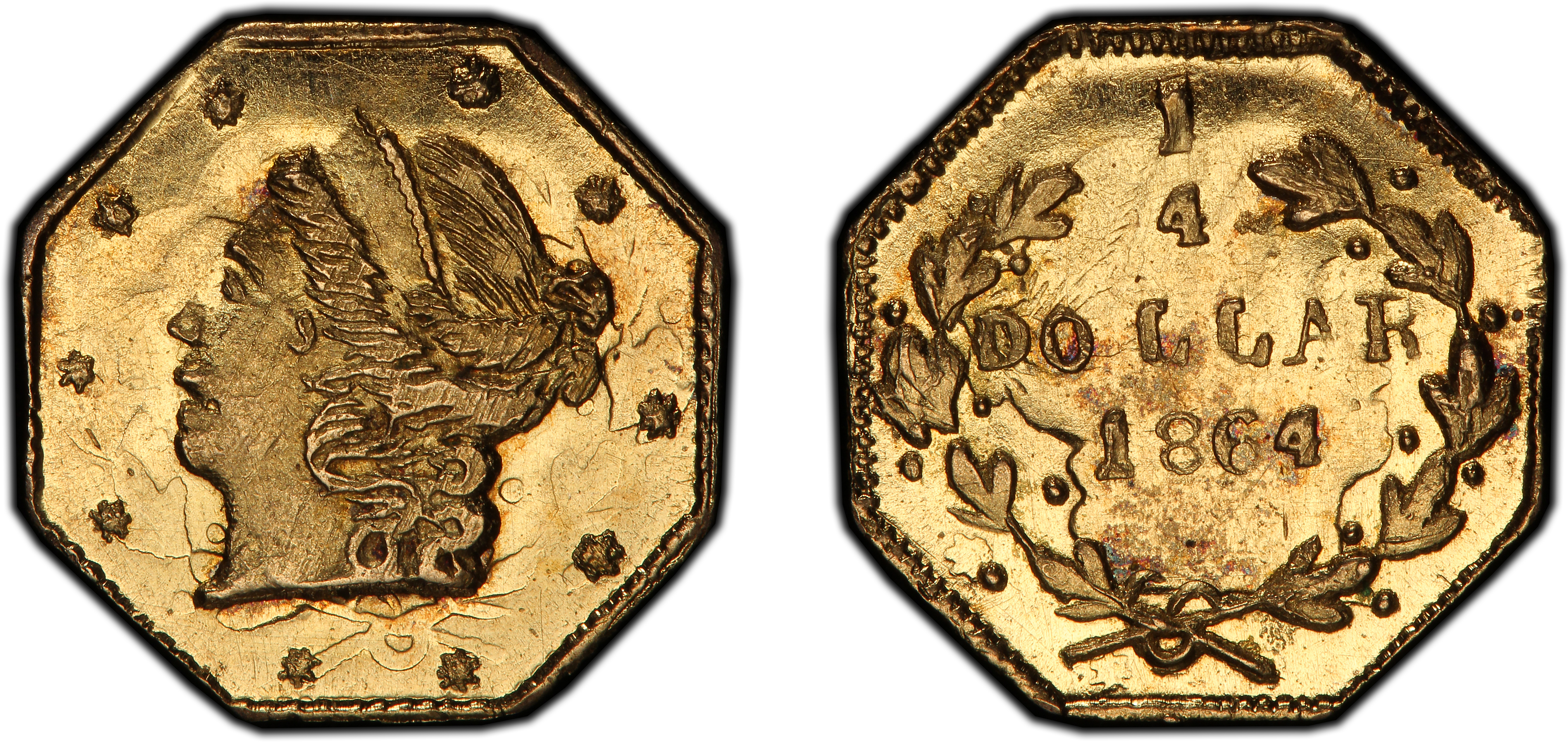
Obverse & Reverse
The 1864 25C BG-706 is a quintessential example of a 'Period Two' California Fractional Gold piece. By the mid-1860s, the initial, urgent need for small-denomination coinage that characterized the 'Period One' (1852-1857) issues had largely subsided. The establishment and robust production of the U.S. Branch Mint in San Francisco in 1854 meant that federally-issued silver and gold coins were now readily available for daily commerce. Consequently, the private production of fractional gold transitioned from a necessity to a novelty. These later pieces, struck from 1858 to 1882, were created not to alleviate a coin shortage, but to satisfy a burgeoning tourist and souvenir market. San Francisco, once a chaotic boomtown, had become a popular destination, and these miniature gold 'coins' were the perfect mementos of the Gold Rush excitement. The Coinage Act of April 22, 1864, which prohibited private coinage, cast a legal shadow over these operations. However, the law was not strictly enforced against these small souvenir tokens until the early 1880s, allowing numerous jewelers and artisans to continue their craft. The BG-706, like its contemporaries, was almost certainly struck by an anonymous San Francisco jeweler. The workmanship is often cruder than federal issues, with unique design elements that were meant to be attractive rather than uniform. These pieces were often underweight and made from gold of inconsistent fineness, as their purpose was aesthetic, not monetary. They were sold as curios, mounted into jewelry, or sent back East as affordable golden souvenirs. Because they were not intended for circulation, many examples survive in high grades, though they are often found holed or with evidence of having been mounted. The specific history of the BG-706 dies is notable for their prominent clash marks, a feature seen on all known examples, suggesting a degree of carelessness or expediency in their production that is characteristic of these commercial souvenir issues.
Associated EventCalifornia Gold Rush (Later Souvenir Period)
Reason For MintingPrimarily produced for sale as souvenirs and jewelry charms for tourists in post-Gold Rush San Francisco.
Minter HistoryThe specific minter for BG-706 is unknown, a common trait for 'Period Two' issues. These pieces were generally produced by various San Francisco jewelers who capitalized on the demand for Gold Rush memorabilia. Unlike the earlier Period One minters who sometimes initialed their work (e.g., Frontier, Deriberpe & Nouizillet), the makers of these later souvenir pieces remain largely anonymous.
Historical SignificanceThe BG-706 represents the commercialization of the Gold Rush narrative. Its existence is a testament to the shift in California's economy from pure resource extraction to tourism and commerce, where the idea of the Gold Rush became as valuable as the gold itself. These pieces are not important as circulating currency, but as cultural artifacts of their time.
N/A
Denomination25 Cents
Minting Period1864
Assayer/MinterUnknown Jeweler
Geographic OriginSan Francisco, California
Obverse DescriptionA crudely rendered Liberty Head facing left, her hair tied in a bun. She is surrounded by a circle of ten five-pointed stars. The date 1864 is below the bust.
Obverse Inscription1864
Reverse DescriptionThe denomination '1/4' is enclosed within a wreath of two branches tied with a bow at the bottom. The legend 'CALIFORNIA GOLD' is inscribed above the wreath along the upper border.
Reverse InscriptionCALIFORNIA GOLD 1/4
CompositionGold
Stated Fineness Actual FinenessVaries, often lower than federal standards.
Diameter10.00 mm
EdgePlain
Unknown
Survival Estimate31-45 (High R-5)
Rarity ScaleHigh R-5
This variety is sought after by specialists in California fractional gold for its distinct 10-star obverse and its consistent, heavy die clash diagnostic. As a 'Period Two' issue, it is more affordable than the earlier circulating pieces, making it an accessible relic of the Gold Rush souvenir trade.
Key VarietiesThe BG-706 is a single, distinct variety. There are no known major variations, patterns, or restrikes from the period of issue. The defining characteristic is the 10-star obverse paired with the specific wreath reverse. It is often collected alongside the BG-707, which shares a similar obverse style but with only eight stars.
Authentication TipsAuthentic BG-706 examples must be denominated; fakes and modern replicas often omit the '1/4' or any indication of value. All genuine examples of this variety are known to be struck from heavily clashed dies, so the absence of a die clash would be highly suspicious. The strike is often somewhat crude and uneven, a characteristic of many jeweler's issues. Modern fakes tend to be thicker, have a soapy or cast-like texture, and may show a coppery core where the gold plating has worn.
Shopping ConsiderationsA premium quality example for its grade will exhibit a sharp strike on the stars and date, which can sometimes be weak. Look for pleasing original luster, which is often semi-prooflike on this variety. Since these were souvenirs, avoid examples that have been holed, show evidence of jewelry mounting, or have been harshly cleaned. The heavy die clash is a key diagnostic, not a flaw, and should be present. Attractive, original reddish-gold or greenish-gold toning is highly desirable and commands a premium.
A coin's grade is its condition, rated on a 1-70 scale. For rare coins, this is the most critical factor in determining value, as a tiny difference in preservation can mean a huge difference in price.
Relevant Grade TypesOriginal examples of BG-706 were business strikes. As they were sold as souvenirs and not intended for circulation, they are most commonly found in Mint State (MS, 60-70) grades. Circulated examples (1-58) exist but are less common, as wear would imply use as money, which was not their primary purpose. No true Proofs (PR/PF) were struck during the original period of issue, and no later-date restrikes are known to exist.
Mint State CharacteristicsUncirculated examples are characterized by their luster, which is often described as semi-prooflike with a deep, reflective quality in the fields. The strike is typically somewhat weak in the centers, particularly on the highest points of Liberty's hair and the wreath. All known specimens are heavily clashed, with outlines of the reverse wreath often visible on the obverse fields and vice-versa; this is a defining characteristic, not an impairment. Contact marks are common due to the softness of the gold.
Circulated Wear PatternsOn circulated examples, wear first appears on the high points of Liberty's hair, cheek, and the bow on the reverse wreath. As wear progresses, the stars on the obverse will begin to lose their sharpness, and the finer details of the wreath will merge. In lower grades (VG and below), the date and legends will become weak and may be partially obliterated.
Key Factors For ValueFor the BG-706, the primary value drivers are grade and surface quality. An example with minimal contact marks and vibrant, prooflike luster will command a significant premium. Eye appeal is crucial; collectors favor pieces with attractive original skin and a sharp strike. While the die clash is expected, examples where the clash does not overly detract from Liberty's portrait are preferred. Coins certified by top-tier grading services (PCGS, NGC) are standard, and a CAC sticker indicating premium quality for the grade adds a further premium.
PCGS Price Guide
| Grade | Price | Population |
|---|---|---|
| 30 | $200.00 | 1 |
| 58 | $350.00 | 2 |
| 58+ | $360.00 | N/A |
| 60 | $400.00 | 2 |
| 61 | $475.00 | 1 |
| 62 | $625.00 | 6 |
| 62+ | $750.00 | N/A |
| 63 | $900.00 | 13 |
| 63+ | $1,050.00 | N/A |
| 64 | $1,500.00 | 10 |
| 64+ | $1,650.00 | N/A |
| 65 | $2,300.00 | 1 |
| 65+ | $2,550.00 | N/A |
| 66 | $3,250.00 | N/A |