1854 G$1 BG-532 (Regular Strike)
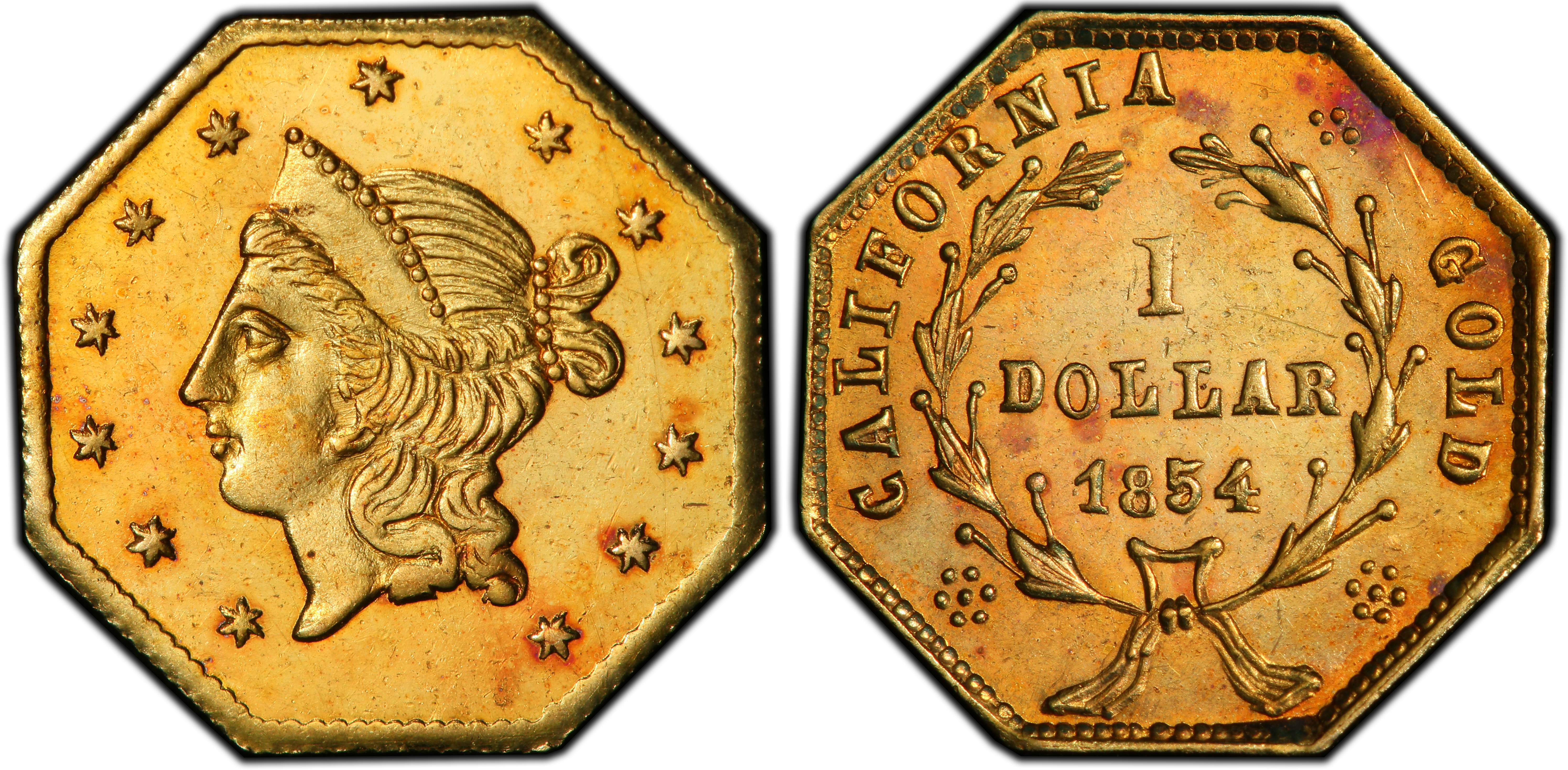
Obverse & Reverse
The 1854 Octagonal Gold Dollar, cataloged as Breen-Gillio 532, is a quintessential artifact from the most frenetic period of the California Gold Rush. Following the discovery of gold at Sutter's Mill in 1848, a massive wave of humanity descended upon California, transforming it from a sparsely populated territory into a chaotic boom-economy. While vast quantities of gold dust and nuggets were being extracted, the region suffered from a crippling deficiency of official United States coinage, especially for small, daily transactions. A pinch of gold dust for a drink or loaf of bread was an imprecise and often contentious method of payment. Into this monetary vacuum stepped a number of enterprising jewelers and metallurgists, many of them French immigrants, who saw a commercial opportunity to meet this desperate need for currency. This specific piece is attributed to Antoine Louis Nouizillet, a French jeweler located at 58 Kearny Street in San Francisco between 1852 and 1854. Nouizillet was part of a small, interconnected community of craftsmen, including M. Deriberpie and the firm of Frontier, Deviercy & Co., who were responsible for the bulk of these 'Period One' (1852-1857) fractional gold coins. These issues were genuinely intended to circulate and facilitate commerce. Production methods were primitive, typically employing a hammer-striking process. A lower die would be set on an anvil, a hand-cut gold planchet placed upon it, and the upper die held in position while struck with a heavy hammer. This technique accounts for the frequent variability in strike quality, planchet shape, and centering seen across surviving examples. The gold itself was locally sourced, but its purity was unregulated and often inconsistent, though generally accepted at face value out of sheer necessity. The Coinage Act of 1864 would later prohibit all private coinage, rendering these fascinating pieces obsolete and cementing their status as relics of a lawless, formative era in American history.
Associated EventCalifornia Gold Rush
Reason For MintingTo alleviate a severe shortage of small-denomination circulating coinage for daily commerce in Gold Rush-era San Francisco.
Minter HistoryAntoine Louis Nouizillet was a French jeweler who operated a business at 58 Kearny Street, San Francisco, during the height of the Gold Rush from 1852 to 1854. He was a key figure among a small group of private minters who produced the earliest, or 'Period One,' California fractional gold pieces. These craftsmen, many of whom were fellow French immigrants, created a variety of 25c, 50c, and $1 coins that served as a vital, if unofficial, medium of exchange before the San Francisco Mint could produce sufficient federal coinage to meet the region's needs.
Historical SignificanceThe BG-532 is a tangible link to the chaotic, formative economy of Gold Rush California. It represents a private solution to a public problem, demonstrating the ingenuity of local artisans in the absence of federal infrastructure. As a 'Period One' issue, it is considered a true circulating coin of the era, unlike many later issues which were made primarily as souvenirs.
BG-532
Denomination$1
Minting Period1854
Assayer/MinterAntoine Louis Nouizillet
Geographic OriginSan Francisco, California
Obverse DescriptionA Liberty Head, facing left, with hair tied in a bun. She is surrounded by thirteen six-pointed stars, representing the original colonies. The date, 1854, appears below the bust.
Obverse Inscription1854
Reverse DescriptionThe denomination '1' is prominently featured in the center, encircled by the inscription 'CALIFORNIA GOLD'. The piece is octagonal in shape.
Reverse InscriptionCALIFORNIA GOLD / 1
CompositionGold
Stated Fineness Actual Fineness EdgePlain
Unknown
Survival Estimate75-125
Rarity ScaleR-4 (Slightly Scarce)
This coin is highly sought after for its direct connection to the California Gold Rush, its distinctive octagonal shape, and its status as a 'Period One' issue genuinely intended for circulation. It represents one of the most iconic and romanticized eras of American history, making it a cornerstone piece for collectors of territorial and private gold.
Key VarietiesThere are no major recognized varieties of BG-532 itself. However, the broader series of California Fractional Gold is rich with varieties based on die states, die marriages (as seen with nearby varieties like BG-526 and BG-529), and errors from the crude minting process. No proof or special collector strikings were made during the original period of issue.
Authentication TipsAuthentic 'Period One' California fractionals like the BG-532 should be compared to high-quality images from major grading services or the Breen-Gillio reference. Key diagnostics include the specific style of the Liberty Head portrait and the font used for the inscriptions. A critical authentication point is the reverse design: genuine circulating issues of this era do NOT feature a bear. The presence of a bear is a definitive marker of a later token or souvenir piece. The fabric of the coin should feel correct for hammered gold, often with a slightly irregular shape and variable strike weakness or strength.
Shopping ConsiderationsFor a premium quality BG-532, a potential buyer should prioritize a sharp strike, particularly on the highest points of Liberty's hair and the stars. Given the hammered production, many examples are weakly struck in areas, so a coin with full details commands a significant premium. Look for original, uncleaned surfaces, which often display a rich, reddish-gold or greenish-gold luster. Avoid examples that have been holed for jewelry, a common fate for these small gold pieces. Also, be wary of tooling or smoothing in the fields designed to hide damage. A well-centered strike on a decent planchet adds significantly to the eye appeal and value.
A coin's grade is its condition, rated on a 1-70 scale. For rare coins, this is the most critical factor in determining value, as a tiny difference in preservation can mean a huge difference in price.
Relevant Grade TypesAll original 1854 BG-532 dollars are business strikes, created for circulation. They are found in Circulated grades (AG-3 to AU-58) and, very rarely, in Mint State (MS-60 to 70). No Proof (PR/PF) examples were struck by Nouizillet during the original period of issue. Any piece described as a 'Proof' would be a modern creation or fantasy piece.
Mint State CharacteristicsAn uncirculated BG-532 is exceptionally rare. Quality is defined by the strength of the strike; a sharp strike on the hair details above Liberty's ear and on the central '1' on the reverse is highly desirable. Luster is typically soft and satiny rather than deeply frosty. Due to the crude manufacturing and soft gold, even Mint State examples will almost always exhibit some light contact marks or planchet imperfections; the key is that these marks are not signs of circulation wear.
Circulated Wear PatternsWear first appears on the highest points of the design. On the obverse, check for flatness on Liberty's cheek, the hair bun, and the tips of the stars. On the reverse, the edges of the numeral '1' and the surrounding letters will show the first signs of friction. In lower grades (VG and below), the date and stars will become faint and parts of the legend may merge with the rim.
Key Factors For ValueThe primary drivers of value for this coin are grade and surface quality. An example with original, lustrous surfaces will always be worth far more than a cleaned or polished piece of the same grade. Strike quality is the next key factor; a boldly struck coin can command a 50% or greater premium over a weakly struck one in the same grade. Finally, superior eye appeal—encompassing attractive original color, a well-centered strike, and a lack of distracting marks—plays a major role. A CAC sticker for this issue is highly valued by collectors as confirmation of premium quality for the grade.
PCGS Price Guide
| Grade | Price | Population |
|---|---|---|
| 35 | $650.00 | 1 |
| 40 | $655.00 | 2 |
| 45 | $665.00 | 8 |
| 45+ | $670.00 | N/A |
| 50 | $680.00 | 9 |
| 50+ | $685.00 | N/A |
| 53 | $700.00 | 5 |
| 53+ | $710.00 | N/A |
| 55 | $725.00 | 41 |
| 55+ | $750.00 | N/A |
| 58 | $875.00 | 37 |
| 58+ | $900.00 | N/A |
| 60 | $1,000.00 | N/A |
| 61 | $1,250.00 | 9 |
| 62 | $1,750.00 | 22 |
| 62+ | $2,000.00 | N/A |
| 63 | $3,000.00 | 6 |
| 63+ | $3,500.00 | N/A |
| 64 | $4,500.00 | 2 |