1866 G25C BG-740 (Regular Strike)
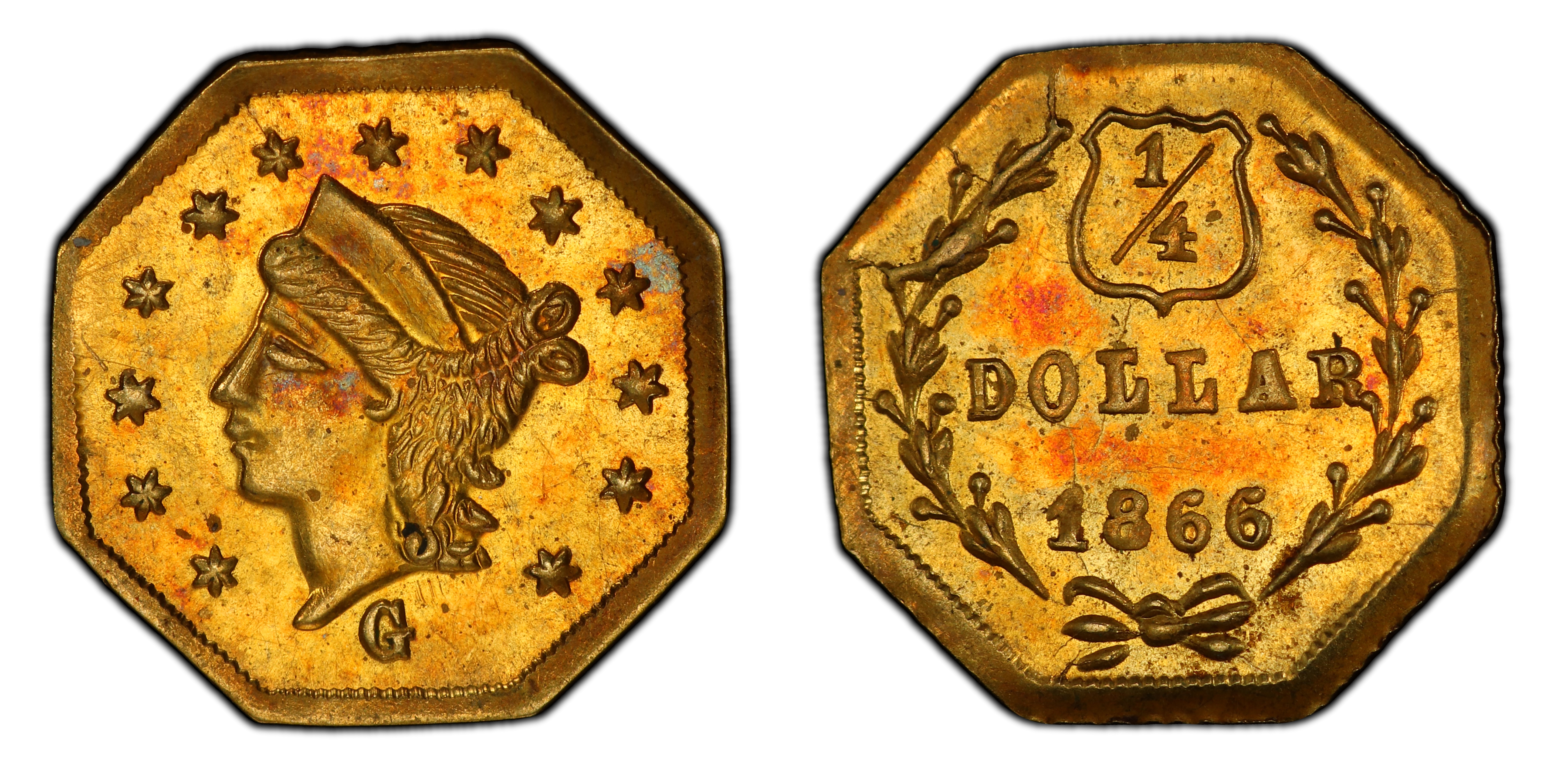
Obverse & Reverse
The 1866 BG-740 25 Cents is a quintessential example of a 'Period Two' California Fractional Gold piece. These fascinating and diminutive coins were born from the unique economic conditions of post-Gold Rush California. While the initial wave of private gold coinage from 1852-1857 ('Period One') was a direct response to a severe shortage of small change for daily commerce, the context for Period Two issues is more nuanced. By the mid-1860s, the San Francisco Mint was in full operation, alleviating the acute need for private fractional currency. However, demand for these miniature gold pieces persisted, driven by a burgeoning souvenir and jewelry market. Jewelers, rather than assayers focused on commerce, became the primary manufacturers. This coin was struck two years after the Coinage Act of April 22, 1864, which explicitly outlawed private coinage. Enforcement of this law was lax, particularly in the West, until the Secret Service cracked down in 1883. Thus, producers like Robert B. Gray operated in a legal gray area, creating pieces that were technically illegal but served a robust tourist and novelty trade. These 'jeweler's issues' were typically underweight for their stated value and not intended for vigorous circulation, but rather as mementos of the Golden State. The 'G' initial below the portrait on the obverse is the hallmark of San Francisco jeweler Robert B. Gray, a prolific producer of these Period Two pieces. Gray had acquired the business and dies of an earlier minter, Antoine Louis Nouzillet, and continued the tradition of striking these intricate gold tokens. The 1866 issue, like others from this era, represents the transition of fractional gold from a circulating medium of necessity to a cherished keepsake, embodying the romanticism and entrepreneurial spirit of the American West.
Associated EventCalifornia Gold Rush Aftermath
Reason For MintingPrimarily struck to be sold as souvenirs and keepsakes to tourists and locals, rather than to alleviate a currency shortage.
Minter HistoryRobert B. Gray & Co. was a prominent San Francisco jewelry firm active in the mid-to-late 19th century. In the late 1850s, Gray purchased the business of Antoine Louis Nouzillet, a 'Period One' minter, acquiring his equipment and dies. Gray modernized the operation and began producing his own distinctive line of fractional gold pieces, characterized by the 'G' hallmark on the obverse. His issues are noted for being of generally higher weight and quality than many other contemporary jeweler's pieces. He produced octagonal and round quarter and half dollars, ceasing production of denominated pieces around 1882 due to increased federal pressure against private minting.
Historical SignificanceThe BG-740 is historically significant not as a circulating coin, but as a tangible artifact of the post-Gold Rush souvenir industry and the persistence of private minting despite federal prohibition. It demonstrates the continued romantic allure of gold and the entrepreneurial spirit of California jewelers who adapted to a changing market, shifting from producing coinage for circulation to creating numismatic novelties.
BG-740
Denomination25 Cents
Minting Period1866
Assayer/MinterRobert B. Gray & Co.
Geographic OriginSan Francisco, California
Obverse DescriptionA head of Liberty facing left, her hair tied in a bun with trailing curls. She wears a coronet inscribed LIBERTY. Thirteen stars encircle the portrait. The date 1866 is below, and the minter's initial 'G' is prominently placed in the field below the bust, between the portrait and the date.
Obverse InscriptionLIBERTY / 1866 / G
Reverse DescriptionThe denomination '1/4 DOLLAR' is enclosed within a wreath composed of two branches tied with a bow at the bottom. The legend 'CALIFORNIA GOLD' appears along the upper periphery, outside the wreath.
Reverse InscriptionCALIFORNIA GOLD / 1/4 DOLLAR
CompositionGold
Stated Fineness Actual FinenessVariable, typical for Period Two issues, but often in the .800 to .900 range.
Weight0.24 grams
Diameter9.60 mm
EdgePlain
Unknown, but very low.
Survival Estimate30-75 coins
Rarity ScaleR-6 (Low R-6)
This coin is highly sought after as a scarce, attributed variety from a known San Francisco jeweler. Its appeal lies in its rarity (R-6), distinctive octagonal shape, clear minter's mark, and its role as a key representative of the 'Period Two' souvenir issues, struck in defiance of federal law.
Key VarietiesThe BG-740 is a specific die marriage and is not known to have major varieties from its original minting period. No special collector issues, patterns, or restrikes are known to exist for this specific variety.
Authentication TipsGenuine examples are struck in gold, are very thin (often compared to the thickness of a business card), and will have the denomination clearly stated as '1/4 DOLLAR'. Fakes are often thicker, made of brass or are gold-plated, and may feel greasy or have casting bubbles. The strike on genuine pieces can be characteristically incomplete or soft in the centers, particularly on the reverse wreath, a feature often missing on modern, well-struck forgeries. The style of the 'G' initial and the date numerals should be compared to known genuine examples.
Shopping ConsiderationsA premium quality example will exhibit sharp details on Liberty's portrait and coronet, with as much central detail on the reverse wreath as can be expected for the issue. Seek out coins with original, lustrous surfaces, often described as having a honey-gold or lemon-gold color. Toning, particularly hints of reddish or cobalt-blue, can add to the eye appeal. Avoid examples that have been harshly cleaned, polished, or mounted as jewelry, as this is common for the type and severely impacts value. Pay close attention to the fields for distracting marks or scratches, which are magnified on such a small coin. A weak central strike is common and should not be a major deterrent unless it is exceptionally severe.
A coin's grade is its condition, rated on a 1-70 scale. For rare coins, this is the most critical factor in determining value, as a tiny difference in preservation can mean a huge difference in price.
Relevant Grade TypesOriginal BG-740 coins were business strikes (MS) intended for sale as souvenirs, not circulation, so most survivors are found in Mint State (MS 60-70) or high-end About Uncirculated (AU 50-58) grades. Circulated examples are scarce. No proofs were struck during the original period of issue, and no later-date Proof restrikes are known.
Mint State CharacteristicsUncirculated examples of BG-740 typically exhibit a soft, satiny luster, though more reflective, prooflike surfaces are sometimes encountered and command a premium. The strike is often sharp on the peripheral legends and stars, but can show characteristic softness on the highest points of Liberty's hair and the center of the reverse wreath. Because the gold is soft, even high-grade Mint State examples will often show minor handling marks or 'ticks' in the fields. Planchet quality can be irregular, consistent with private manufacturing.
Circulated Wear PatternsOn circulated examples, wear first appears on the high points of Liberty's cheek, hair curls above the ear, and the coronet. On the reverse, the highest parts of the wreath and the bow will show flattening. In lower grades (VF and below), the word LIBERTY on the coronet will become indistinct, and the finer details of the wreath will merge.
Key Factors For ValueFor the BG-740, value is driven by several factors. Grade is paramount, with a significant jump in price for each point from MS-62 to MS-65. Surface quality is critical; an example with clean, original, lustrous surfaces will always be worth more than a cleaned or marked coin of the same grade. Strike sharpness contributes significantly, with well-struck examples showing good detail in the hair and reverse wreath being highly prized. Finally, superior eye appeal—often defined by attractive original color and minimal distracting marks—can add a substantial premium. A CAC sticker for this issue confirms quality and typically results in a higher market value.
PCGS Price Guide
| Grade | Price | Population |
|---|---|---|
| 55 | $475.00 | 2 |
| 55+ | $485.00 | N/A |
| 58 | $525.00 | 7 |
| 58+ | $535.00 | N/A |
| 60 | $575.00 | 1 |
| 61 | $625.00 | 2 |
| 62 | $825.00 | 8 |
| 62+ | $900.00 | N/A |
| 63 | $975.00 | 8 |
| 63+ | $1,250.00 | N/A |
| 64 | $2,250.00 | 2 |