1854 G$1 BG-507 (Regular Strike)
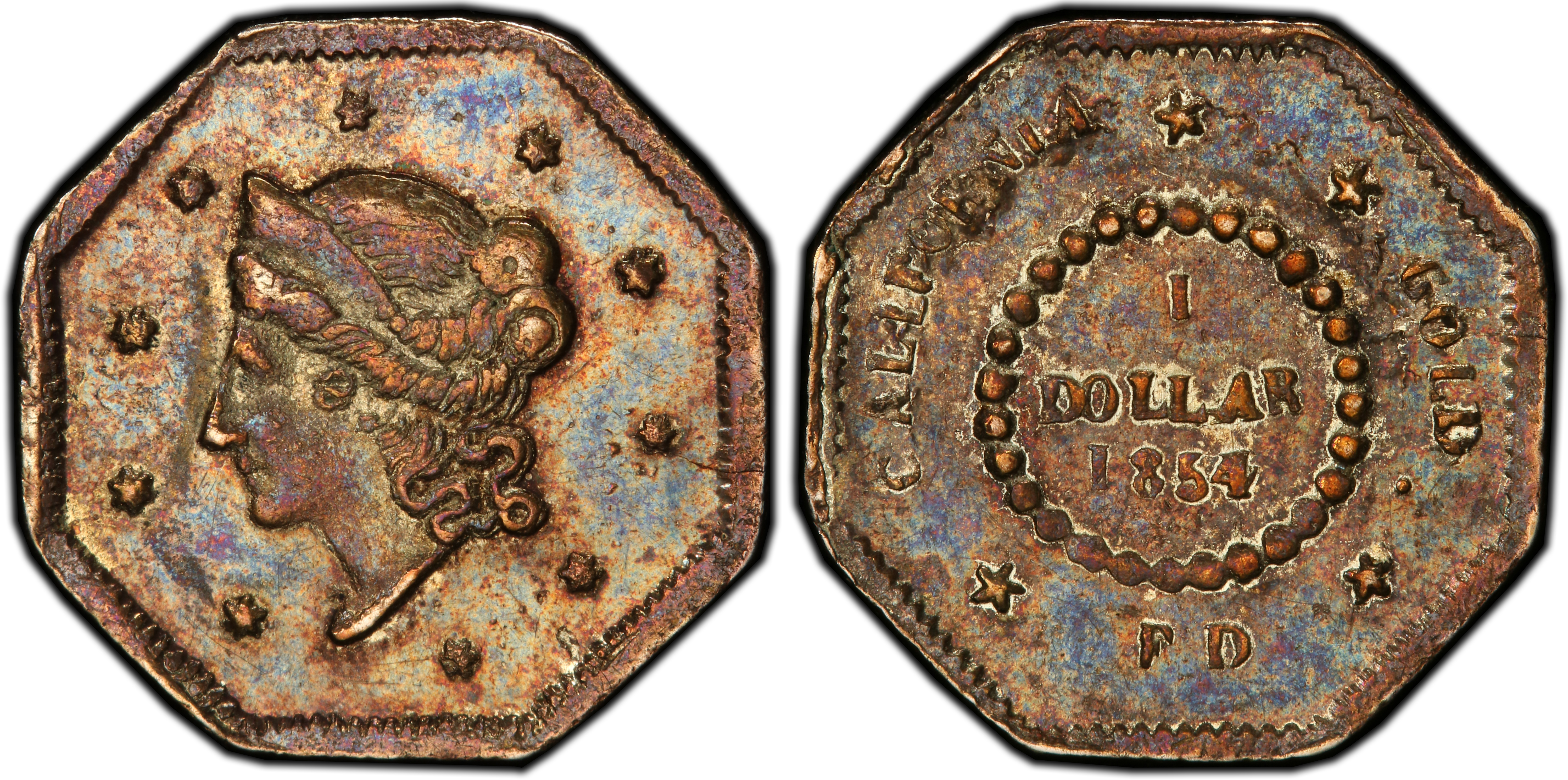
Obverse & Reverse
The 1854 BG-507 One Dollar piece is a quintessential artifact from the first period (1852-1856) of California's private gold coinage era. Born from the acute necessity for small-denomination currency, these fractional gold coins addressed a critical gap in the commerce of the booming Gold Rush economy. Following the massive influx of population after 1849, gold dust became a common medium of exchange, but it was imprecise and inconvenient for everyday transactions. While the U.S. Assay Office and private minters like Moffat & Co. produced larger denomination coins, there was a chronic shortage of circulating coins valued under a quarter eagle. This void was filled by enterprising jewelers and metallurgists in San Francisco, who began striking their own quarter, half, and one-dollar gold pieces. These 'Period One' issues, including the BG-507, were generally of honest weight and fineness, intended to circulate alongside federal coinage and were modeled stylistically after the U.S. Mint's own Liberty Head gold dollar. The BG-507 is attributed to the firm of Frontier, Deviercy & Co., French jewelers who were prominent producers of these fractional coins. Their operation, like others, was relatively small-scale, utilizing hand-operated presses or simple hammer-striking methods, which resulted in coins of varying strike quality. These tiny octagonal dollars facilitated daily commerce, allowing miners and merchants to conduct small transactions without resorting to cumbersome gold dust. However, their existence was short-lived. The establishment and ramp-up of production at the official San Francisco Branch Mint in 1854 signaled the beginning of the end for these private issues. As federal coins became more plentiful, the need for private fractional gold diminished, and by 1856, their production for circulation largely ceased, making surviving examples like the BG-507 treasured relics of a uniquely chaotic and entrepreneurial period in American history.
Associated EventCalifornia Gold Rush
Reason For MintingTo alleviate a severe shortage of small-denomination coinage for daily commercial transactions in Gold Rush-era California.
Minter HistoryFrontier, Deviercy & Co. was a partnership of French jewelers, Pierre Frontier and Eugene Deviercy, operating in San Francisco during the early 1850s. They were among the most prolific and skilled private minters of Period One California fractional gold. Their issues are often identified by the initials 'F.D.' or are attributed based on die characteristics and style. They produced a variety of denominations and designs, contributing significantly to the circulating medium of the region before the San Francisco Mint could fully meet the public's demand for coinage.
Historical SignificanceThe BG-507 represents a tangible solution to a major economic problem in a remote and rapidly growing territory. It is a testament to the private enterprise that filled a vacuum left by the federal government and is a key numismatic artifact of the American West. As a 'Period One' issue, it is among the few fractional gold pieces believed to have genuinely circulated as money, unlike many later issues which were primarily made as souvenirs.
K-N/A
Denomination$1
Minting Period1854
Assayer/MinterFrontier, Deviercy & Co.
Geographic OriginSan Francisco, California
Obverse DescriptionThe obverse features a small, somewhat crude Liberty Head facing left, modeled after the contemporary U.S. gold dollar. The portrait is surrounded by 13 five-pointed stars, typically unevenly spaced and struck. The date, 1854, is positioned below the bust.
Obverse InscriptionLIBERTY (on coronet, often weakly struck or indistinct)
Reverse DescriptionThe reverse displays the denomination '1' and the word 'DOLLAR' within a wreath. The wreath is composed of two branches tied together by a bow at the bottom. The legend 'CALIFORNIA GOLD' is inscribed around the periphery, outside the wreath.
Reverse InscriptionCALIFORNIA GOLD / 1 / DOLLAR
CompositionGold
Stated Fineness Actual FinenessTypically .800 to .900, often from unrefined native California gold containing silver.
Weight1.00 grams
Diameter11.50 mm
EdgePlain
Unknown
Survival Estimate13-30 coins
Rarity ScaleR-6
This coin is highly sought after as a genuine, circulating monetary artifact of the California Gold Rush. Its octagonal shape, high rarity (R-6), and connection to the historically significant 'Period One' of fractional gold production make it a prize for specialists in territorial and pioneer gold.
Key VarietiesThe primary variety is the BG-507 regular strike. No known proof strikings or official restrikes from the original period exist. The Breen-Gillio reference work on California Fractional Gold is the definitive guide to die marriages and minor varieties within the series. Collectors should note that discovering new die states or pairings is a rare but occasional event in this series.
Authentication TipsAuthentic examples are struck on solid gold planchets. Common counterfeits are gold-plated base metal; check for any wear revealing a different colored metal beneath, especially on the high points and edge. Weight is a critical diagnostic; fakes made of brass or other base metals will be significantly underweight. Look for the characteristic soft, slightly crude details of a hand-cut die, as modern fakes may appear too sharp or have a 'tooling' look. The surfaces should have the luster and patina consistent with 19th-century gold, not the bright, brassy look of many modern copies.
Shopping ConsiderationsFor this issue, a premium quality example is defined by the sharpness of the strike, which is often incomplete. Look for coins with a bold date and clear legends, as these areas were often weakly struck. The central devices, particularly Liberty's hair and the wreath details, should show as much definition as possible. Original, uncleaned surfaces with some remaining luster command a significant premium. Avoid examples that have been harshly cleaned, polished, or used as jewelry, which is a common fate for these small gold pieces. Check carefully for scratches, rim bumps, and planchet flaws, which are common but should be minimal on a choice specimen.
A coin's grade is its condition, rated on a 1-70 scale. For rare coins, this is the most critical factor in determining value, as a tiny difference in preservation can mean a huge difference in price.
Relevant Grade TypesAll original BG-507 issues are business strikes intended for circulation and are found in Circulated grades (AG-3 to AU-58) and, very rarely, in Mint State (MS, 60-70). No proofs were struck during the original minting period. Any piece described as a 'Proof' would be a later fabrication or fantasy piece and not a product of the original minters.
Mint State CharacteristicsAn uncirculated BG-507 will exhibit satiny or sometimes slightly prooflike luster in the fields. Strike is a key factor; even on Mint State examples, weakness is common on the high points of Liberty's hair and the 'DOLLAR' inscription on the reverse. The tiny size and softness of the gold make these coins prone to contact marks, so a 'gem' example (MS-65 or higher) would be exceptionally rare and would have nearly mark-free surfaces and a very sharp strike for the issue.
Circulated Wear PatternsWear first appears on the highest points: Liberty's cheek, hair above the eye, and the coronet. On the reverse, the bow of the wreath and the leaves at the top are the first elements to show flatness. On moderately circulated examples (VF-XF), the finer hair details will merge, and the individual leaves in the wreath will become indistinct. In lower grades, the date and peripheral lettering will begin to fade into the fields.
Key Factors For ValueRarity and grade are paramount. Beyond the technical grade, the quality of the strike is crucial; a well-struck AU-58 might be preferred over a weakly struck MS-61. Surface quality is next; an example with original, undisturbed surfaces and a pleasing reddish-gold patina is far more desirable than a cleaned or polished piece of the same grade. Eye appeal, encompassing luster, color, and strike, plays a huge role. A CAC sticker for this issue provides third-party verification of quality for the grade and typically results in a significant price premium.
PCGS Price Guide
| Grade | Price | Population |
|---|---|---|
| 40 | $1,675.00 | 1 |
| 45 | $1,750.00 | 3 |
| 45+ | $2,050.00 | N/A |
| 50 | $2,400.00 | N/A |
| 50+ | $2,575.00 | N/A |
| 53 | $2,750.00 | 1 |
| 53+ | $3,250.00 | N/A |
| 55 | $3,750.00 | 2 |
| 55+ | $4,000.00 | N/A |
| 58 | $4,500.00 | 3 |
| 58+ | $4,750.00 | N/A |
| 60 | $5,250.00 | N/A |
| 61 | $6,000.00 | N/A |
| 62 | $7,000.00 | 2 |
| 62+ | $8,000.00 | N/A |
| 63 | $11,000.00 | 1 |
| 63+ | $13,250.00 | N/A |
| 64 | $16,500.00 | N/A |