1854 G50C BG-423 (Regular Strike)
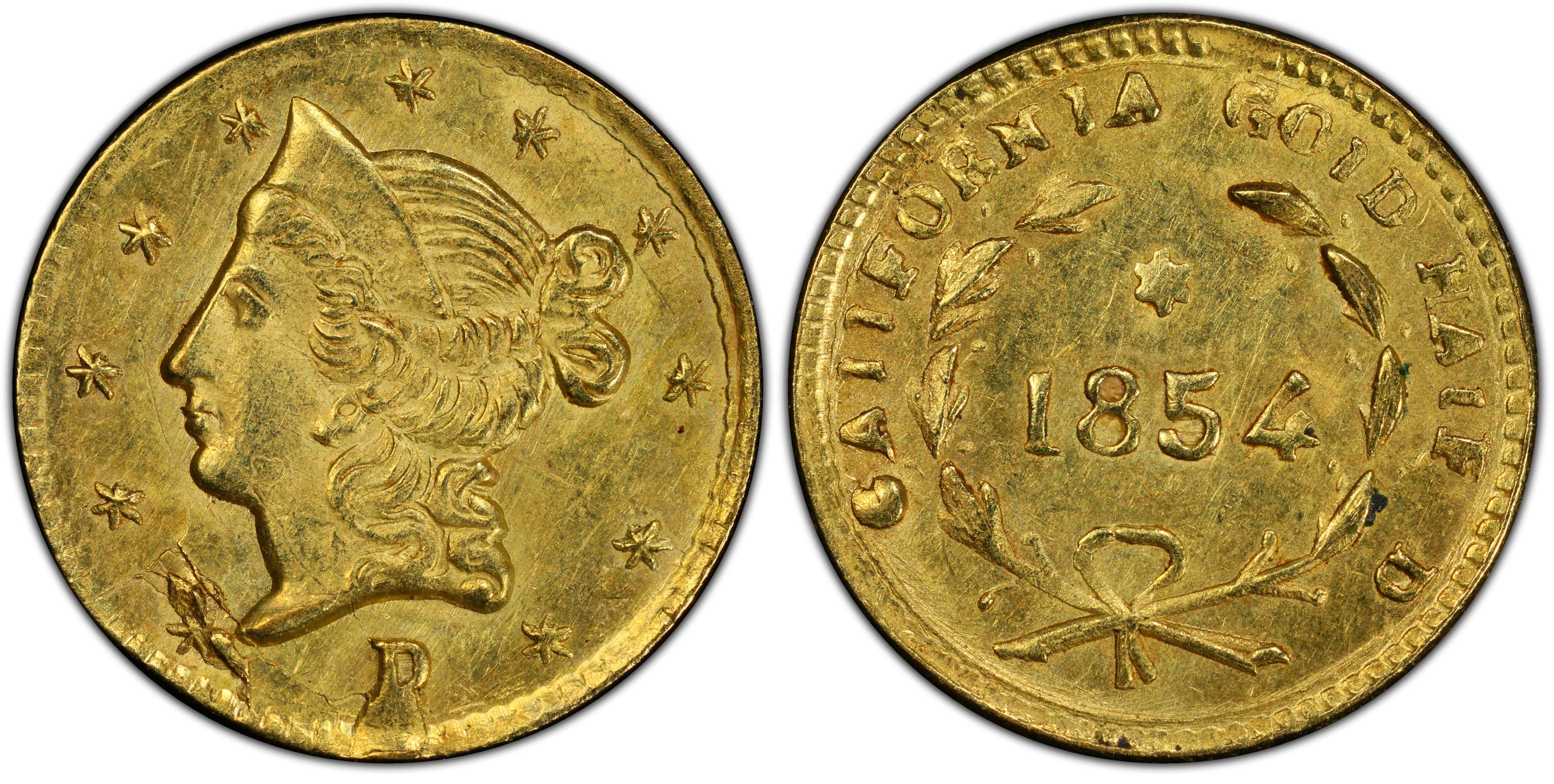
Obverse & Reverse
The 1854 Gold 50 Cents, cataloged as Breen-Gillio 423, is a quintessential artifact from the chaotic and economically starved environment of the California Gold Rush. Following the discovery of gold at Sutter's Mill in 1848, a massive influx of over 300,000 people descended upon California, creating a vibrant but tumultuous society. While gold dust and large-denomination private issue coins ($5 and up) were plentiful, the region suffered from a crippling shortage of small-denomination coinage for everyday transactions. A 'pinch' of gold dust for a drink or loaf of bread was an imprecise and often contentious method of payment. Federal coinage was scarce on the West Coast, and the newly established San Francisco Mint, which opened in 1854, initially focused on larger denominations, failing to alleviate the 'small change' problem. Into this monetary vacuum stepped a number of enterprising jewelers and metallurgists. M. Deriberpie, a French jeweler in San Francisco, was among the most prominent producers of what are now known as 'Period One' (1852-1857) California Fractional Gold coins. These pieces were not government-sanctioned but were privately struck to meet a desperate commercial need. The BG-423 was crudely produced, likely by the 'hammer method,' where dies were struck by hand with a sledgehammer. This resulted in coins of varying strike quality. They were made from native California gold, which had a high silver content, giving them a lighter, paler color than federal gold issues. Their intrinsic value was often below their face value, but in the inflated boomtown economy, their utility outweighed their metallic deficiency. These tiny coins genuinely circulated, as evidenced by the wear seen on many surviving examples and their discovery in contemporary shipwrecks. The initial 'D' for Deriberpie on the obverse served as a maker's mark, a private guarantee in a marketplace of questionable private issues. The passage of federal laws against private coinage in 1864 eventually ended this fascinating chapter of American monetary history, cementing the status of pieces like the BG-423 as rare relics of Gold Rush ingenuity and necessity.
Associated EventCalifornia Gold Rush
Reason For MintingTo alleviate a severe shortage of small-denomination coinage for daily commerce in Gold Rush-era San Francisco.
Minter HistoryM. Deriberpie was a French jeweler and private minter active in San Francisco during the Gold Rush. He was one of the key producers of 'Period One' California fractional gold pieces. His initial, 'D', appears on the obverse of his attributed coins, serving as a maker's mark. He is known to have partnered with another prominent French jeweler, Antoine Louis Nouizillet, on some issues marked 'D.N.' Little else is recorded about his personal biography, but his numismatic legacy is significant as a supplier of much-needed currency during a formative period in California's history.
Historical SignificanceThe BG-423 is a tangible link to the primitive, demand-driven economy of the California Gold Rush, representing a private solution to a government failure in providing adequate coinage for a burgeoning population. It is a key example of the 'Period One' issues that actually circulated, making it a historically important piece of pioneer money.
N/A
Denomination50 Cents
Minting Period1854
Assayer/MinterM. Deriberpie
Geographic OriginSan Francisco, California
Obverse DescriptionA small Liberty Head portrait facing left, stylistically similar to the contemporary federal gold dollar, but of cruder execution. The portrait is surrounded by thirteen small six-pointed stars. The minter's initial, a small but crisp letter 'D' for Deriberpie, is placed in the lower obverse field below the bust's truncation.
Obverse InscriptionD
Reverse DescriptionA simple wreath composed of two branches tied with a bow at the bottom encircles the date. The denomination and origin are inscribed around the periphery, outside the wreath.
Reverse InscriptionCALIFORNIA GOLD HALF D / 1854
CompositionGold
Stated Fineness Actual FinenessVariable; typically 14 to 22 karats (.583 to .917 fine). One example was tested as at least 18K gold.
EdgePlain
Unknown
Survival Estimate13-30 coins known
Rarity ScaleR-6
This coin is highly prized for its extreme rarity, its direct connection to the California Gold Rush, and its status as a 'Period One' issue genuinely intended for circulation. The presence of the minter's initial 'D' adds a layer of personality and historical attribution that is missing from anonymous issues.
Key VarietiesThe primary variety is the regular business strike. No proof or special presentation strikings from the period of issue are known to exist. A key diagnostic for later die state examples is a prominent, heavy die break (cud) appearing on the obverse at the 8 o'clock position, touching the rim and stars.
Authentication TipsGenuine examples are always denominated; fakes and later souvenir tokens often lack a face value or use phrases like 'CAL GOLD CHARM'. The fabric of genuine pieces is often slightly irregular due to hand-striking, and they can exhibit weak strikes in areas. The gold has a characteristically pale or 'light' color due to the natural silver alloy. Replicas are often brassy in color, thicker, and have a more uniform, modern appearance. Any piece featuring a bear on the reverse is a fantasy item. The specific die characteristics, such as the shape of the 'D' and the spacing of letters, should be compared to known genuine examples.
Shopping ConsiderationsFor a premium quality example, seek a coin with a bold strike, particularly on the Liberty portrait, stars, and the date. Surface quality is paramount; many surviving examples are damaged, holed for use as jewelry, or harshly cleaned. An example with original, unmolested surfaces and perhaps some remaining luster commands a significant premium. Given the crudeness of manufacture, perfectly struck specimens are virtually nonexistent. Look for pleasing eye appeal and avoid coins with distracting planchet flaws, excessive contact marks, or evidence of tooling or repairs. The late die state with the heavy die break is a recognized variety and can be a desirable feature for some specialists.
A coin's grade is its condition, rated on a 1-70 scale. For rare coins, this is the most critical factor in determining value, as a tiny difference in preservation can mean a huge difference in price.
Relevant Grade TypesOriginal period issues of BG-423 were business strikes intended for circulation and are found in Circulated (1-58) and Mint State (MS, 60-70) grades. No Proofs were struck during the original minting period, and there are no known later-date Proof restrikes or special collector strikings for this variety.
Mint State CharacteristicsUncirculated examples of BG-423 are exceedingly rare. A true Mint State specimen would be defined by its luster, which can range from satiny to semi-prooflike. The strike is a critical factor; they are often weakly struck in the center of the portrait or on the highest points of the wreath. Planchets were not always perfectly prepared, so some minor original flaws may be present and acceptable. Contact marks are common due to the softness of the gold and primitive handling, with the high points of the design being most susceptible.
Circulated Wear PatternsWear first appears on the highest points of the design. On the obverse, this includes Liberty's hair above the eye and ear, and the cheekbone. On the reverse, the highest leaves and bow of the wreath will show the first signs of friction. In lower grades (VG and below), the stars, date, and peripheral lettering will become weak and begin to merge with the fields.
Key Factors For ValueValue is driven primarily by rarity and grade. Surface preservation is the most important factor; a coin with original, lustrous 'skin' is far more valuable than a cleaned or polished example of the same grade. Strike quality is next; a sharply struck coin with full details is highly desirable. Eye appeal, which includes attractive toning and a lack of distracting marks, significantly impacts value. Given the coin's rarity, even damaged or holed examples are valuable, but pieces without such impairments carry a massive premium. A CAC sticker for this issue would confirm premium quality for the grade and add substantially to its market value.
PCGS Price Guide
| Grade | Price | Population |
|---|---|---|
| 45 | $900.00 | 1 |
| 45+ | $945.00 | N/A |
| 50 | $1,000.00 | N/A |
| 50+ | $1,075.00 | N/A |
| 53 | $1,200.00 | N/A |
| 53+ | $1,300.00 | N/A |
| 55 | $1,450.00 | 1 |
| 55+ | $1,550.00 | N/A |
| 58 | $1,750.00 | 8 |
| 58+ | $1,900.00 | N/A |
| 60 | $2,100.00 | 1 |
| 61 | $2,500.00 | 1 |
| 62 | $3,000.00 | 2 |
| 62+ | $3,250.00 | N/A |
| 63 | $3,750.00 | 3 |
| 63+ | $4,250.00 | N/A |
| 64 | $5,750.00 | 1 |