1853 G25C BG-217 (Regular Strike)
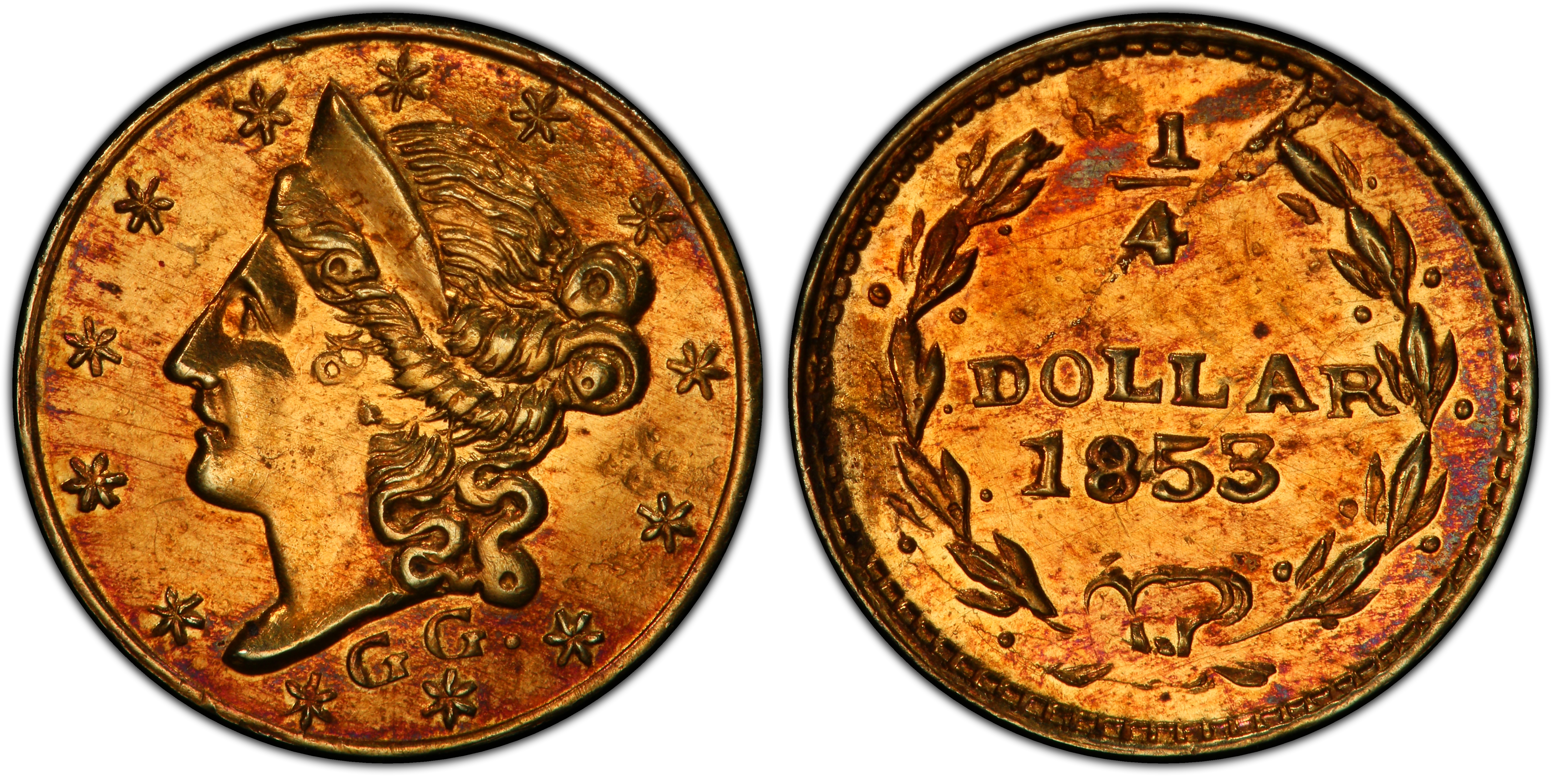
Obverse & Reverse
The BG-217 25-cent piece emerges from the chaotic, formative years of the California Gold Rush, a period numismatically defined by a severe shortage of circulating small change. By 1853, San Francisco was a burgeoning metropolis, but commerce was crippled by the impracticality of using gold dust for minor transactions. Federal coinage was scarce on the West Coast, as the San Francisco Mint would not become fully operational until 1856. In this vacuum, local jewelers and metallurgists stepped in, creating their own private currency from the abundant native gold. These 'fractional gold' pieces, in denominations of 25 cents, 50 cents, and one dollar, were a direct response to this economic necessity. The BG-217 is a prime example of these 'Period One' (1852-1857) issues, which are considered by numismatists to be legitimate, circulating coinage born of necessity. Unlike later, souvenir-oriented issues, these early pieces saw genuine use in daily trade, though they were often underweight compared to their stated value. The production was rudimentary, often involving hand-cut dies and manual screw presses, leading to crude but charmingly unique coins. Public reception was mixed; while merchants and citizens welcomed the convenience, the inconsistent weight and fineness were points of contention. Ultimately, the establishment of the federal mint and the subsequent influx of official U.S. coinage rendered these private issues obsolete. The Secret Service also began cracking down on private minters, citing federal law, which drove the practice underground and ended the era of circulating fractional gold. Today, the BG-217 and its contemporaries are treasured as tangible relics of the Gold Rush, representing a fascinating intersection of economic necessity, private enterprise, and numismatic history.
Associated EventCalifornia Gold Rush
Reason For MintingTo alleviate a severe shortage of small-denomination coinage for daily commerce in Gold Rush-era California.
Minter HistoryAntoine Louis Nouizillet was one of several French jewelers who immigrated to San Francisco during the Gold Rush. He, along with contemporaries like M. Deriberpe, applied his skills in metallurgy and die-cutting to meet the region's desperate need for small change. Operating his jewelry business in the city, he began producing fractional gold pieces around 1853. While his coins are unsigned, die characteristics and provenance have allowed modern numismatists, principally Walter Breen and Ronald Gillio, to attribute specific varieties like the BG-217 to his hand. His operations, like those of other Period One minters, ceased as federal coinage became plentiful and legal pressures mounted against private issues.
Historical SignificanceThe BG-217 is historically significant as a genuine circulating medium of exchange from the height of the California Gold Rush. It represents a period of private innovation and necessity-driven coinage before the federal government established monetary control in the region. As a Period One issue, it stands apart from later souvenir pieces and is a direct link to the daily economic life of miners, merchants, and settlers in 1850s San Francisco.
BG-217
DenominationG25C (Gold 25 Cents)
Minting Period1853
Assayer/MinterAttributed to Antoine Louis Nouizillet
Geographic OriginSan Francisco, California
Obverse DescriptionA Liberty Head, facing left, with hair tied in a bun. The portrait is encircled by thirteen six-pointed stars.
Obverse Inscription Reverse DescriptionThe inscription 'CALIFORNIA GOLD' encircles the top periphery. The denomination '1/4' is in the center, with the date '1853' directly below it. A decorative ornament or vine-like device is positioned below the date.
Reverse InscriptionCALIFORNIA GOLD 1/4 1853
CompositionGold
Stated Fineness Actual FinenessTypically around .880 fine, consistent with unrefined native California gold which contained a natural silver alloy.
Diameter10.00 mm
EdgePlain
Unknown; very small.
Survival Estimate5-6 known examples.
Rarity ScaleR-7 (High)
The BG-217 is highly sought after due to its extreme rarity (R-7) and its status as a genuine, circulating Period One fractional gold piece. Its crude beauty and direct connection to the California Gold Rush make it a prize for specialists in territorial gold and early American coinage.
Key VarietiesThe primary variety is the BG-217 itself. A closely related variety, BG-217A, is considered unique (R-9). There are no known later-date restrikes or special collector issues of this specific die marriage. Collectors of the broader series will note hundreds of different die pairings (BG numbers) across the various minters of Period One, but the BG-217 is a distinct and recognized variety.
Authentication TipsAuthenticity is paramount for fractional gold. Genuine BG-217 examples exhibit a specific die state with characteristic crudeness in the lettering and stars. The gold color should appear slightly washed out or 'brassy' due to the natural silver content, unlike the deep yellow of modern plated counterfeits. Weight and diameter can vary slightly but should be close to the known standard for this type. Many modern fakes exist, often with sharp, perfectly formed details that are inconsistent with the hand-made dies of the 1850s. Verification by a leading third-party grading service (PCGS or NGC) that specializes in this series is essential.
Shopping ConsiderationsFor a coin of this rarity, any available example is significant. A 'premium quality' specimen would be one that is well-centered and sharply struck for the issue, with clear date and legends. Original, uncleaned surfaces are critical; many surviving pieces have been cleaned or damaged over the years. Look for a specimen with minimal distracting marks and some remaining luster. Given the crude manufacturing, absolute perfection is not expected, but eye appeal is still a major value driver. Avoid examples with evidence of tooling, harsh cleaning, or significant rim damage. A CAC sticker on a certified holder would provide a strong endorsement of quality for the assigned grade.
A coin's grade is its condition, rated on a 1-70 scale. For rare coins, this is the most critical factor in determining value, as a tiny difference in preservation can mean a huge difference in price.
Relevant Grade TypesOriginal BG-217 issues were business strikes intended for circulation and are found in Circulated (1-58) and, very rarely, Mint State (MS, 60-70) grades. Due to their rarity, most known examples are circulated. No Proof (PR/PF) examples were struck during the original minting period, and there are no known later-date Proof restrikes of this specific variety.
Mint State CharacteristicsAn uncirculated BG-217 would be a significant rarity. Such a coin would exhibit a soft, satiny luster characteristic of early gold. The strike is often somewhat weak in the centers or on peripheral lettering due to the primitive press technology used. Expect to see planchet irregularities and possibly minor adjustment marks, which are part of the coin's character and not necessarily impairments. The surfaces would be free of wear, but small, scattered contact marks are common even on high-grade pieces due to the softness of the gold.
Circulated Wear PatternsWear first appears on the highest points of the design. On the obverse, this includes Liberty's cheek, the hair above the ear, and the eyebrow. On the reverse, the fraction '1/4' and the digits of the date '1853' are the first elements to show flatness. In lower grades (VG and below), the stars on the obverse will begin to merge with the field, and the legends on the reverse will become faint.
Key Factors For ValueFor the BG-217, rarity is the primary value driver. Beyond that, the key factors are surface preservation and eye appeal. An example with original, uncleaned surfaces commands a massive premium over a cleaned or polished coin of the same grade. Strike quality is also important; a coin with a bold strike on the date and Liberty's portrait is highly desirable. Finally, attractive, original reddish-gold toning that has developed over time can enhance a coin's appeal and value. Given the prevalence of counterfeits, certification by PCGS or NGC is non-negotiable for establishing authenticity and market value.
PCGS Price Guide
| Grade | Price | Population |
|---|---|---|
| 58 | $11,000.00 | 3 |
| 58+ | $12,500.00 | N/A |
| 60 | $14,500.00 | N/A |
| 61 | $16,000.00 | N/A |
| 62 | $18,500.00 | 2 |