1856 G50C BG-311 (Regular Strike)
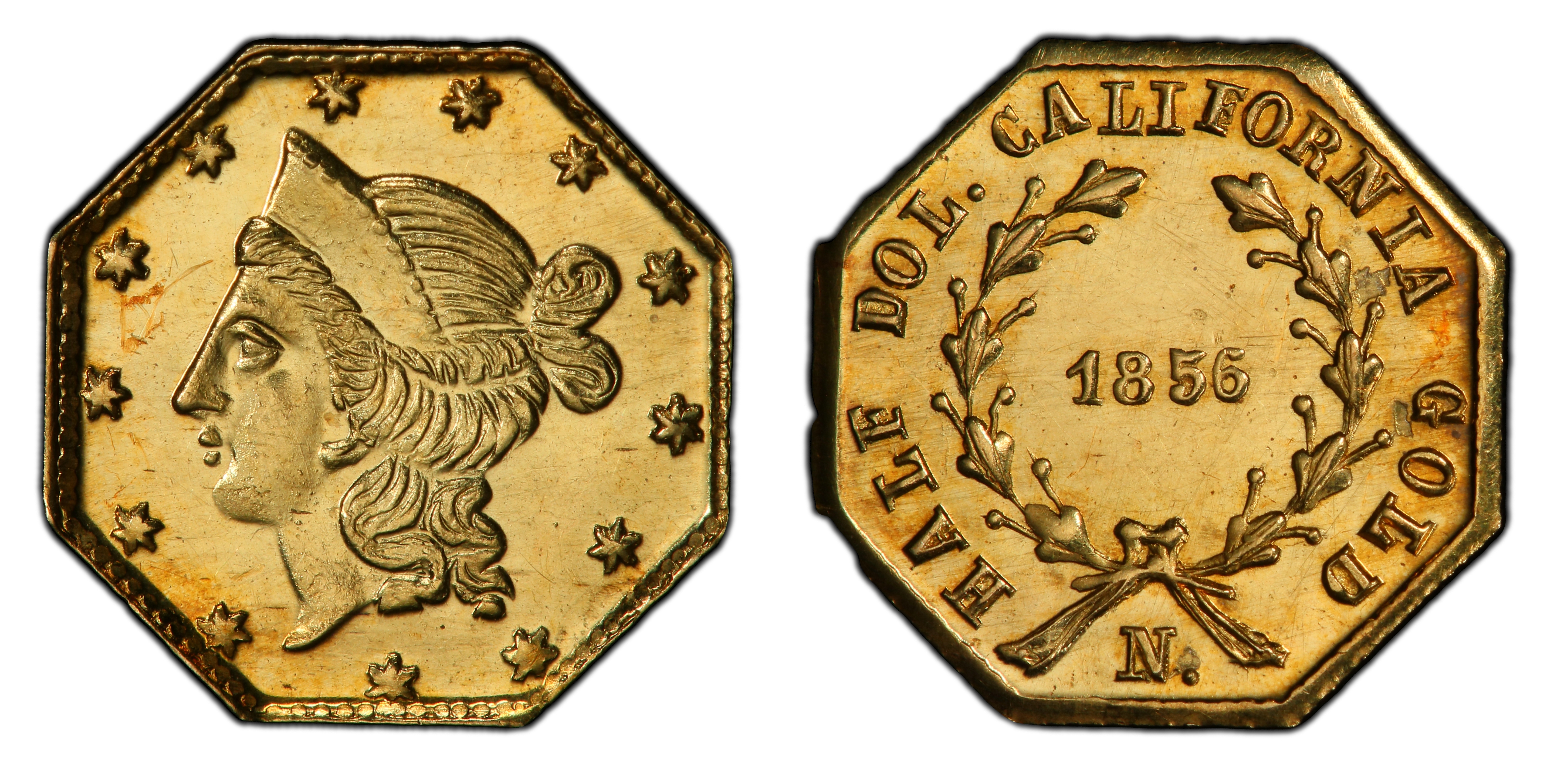
Obverse & Reverse
The 1856 Octagonal Gold 50 Cents, cataloged as Breen-Gillio 311, is a quintessential artifact from the first phase of private small-denomination coinage in Gold Rush California. This period, now known to numismatists as 'Period One' (1852-1857), was born of pure necessity. The massive influx of prospectors and merchants following the 1848 discovery of gold created a vibrant, cash-rich economy that was paradoxically starved for circulating currency, especially for small, daily transactions. Gold dust, while plentiful, was cumbersome, prone to spillage, and difficult to measure accurately for minor purchases. The United States government was slow to react, with the San Francisco Mint only beginning to strike silver coins in meaningful quantities by 1855-1856. Into this numismatic vacuum stepped a number of entrepreneurial San Francisco jewelers and metallurgists, many of French origin. These craftsmen, including known figures like Antoine Louis Nouizillet and the firm of Frontier, Deviercy & Co., possessed the requisite skills to work with gold on a small scale. They began producing their own 25-cent, 50-cent, and one-dollar gold pieces. These were not official government coins, but privately issued tokens whose acceptance relied on the public's desperate need for a medium of exchange. The BG-311 was struck at the zenith of this period. By 1856, the techniques for producing these miniature coins were well-practiced, though still rudimentary, often employing a simple hammer-striking method. This resulted in coins of varying strike quality. While intended for commerce, these pieces were almost universally underweight, containing less gold than their face value implied. However, in the inflated boomtown economy of San Francisco, this discrepancy was largely tolerated. The convenience of a coin, however light, far outweighed the alternative of dealing with imprecise pinches of gold dust. The discovery of Period One fractional gold pieces, including examples of BG-311, in the wreck of the S.S. Central America, which sank in 1857, provides irrefutable proof that these coins were in active circulation and were being transported east as part of the flow of California's wealth. The production of Period One fractionals ceased around 1857 as the new federal mint finally saturated the region with official silver coinage, rendering the private issues obsolete for their original purpose. Their legacy, however, was cemented as tangible symbols of the ingenuity and ad-hoc solutions that defined one of America's most dynamic and chaotic eras.
Associated EventCalifornia Gold Rush
Reason For MintingTo alleviate a severe shortage of small denomination coinage for everyday commercial transactions in Gold Rush-era San Francisco.
Minter HistoryThe specific minter of BG-311 is unknown, a common trait for many fractional gold varieties. However, it was produced by one of the several private firms, likely operated by French jewelers, active in San Francisco between 1852 and 1857. These craftsmen used their metallurgical skills to fill a crucial economic niche before the U.S. Mint in San Francisco ramped up production of small-denomination coinage. While some minters marked their issues (e.g., 'FD' for Frontier & Deviercy), many, like the producer of BG-311, remain anonymous.
Historical SignificanceThe BG-311 is a historically significant representative of America's private coinage era, demonstrating how local economies adapted to the failure of federal monetary policy on the frontier. As a 'Period One' issue, it is considered a true circulating medium of exchange from the Gold Rush, unlike later issues (Period Two and Three) which were primarily made as souvenirs. Its existence speaks directly to the unique economic conditions of mid-19th century California.
N/A
Denomination50 Cents
Minting Period1856
Assayer/MinterUnknown Private Assayer
Geographic OriginSan Francisco, California
Obverse DescriptionA beaded border surrounds a somewhat crude depiction of the head of Liberty facing left, her hair tied in a bun. She wears a coronet, and is encircled by thirteen five-pointed stars, representing the original colonies.
Obverse Inscription Reverse DescriptionA wreath, described in auction records as having four pairs of berries on each branch, encircles the date '1856'. The denomination 'HALF DOL.' appears at the left border, outside the wreath. The coin has a distinct octagonal shape.
Reverse InscriptionHALF DOL. 1856
CompositionGold
Stated Fineness Actual FinenessVariable, typically .800 to .900, often alloyed with native silver giving it a lighter color.
Weight0.80 grams
Diameter11.00 mm
EdgeReeded
Unknown
Survival Estimate76-200 (based on R-4 rating)
Rarity ScaleR-4 (Scarce)
The BG-311 is highly sought after as a genuine circulating coin from the California Gold Rush. Its appeal lies in its octagonal shape, clear 1856 date, and its status as a 'Period One' issue, which distinguishes it from the more common souvenir pieces made later. It represents a tangible link to the tumultuous but industrious economy of the '49ers.
Key VarietiesThe primary variety associated with BG-311 is the BG-915A, a restrike made circa 1860. This later issue is diagnostically distinct: it was struck on a gold-plated, baser gold planchet and, most notably, has a plain edge, whereas the original 1856 business strike BG-311 has a reeded edge. A copper trial piece, BG-311a, is also cataloged but is exceedingly rare.
Authentication TipsAuthentic BG-311 pieces must have a reeded edge. The reverse legend 'HALF DOL.' is a key diagnostic. Be wary of pieces that appear cast, with mushy details or a soapy luster. All genuine Period One fractionals must have a denomination (e.g., DOL., CENTS, etc.); pieces with a bear on the reverse or legends like 'CAL GOLD' without a denomination are almost always modern replicas. Comparison to high-quality certified images is the best defense.
Shopping ConsiderationsA premium quality BG-311 for its grade will exhibit a sharp, well-centered strike. Focus on the definition of Liberty's hair details and the individual leaves and berries of the wreath. Due to the crude hammer-striking method, many examples are weakly struck in areas, but coins with superior overall sharpness command significant premiums. Look for original, uncleaned surfaces which may show a slightly reddish or brassy gold color from the natural alloy. Avoid examples that have been used as jewelry, evidenced by solder marks, harsh cleaning, or repairs. Prooflike (PL) examples are exceptionally rare and highly prized, often associated with specimens recovered from the S.S. Central America treasure.
A coin's grade is its condition, rated on a 1-70 scale. For rare coins, this is the most critical factor in determining value, as a tiny difference in preservation can mean a huge difference in price.
Relevant Grade TypesOriginal period issues of BG-311 were business strikes intended for circulation and are found in Circulated (1-58) and Mint State (MS, 60-70) grades. No proofs were struck during the original minting period. The only related special issues are the later-date BG-915A restrikes, which are considered separate numismatic items and are not original business strikes.
Mint State CharacteristicsAn uncirculated BG-311 is defined by the presence of original mint luster, which is typically soft and satiny rather than deeply frosty. The quality of the strike is a key determinant of grade within the MS range; many are weakly struck on the stars or parts of the wreath due to the hammer-striking process. A top-tier Mint State coin will display unusually sharp detail in Liberty's hair and the wreath. Small planchet flaws or adjustment marks are not uncommon and should be assessed for their impact on eye appeal. Contact marks, while expected, should not be large or distracting.
Circulated Wear PatternsWear first appears on the highest points of the design. On the obverse, this is Liberty's cheek, the upper part of her ear, and the hair above her eye. On the reverse, the high points of the wreath's leaves and berries will show friction first. On lower-grade examples (VF and below), the finer details of the hair and wreath will merge, and the stars will begin to lose their points.
Key Factors For ValueBeyond the numerical grade, the primary drivers of value for a BG-311 are strike quality and surface preservation. A coin with a bold strike, showing clear details on Liberty and the wreath, is far more desirable than a weakly struck example of the same grade. Original, uncleaned 'skin' with attractive reddish-gold toning is highly prized. Conversely, coins that have been harshly cleaned, polished, or repaired will trade at a significant discount. The presence of a CAC sticker indicates premium quality for the grade and typically results in a higher market value.
PCGS Price Guide
| Grade | Price | Population |
|---|---|---|
| 40 | $200.00 | 2 |
| 45 | $210.00 | 4 |
| 45+ | $215.00 | N/A |
| 50 | $220.00 | 6 |
| 50+ | $225.00 | N/A |
| 53 | $260.00 | 5 |
| 53+ | $275.00 | N/A |
| 55 | $300.00 | 21 |
| 55+ | $325.00 | N/A |
| 58 | $350.00 | 28 |
| 58+ | $385.00 | N/A |
| 60 | $450.00 | 3 |
| 61 | $575.00 | 16 |
| 62 | $800.00 | 41 |
| 62+ | $875.00 | N/A |
| 63 | $975.00 | 32 |
| 63+ | $1,150.00 | N/A |
| 64 | $2,500.00 | 7 |
| 64+ | $3,000.00 | N/A |
| 65 | $3,750.00 | N/A |