1854 G$1 BG-508 (Regular Strike)
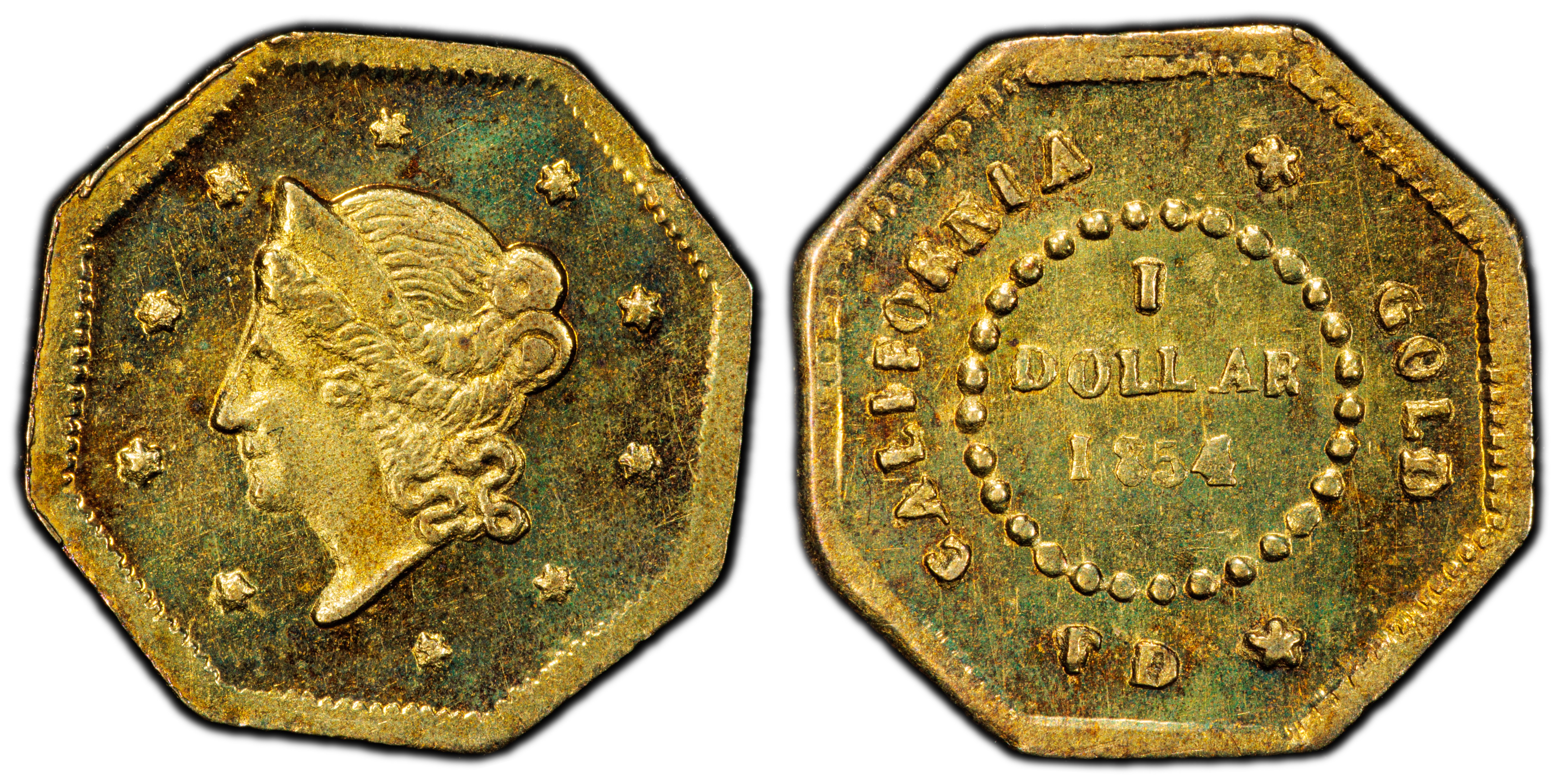
Obverse & Reverse
The 1854 BG-508 Octagonal One Dollar piece emerges directly from the chaotic, commerce-starved crucible of the California Gold Rush. Following James Marshall's 1848 discovery, a massive influx of over 300,000 people descended upon California, transforming it from a sparsely populated territory into a bustling economic frontier. This explosive growth created an acute crisis in commerce: a severe shortage of circulating small-denomination coinage. Gold dust, weighed in 'pinches,' served as a clumsy and often inaccurate medium of exchange for everyday transactions. While federal and private mints produced larger denomination coins ($5 to $50), the need for quarters, halves, and dollars was largely unmet. The new San Francisco Mint, which opened in 1854, produced only a small quantity of gold dollars that year, which were quickly hoarded or exported. Into this void stepped enterprising jewelers and metallurgists, many of them recent French immigrants, who began privately manufacturing fractional gold coins. These 'Period One' issues, struck from 1852 to 1857, were genuinely intended to function as currency and alleviate the coinage shortage. Frontier, Deviercy & Co., the makers of the BG-508, were prominent among these private minters. They operated in San Francisco, employing the 'hammer method' of striking—a manual process where dies were struck with a sledgehammer, resulting in coins of varying strike quality. These fractional pieces, though often underweight and of inconsistent fineness, were accepted in local trade out of sheer necessity. The BG-508, with its octagonal shape and Liberty Head design mimicking federal issues, was created to inspire public confidence. Its circulation likely diminished after 1856-1857, as the San Francisco Mint ramped up production of federal silver and gold coins. The Coinage Act of 1864 eventually made all private coinage illegal, cementing the status of pieces like the BG-508 as relics of a unique and pivotal era in American economic history.
Associated EventCalifornia Gold Rush
Reason For MintingTo alleviate a severe shortage of small-denomination circulating coinage for daily commerce in Gold Rush-era California.
Minter HistoryPierre Frontier and Eugene Deviercy were San Francisco-based French jewelers who formed a partnership to produce 'Period One' California Fractional Gold coins. Their mark, 'F.D.', appears on the reverse of many of their issues, including the BG-508. Like other private minters of the era, they identified a critical market need and used their metallurgical skills to fill it, creating coins that were essential, if temporary, components of the regional economy. Their work is characterized by the Liberty Head motif, closely modeled on the federal gold coinage of the time to promote acceptance, and they produced a range of varieties in both octagonal and round formats.
Historical SignificanceThe BG-508 is a tangible artifact of the private monetary system that arose to support the explosive economic growth of the California Gold Rush. It represents a period of American history when the frontier outpaced the federal government's ability to provide basic infrastructure like a reliable money supply. As a 'Period One' issue, it is among the select group of fractional gold pieces believed to have genuinely circulated, making it a key piece of territorial numismatic history.
BG-508
Denomination$1
Minting Period1854
Assayer/MinterFrontier, Deviercy & Co.
Geographic OriginSan Francisco, California
Obverse DescriptionA fairly large Liberty Head, facing left, closely styled after the federal gold dollars of Christian Gobrecht. Her hair is tied in a bun at the back. She is surrounded by thirteen five-pointed stars, typically arranged with seven to the left and six to the right.
Obverse Inscription Reverse DescriptionThe denomination '1' and 'DOLLAR' are contained within a wreath of two branches tied by a bow at the bottom. The legend 'CALIFORNIA GOLD' appears above the wreath. The minter's initials, 'F D', for Frontier & Deviercy, are located below the bow, near the bottom border.
Reverse InscriptionCALIFORNIA GOLD / 1 / DOLLAR / F D
CompositionGold
Stated Fineness Actual FinenessVariable, but Period One issues generally contained a high percentage of gold, often alloyed with native silver which gave them a lighter color. Fineness could range from .800 to over .900.
Weight0.90 grams
Diameter11.00 mm
EdgePlain
Unknown; as with most private issues, mintage records were not kept.
Survival Estimate75-125 known examples across all grades.
Rarity ScaleR-4+
The BG-508 is highly sought after as a representative 'Period One' octagonal dollar from a known maker. Its appeal lies in its direct connection to the Gold Rush economy, its classic Liberty Head design, and its status as a coin intended for actual circulation, unlike many later souvenir issues.
Key VarietiesThe primary variety is the regular strike BG-508. No proof strikings or major die varieties from the original minting period are known. Collectors should be aware that the broader California Fractional Gold series includes restrikes and souvenir pieces made in later periods ('Period Two' and 'Period Three'), but the BG-508 is a 'Period One' issue and should not be confused with them. Research continues to uncover new die marriages in the fractional gold series, but none are currently cataloged for BG-508.
Authentication TipsGenuine 'Period One' fractionals like the BG-508 are characteristically thin. Fakes are often too thick and have a soapy or cast-like appearance. Look for sharp, albeit sometimes unevenly impressed, details consistent with manual hammer striking. The lettering style, particularly on the reverse, should match known genuine examples. The 'F D' mintmark should be clear and correctly formed. Weakness in the center or peripherally is common and not necessarily an indicator of a fake; in fact, an unusually perfect strike could warrant suspicion. Modern replicas are common and often lack the denomination, a key feature of genuine circulating issues.
Shopping ConsiderationsA premium quality BG-508 will exhibit a sharp strike for the issue, with clear details on Liberty's hair and the wreath leaves. Many examples possess attractive prooflike or semi-prooflike surfaces, a highly desirable trait. Original, uncleaned surfaces with a touch of reddish-gold or greenish-gold toning (from silver content) are prized over harshly cleaned or polished specimens. Check for common problems like dents, rim bumps, or evidence of having been mounted in jewelry. Given the manual striking process, perfectly centered examples command a premium.
A coin's grade is its condition, rated on a 1-70 scale. For rare coins, this is the most critical factor in determining value, as a tiny difference in preservation can mean a huge difference in price.
Relevant Grade TypesAll original BG-508 examples are business strikes intended for circulation. They are found in Circulated grades (AG-3 to AU-58) and Mint State grades (MS-60 to MS-70). No proofs were struck during the original period of issue, and there are no known later-date proof restrikes of this specific variety.
Mint State CharacteristicsAn uncirculated BG-508 is defined by the absence of wear. Quality is determined by the strength of the strike, the quality of the luster, and the presence of contact marks. Strikes are often uneven; a coin with sharp central details on both sides is rare. Luster is typically vibrant and can be prooflike, satiny, or slightly frosty. Due to their small size and handling in bags, even high-grade specimens will often show tiny contact marks or hairlines, but examples with clean, original surfaces are most desirable.
Circulated Wear PatternsWear first appears on the highest points of the design. On the obverse, look for flattening on Liberty's ear, hair strands above the eye, and cheekbone. On the reverse, the high points of the wreath's leaves and bow will show initial friction and smoothness. In lower grades (VG and below), the stars on the obverse and the letters in the legends will become weak and begin to merge with the fields.
Key Factors For ValueFor the BG-508, the key value drivers are surface preservation and strike quality. An example with original, prooflike surfaces will command a significant premium over a cleaned or abraded piece of the same grade. A sharp, well-centered strike is highly desirable and adds to eye appeal. Coins with attractive, original toning are also preferred. Certification by PCGS or NGC is standard for this series, and a CAC sticker indicating premium quality for the grade will add a substantial price premium.
PCGS Price Guide
| Grade | Price | Population |
|---|---|---|
| 40 | $500.00 | 1 |
| 45 | $575.00 | 3 |
| 45+ | $590.00 | N/A |
| 50 | $625.00 | 2 |
| 50+ | $650.00 | N/A |
| 53 | $675.00 | 8 |
| 53+ | $700.00 | N/A |
| 55 | $800.00 | 18 |
| 55+ | $850.00 | N/A |
| 58 | $925.00 | 10 |
| 58+ | $1,000.00 | N/A |
| 60 | $1,150.00 | 2 |
| 61 | $1,225.00 | 6 |
| 62 | $1,350.00 | 17 |
| 62+ | $1,650.00 | N/A |
| 63 | $2,050.00 | 13 |
| 63+ | $2,750.00 | N/A |
| 64 | $4,750.00 | 4 |
| 64+ | $5,250.00 | N/A |
| 65 | $6,750.00 | 1 |