1863 25C BG-733 (Regular Strike)
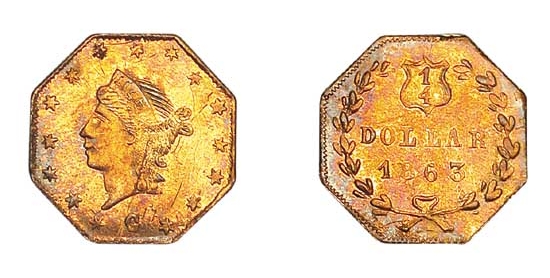
Obverse & Reverse
The 1863 25C octagonal gold piece, cataloged as BG-733, emerges from the second major era of California fractional gold production (1859-1882). Unlike the 'Period One' issues born of necessity from a severe shortage of small change during the initial Gold Rush, these later pieces served a different purpose. By 1863, the San Francisco Mint was in full operation, alleviating the coinage crisis. Instead, these small gold tokens were primarily manufactured by jewelers as souvenirs and novelty items, capitalizing on the romantic allure of the Gold Rush that captivated tourists and those back East. The nation was embroiled in the Civil War, an event which ironically may have increased the appeal of gold, a tangible asset in a time of uncertainty and paper 'greenbacks.' Robert B. Gray & Co., a prominent San Francisco jewelry firm that succeeded Antoine Nouizillet, is credited with producing this variety. These pieces were not intended to and did not circulate in the traditional sense. Their production technique, often involving manual hammering, resulted in coins of varying strike quality. The passage of the Private Coinage Act on June 8, 1864, which outlawed all private currency, technically rendered these pieces illegal. However, enforcement was lax, and production of such souvenir items continued clandestinely for years, often using backdated dies to avoid legal trouble. The BG-733 is a quintessential example of this fascinating numismatic niche, a tangible link to California's sustained identity as the 'Golden State' long after the initial frenzy had passed. Its extreme rarity today suggests a very small original output, likely intended for a limited clientele.
Associated EventCalifornia Gold Rush (Later Souvenir Period)
Reason For MintingPrimarily created as a souvenir or charm for the tourist trade, not to alleviate a shortage of circulating coinage.
Minter HistoryRobert B. Gray & Co. was a San Francisco jewelry company that became a significant producer of 'Period Two' California fractional gold. Around 1859-60, Gray took over the business of Antoine Louis Nouizillet, one of the most prolific 'Period One' minters. Gray utilized some of Nouizillet's existing dies but also created his own, sometimes marked with a 'G'. The firm was a key player in the transition of fractional gold from quasi-circulating currency to souvenir tokens before selling its interests to the California Jewelry Co. in 1871.
Historical SignificanceThe BG-733 represents a shift in the purpose of private gold coinage, from a necessary medium of exchange to a commercial collectible. It highlights the enduring romanticism of the Gold Rush and the entrepreneurial spirit of jewelers who catered to a national fascination with California gold, even in the midst of the Civil War.
BG-733
Denomination25C
Minting Period1863
Assayer/MinterRobert B. Gray & Co.
Geographic OriginSan Francisco, California
Obverse DescriptionA Liberty Head motif, facing left, with 13 stars surrounding the portrait. The date, 1863, is positioned below the bust.
Obverse Inscription1863
Reverse DescriptionThe denomination '1/4' is centered within a wreath. The legend 'CALIFORNIA GOLD' encircles the top portion of the wreath, and the abbreviation 'DOL.' is at the bottom.
Reverse InscriptionCALIFORNIA GOLD 1/4 DOL.
CompositionGold
Stated Fineness Actual FinenessVariable, but often lower than coinage standard for Period Two issues, ranging from 14 to 22 karats.
Diameter9.50 mm
EdgePlain
Unknown, but exceedingly small.
Survival Estimate5 known survivors.
Rarity ScaleHigh R-7
This coin is a classic American rarity, sought after for its extreme scarcity, historical connection to the California Gold Rush souvenir trade, and its status as a pinnacle piece within the extensive and popular California Fractional Gold series.
Key VarietiesThere are no known major varieties of the BG-733 from the original minting period. This issue itself is a single, distinct die marriage. No known restrikes, patterns, or trial pieces are recorded. The primary variations among the few known specimens relate to strike quality and surface characteristics.
Authentication TipsAuthentication requires expert examination. Key diagnostics include precise die markers, such as a known alloy spot at 3 o'clock on the obverse of the Jay Roe specimen. The style of the Liberty head and the lettering punches must match those known to be used by Robert B. Gray. Counterfeits are common in the Cal Gold series and are often crudely made, have incorrect weight or a soapy, cast-like appearance. Genuine pieces, even if weakly struck, will show sharp details under magnification from a die-struck process.
Shopping ConsiderationsFor a coin of this rarity, any opportunity to acquire one is significant. A 'premium quality' example would be one of the known high-grade survivors, such as the MS62 graded specimens. Look for prooflike or reflective surfaces, which are known on this variety. Given the manual striking process, expect some unevenness, but seek a specimen with a relatively sharp strike on the date and central devices. Any original, uncleaned surface is paramount. Avoid examples that have been used in jewelry, exhibiting solder marks, harsh cleaning, or heavy rim damage. Pedigree is also a major factor for this issue, with provenances including the Grafton, Jay Roe, and Hamous collections adding to its desirability and value.
A coin's grade is its condition, rated on a 1-70 scale. For rare coins, this is the most critical factor in determining value, as a tiny difference in preservation can mean a huge difference in price.
Relevant Grade TypesOriginal issues were business strikes, although not intended for circulation, and are found in both Circulated (1-58) and, more commonly for this souvenir issue, Mint State (MS, 60-70) grades. No true Proofs were struck during the original period of issue. The known survivors are all in high grades, suggesting they were saved as keepsakes from the time of issue.
Mint State CharacteristicsUncirculated examples of BG-733 are noted for having prooflike or semi-prooflike fields, a characteristic that adds significantly to their eye appeal. The strike can be inconsistent due to the manual hammering process, with some weakness possible on peripheral legends or the stars. Luster is typically bright and flashy. Being small and made of soft gold, they are susceptible to minor abrasions and contact marks, even on high-grade pieces. The presence of a lint mark above 'DO' in DOLLAR has been noted on at least one survivor.
Circulated Wear PatternsWhile the known examples are primarily Mint State, if a circulated specimen were to exist, wear would first appear on the highest points: the hair over Liberty's ear and eye, her cheek, and on the reverse, the leaves and berries at the top of the wreath and the fraction '1/4'. In lower grades, the stars and date would begin to lose their sharpness and merge with the fields.
Key Factors For ValueWith only five known examples, simple existence is the primary value driver. Beyond that, grade is critical; the difference between an AU and a choice MS specimen is immense. Surface quality is paramount: a coin with original, vibrant, prooflike surfaces will command a massive premium over one that is hairlined, cleaned, or spotted. Sharpness of strike and exceptional eye appeal further enhance value. A documented, prestigious pedigree, like that of the Jay Roe specimen, adds a significant layer of desirability and historical importance. A CAC sticker on a coin of this caliber would provide ultimate confirmation of quality for the assigned grade.
PCGS Price Guide
| Grade | Price | Population |
|---|---|---|
| 50 | $2,200.00 | 1 |
| 50+ | $2,350.00 | N/A |
| 53 | $2,600.00 | N/A |
| 53+ | $2,750.00 | N/A |
| 55 | $3,000.00 | 1 |
| 55+ | $3,200.00 | N/A |
| 58 | $3,500.00 | 1 |
| 58+ | $3,700.00 | N/A |
| 60 | $4,000.00 | N/A |
| 61 | $4,250.00 | N/A |
| 62 | $5,000.00 | 3 |