1853 G$1 BG-522 (Regular Strike)
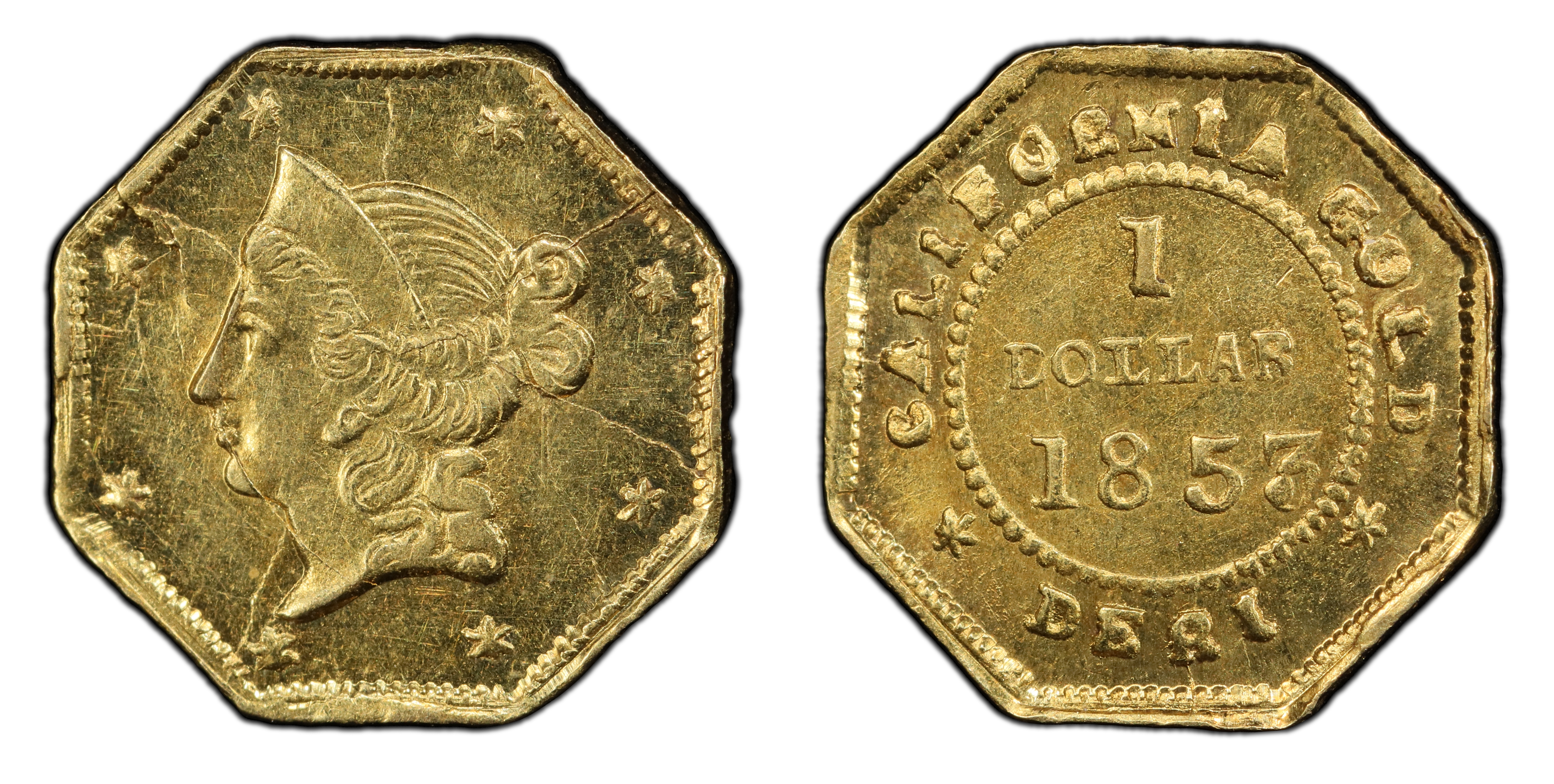
Obverse & Reverse
The 1853 G$1 BG-522 is a quintessential artifact from the first period of California's private gold coinage, a fascinating and chaotic chapter in American economic history. Following the massive influx of population during the Gold Rush, California's economy boomed, but it suffered from a chronic and severe shortage of circulating small-denomination coinage. Gold dust, a common medium of exchange, was imprecise and inconvenient for everyday transactions. While larger gold ingots and coins were being produced by private assayers, the need for coins valued under five dollars was acute. Into this monetary vacuum stepped a number of enterprising jewelers and metalsmiths, many of French origin, who saw a commercial opportunity. One of the most significant of these was Antoine Louis Nouizillet, a jeweler based in San Francisco. Between 1852 and 1856, these craftsmen produced fractional gold coins in quarter, half, and one-dollar denominations. These 'Period One' issues, including the BG-522, were not novelty items but were struck with the genuine intent of serving as a circulating medium of exchange. They were crudely but effectively manufactured, typically by the hammer method, where dies were struck by hand. This resulted in frequent inconsistencies in strike sharpness and planchet quality. The BG-522 variety, an octagonal gold dollar, features a Liberty Head design stylistically imitative of the official U.S. gold dollars, a deliberate choice to inspire public confidence. These pieces circulated for a few years, but their extremely small size made them easy to lose, and the establishment and increased output of the official San Francisco Mint in 1854 signaled the beginning of their end as a necessary currency. By the late 1850s, the fractional gold pieces transitioned from being essential currency to popular souvenirs and jewelry items, marking the shift to 'Period Two' issues, which were often of lower gold content and more fanciful design. The BG-522 stands as a tangible link to the desperate, innovative, and unregulated economy of Gold Rush San Francisco, a time when private citizens took it upon themselves to mint the money their commerce demanded.
Associated EventCalifornia Gold Rush
Reason For MintingTo alleviate a severe shortage of small-denomination circulating coinage for daily commerce in Gold Rush-era California.
Minter HistoryAntoine Louis Nouizillet was a French jeweler and one of the most prolific private minters of Period One (1852-1856) California fractional gold. Operating in San Francisco during the height of the Gold Rush, he was a central figure in the cottage industry that arose to address the region's lack of small change. Nouizillet's business produced a wide variety of quarter, half, and one-dollar gold pieces, both under his own name and in partnerships, most notably with M. Deriberpe (some pieces are marked 'D.N.'). His work is characterized by the Liberty Head motif, emulating U.S. federal coinage. The pieces were manufactured by hand, leading to numerous die varieties and frequent imperfections that are now studied by specialists. Around 1859-1860, as the fractional gold market shifted from circulation to souvenirs, Nouizillet sold his business and dies to Robert B. Gray & Co., who continued to produce pieces using his equipment. Nouizillet's coinage is a primary example of the private enterprise that filled a critical monetary gap before federal coinage became readily available on the West Coast.
Historical SignificanceThe BG-522 is a key representative of America's last major series of privately issued coins intended for general circulation, embodying the economic necessity and frontier spirit of the California Gold Rush.
BG-522
DenominationG$1
Minting Period1853
Assayer/MinterAntoine Louis Nouizillet
Geographic OriginSan Francisco, California
Obverse DescriptionA diademed Liberty Head facing left, similar in style to the U.S. gold dollars of the period. The head is surrounded by thirteen six-pointed stars along the octagonal border.
Obverse Inscription Reverse DescriptionThe reverse is dominated by a wreath composed of two branches tied by a bow at the bottom. Within the wreath, the denomination '1' and 'DOLLAR' are inscribed. The date '1853' is positioned inside the wreath, just below the denomination.
Reverse InscriptionCALIFORNIA GOLD
CompositionGold
Stated Fineness Actual FinenessTypically varied, often made from native California gold which contained silver and other elements, resulting in fineness between .800 and .900.
EdgePlain
Unknown
Survival EstimateFewer than 20 believed to exist in all grades.
Rarity ScaleR-6 (Very Rare)
The BG-522 is highly sought after for its extreme rarity, its direct connection to the authentic commercial period of the Gold Rush, and its status as a product of the important minter Antoine Louis Nouizillet. Its octagonal shape and 'Period One' history make it a prize for specialists.
Key VarietiesThis is a specific die marriage (BG-522) from the original minting period. There are no known major varieties of BG-522 itself, nor are there any known later-date restrikes or special collector issues associated with these specific dies. All known examples are considered original business strikes from 1853.
Authentication TipsGenuine BG-522 examples exhibit specific die characteristics known to specialists. Pay close attention to the positioning of the stars relative to Liberty's profile and the style of the numerals in the date. The lettering of 'CALIFORNIA GOLD' has a distinct, slightly crude punch style. Counterfeits from the era or later tourist pieces often have a soapy, cast-like appearance, incorrect weight, or feature a bear on the reverse, a fantasy element never used on genuine circulating fractionals. Authentication by a leading third-party grading service is highly recommended.
Shopping ConsiderationsA premium quality example for its grade will show a relatively sharp strike for the issue. Focus on the details of Liberty's hair and the individual leaves and berries in the wreath, as these areas are often weak. Original, uncleaned surfaces are paramount; many of these tiny coins were harshly cleaned or used in jewelry. Look for a pleasing, original reddish or greenish-gold patina that indicates undisturbed surfaces. Avoid examples with significant planchet flaws, such as large cracks or laminations, unless they are minor and characteristic of the issue. Eye appeal is critical, and a coin with a bold strike and clean surfaces will command a significant premium over a weakly struck or heavily marked peer of the same grade.
A coin's grade is its condition, rated on a 1-70 scale. For rare coins, this is the most critical factor in determining value, as a tiny difference in preservation can mean a huge difference in price.
Relevant Grade TypesOriginal period issues of BG-522 were business strikes intended for circulation. Therefore, they are found in Circulated grades (AG-3 to AU-58) and, very rarely, in Mint State (MS-60 to 70). No Proof (PR/PF) examples were struck during the original period of issue, and there are no known later-date Proof restrikes for this variety. Any piece represented as a Proof is highly suspect.
Mint State CharacteristicsUncirculated examples of BG-522 are exceptionally rare. A typical Mint State piece will likely exhibit some weakness in the strike, particularly on the highest points of the design such as Liberty's ear and the coronet, and the bow of the wreath. Luster is typically satiny rather than deeply frosty. Due to the crude manufacturing process and the softness of the gold, even uncirculated specimens are expected to have some minor planchet irregularities or tiny handling marks. A truly choice Mint State example would be distinguished by a virtually complete strike and minimal, scattered marks.
Circulated Wear PatternsWear first appears on the highest points of the design. On the obverse, check for flatness on the hair above the eye and ear, the cheek, and the coronet's beads. On the reverse, the high points of the wreath's leaves and the bow knot will show the first signs of friction. In lower grades (Fine and below), the stars on the obverse and the letters in the legends will become soft and begin to merge with the fields. The date and denomination within the wreath are relatively protected and often remain legible even on well-worn examples.
Key Factors For ValueFor the BG-522, value is driven primarily by rarity and grade. Surface quality is paramount; an example with original, uncleaned 'skin' is far more valuable than a cleaned or polished specimen of the same grade. Strike quality is the next key factor; a coin with a sharp, well-centered strike is highly desirable and commands a substantial premium. Eye appeal, encompassing attractive natural toning and a lack of distracting marks, is crucial. Finally, given the prevalence of counterfeits in the fractional gold series, certification by a top-tier service like PCGS or NGC is virtually required for market acceptance, with a CAC sticker adding a further premium for exceptional quality within the assigned grade.
PCGS Price Guide
| Grade | Price | Population |
|---|---|---|
| 40 | $2,000.00 | 1 |
| 45 | $2,250.00 | 1 |
| 45+ | $2,500.00 | N/A |
| 50 | $2,850.00 | 2 |
| 50+ | $3,000.00 | N/A |
| 53 | $3,250.00 | 1 |
| 53+ | $3,500.00 | N/A |
| 55 | $4,000.00 | N/A |
| 55+ | $4,500.00 | N/A |
| 58 | $6,250.00 | 10 |
| 58+ | $7,000.00 | N/A |
| 60 | $7,750.00 | N/A |
| 61 | $8,750.00 | 2 |
| 62 | $10,000.00 | 3 |