1853 G50C BG-411 Eagle (Regular Strike)
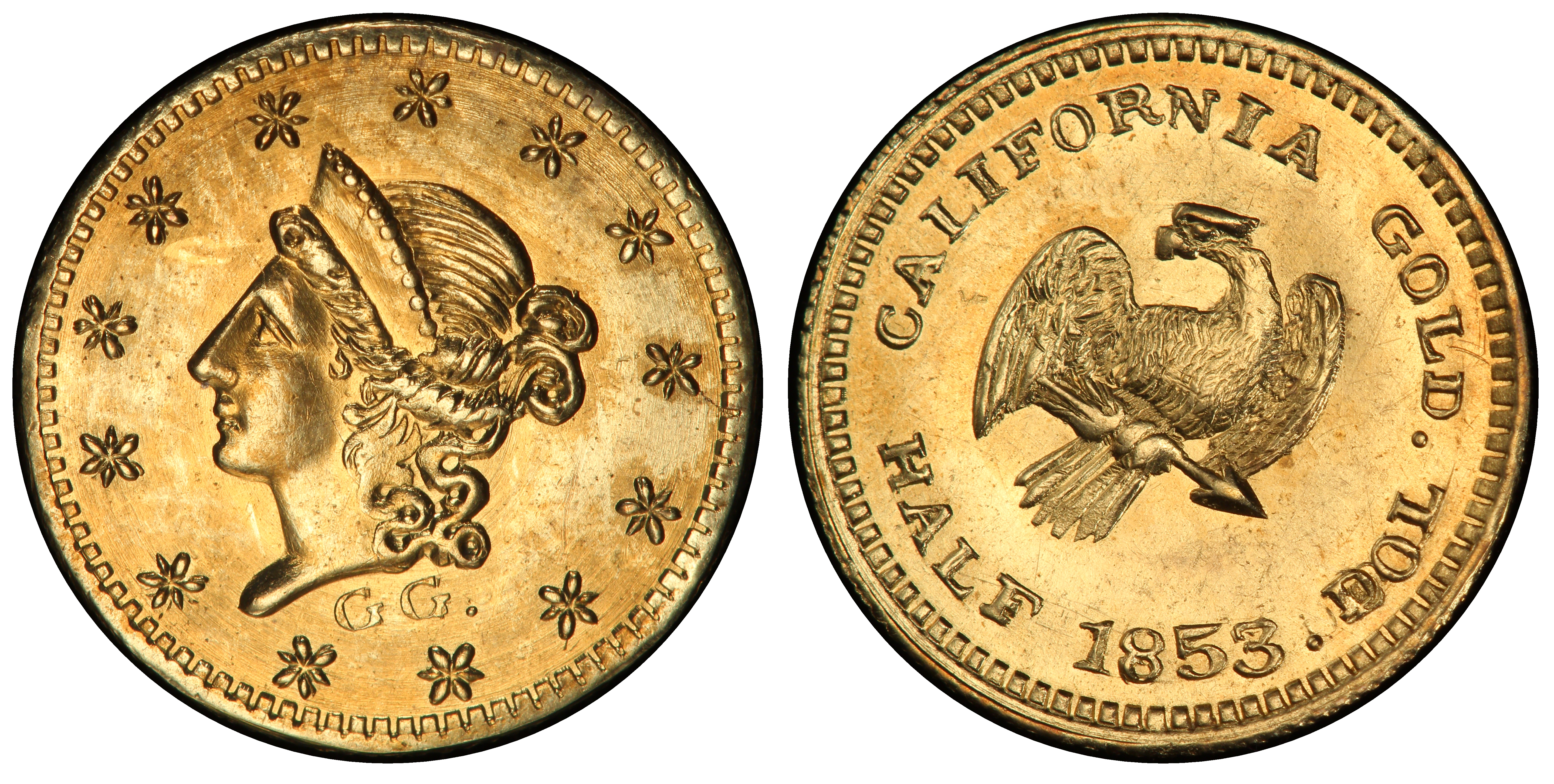
Obverse & Reverse
The 1853 Gold 50 Cents, cataloged as Breen-Gillio 411, is a quintessential artifact from the first period of private coinage during the California Gold Rush. Following the discovery of gold at Sutter's Mill in 1848, a massive influx of prospectors and merchants descended upon California, creating a vibrant but chaotic economy. While private assayers like Moffat & Co. and Wass, Molitor & Co. produced large-denomination gold coins to convert raw dust and nuggets into a manageable form, a severe and crippling shortage of small-denomination coinage plagued daily commerce. Common transactions—buying a meal, a tool, or a drink—were complicated by the lack of official U.S. coins, forcing the use of clumsy and often inequitable pinches of gold dust. Into this void stepped a number of jewelers and artisans in San Francisco who, beginning in 1852, began striking their own fractional gold coins in 25-cent, 50-cent, and one-dollar denominations. These 'Period One' issues (1852-1857) were not officially sanctioned but were intended to circulate out of sheer necessity. They were struck by hand, using a hammer and anvil to impress designs from crude, privately prepared dies onto small gold planchets. The BG-411 is a product of this environment. Its anonymous maker, likely a San Francisco jeweler, created dies that mimicked the style of federal coinage to foster public acceptance. However, like most of its contemporaries, the coin was underweight for its face value, a common practice that maximized the minter's profit but drew criticism. Despite this, the overwhelming need for small change ensured their use in local trade, at least until the San Francisco Mint began full-scale production of federal coinage in 1854, gradually rendering the private issues obsolete. The high rarity of the BG-411 today suggests a very limited original mintage, likely produced to fill an immediate, short-term need before the dies failed or the minter ceased operations. Its survival is a testament to the ingenuity and ad-hoc capitalism that defined the Gold Rush era.
Associated EventCalifornia Gold Rush
Reason For MintingTo alleviate a severe shortage of small-denomination coinage for everyday commercial transactions in Gold Rush-era California.
Minter HistoryThe identity of the minter responsible for the BG-411 variety is lost to history. Period One fractional gold pieces were often produced anonymously by San Francisco jewelers who possessed the requisite skills in die-sinking and metallurgy. Unlike larger, more organized private mints that stamped their names on their products, these small-scale minters rarely identified themselves, leaving behind only the numismatic evidence of their distinct, and often primitive, workmanship.
Historical SignificanceAs a 'Period One' issue, the BG-411 represents a genuine attempt to solve a circulating currency crisis in a frontier economy. It is a tangible link to the daily life of miners and merchants in 1850s San Francisco and stands as a prime example of a privately issued coin that functioned as money before federal coinage became widely available in the region.
N/A
Denomination50 Cents
Minting Period1853
Assayer/MinterUnknown
Geographic OriginSan Francisco, California
Obverse DescriptionA crudely rendered bust of Liberty facing left, modeled after the contemporary U.S. gold dollar. Liberty wears a coronet, and her hair is tied in the back. The field is surrounded by thirteen small, unevenly spaced stars. The date, 1853, appears below the bust, though it is often weakly struck or indistinct.
Obverse Inscription1853
Reverse DescriptionA small eagle with outstretched wings, head turned to its right. Due to the eagle's somewhat puffed-out chest and long tail feathers, this variety is often nicknamed the 'Peacock Reverse.' The eagle clutches no arrows or olive branch. The denomination is expressed in the legend surrounding the eagle.
Reverse InscriptionCALIFORNIA GOLD HALF DOL.
CompositionGold
Stated Fineness Actual FinenessTypically around .880 fine, consistent with unrefined native California gold which often contained a significant amount of silver.
EdgePlain
Extremely Low
Survival Estimate4-6 known
Rarity ScaleR-7
The BG-411 is a highly coveted numismatic rarity, prized for its status as a 'Period One' issue and its distinctive 'Peacock' reverse. Its extreme scarcity, with fewer than a half-dozen examples believed to exist, places it among the ultimate challenges for the advanced collector of California fractional gold.
Key VarietiesThere are no known major varieties of the BG-411 struck during the original minting period. No patterns, proofs, or later restrikes of this specific die marriage are known to exist. The entire issue consists of business strikes from this single die pair.
Authentication TipsAuthenticity should be confirmed by third-party grading services. Genuine examples exhibit a distinctive crude style consistent with hand-striking. Look for softness in the centers and uneven strike depth. The planchets are typically thin and may show planchet adjustment marks or parallel striations from the rolling process. The surfaces should have the correct color and luster for native California gold, which is often a slightly lighter, brassy or greenish-yellow due to the natural silver alloy. Modern counterfeits are often thicker, have a soapy or artificial luster, and may feature incorrect design details or modern tool marks.
Shopping ConsiderationsFor a coin of this rarity, any example that becomes available is a major event. A 'premium quality' specimen would be one that is well-centered and shows as much of the design detail as possible, particularly on the eagle's feathers and Liberty's coronet. Given their utilitarian origin, most known examples are circulated or have impairments. A problem-free coin, even in a lower grade like VF or XF, is a major prize. Look for original, uncleaned surfaces with attractive reddish-gold toning. Avoid examples that have been holed and plugged, a common fate for these tiny coins which were often used as jewelry. Even a cleaned example may be the only opportunity to acquire this variety in a lifetime.
A coin's grade is its condition, rated on a 1-70 scale. For rare coins, this is the most critical factor in determining value, as a tiny difference in preservation can mean a huge difference in price.
Relevant Grade TypesAll original BG-411 coins were business strikes intended for circulation and are found in Circulated (1-58) and, very rarely, Mint State (MS, 60-70) grades. Due to their extreme rarity and brief production, no Proof (PR/PF) examples were struck during the original period, and no later restrikes are known.
Mint State CharacteristicsA true Mint State example of BG-411 is a landmark rarity. Such a piece would exhibit some original mint luster, likely with a soft, satiny texture rather than a deep frost. Strike quality is paramount; however, even the finest known examples will show some characteristic weakness, particularly on the highest points of Liberty's hair and the eagle's breast feathers. Due to the softness of the gold and the crude production methods, even uncirculated specimens are expected to have scattered light contact marks and possibly minor planchet imperfections.
Circulated Wear PatternsWear first appears on the high points of the design. On the obverse, check the hair above Liberty's eye and ear, and the cheekbone. On the reverse, the highest points are the eagle's head, breast, and the upper portions of its wings. In lower grades (VG and below), the date and stars will become faint, and the finer details of the eagle's feathers will merge into a general outline.
Key Factors For ValueFor the BG-411, rarity is the primary driver of value. Given that virtually all potential buyers will be advanced specialists, the key differentiators are surface preservation and strike. An example with original, uncleaned 'skin' commands a massive premium over one that has been cleaned, polished, or repaired. Sharpness of the strike is critical; a coin that clearly shows the details of the 'Peacock' reverse and a legible date is far superior. Eye appeal, encompassing attractive toning and a lack of distracting marks, significantly enhances value. A CAC sticker on an already graded coin would provide an additional layer of confirmation of quality for the grade.
PCGS Price Guide
| Grade | Price | Population |
|---|---|---|
| 55 | $22,500.00 | 1 |
| 55+ | $23,500.00 | N/A |
| 58 | $25,000.00 | 1 |
| 58+ | $27,500.00 | N/A |
| 60 | $32,500.00 | N/A |
| 61 | $37,500.00 | N/A |
| 62 | $42,500.00 | 2 |
| 62+ | $50,000.00 | N/A |
| 63 | $55,000.00 | 1 |
| 63+ | $62,500.00 | N/A |
| 64 | $70,000.00 | 1 |